Secret Origins #39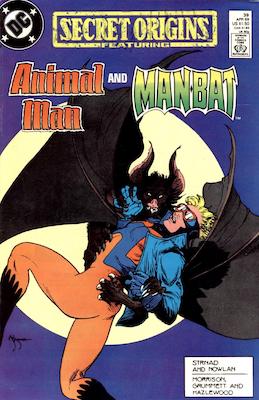
“The Myth of the Creation”, April 1989
Credits:
Grant Morrison [writer]
Tom Grummett [penciller]
Doug Hazlewood [inker]
Janice Chiang [letterer]
Helen Vesik [colorist]
Mark Waid [editor]
Michael Kaluta [cover (uncredited)]
Front Matter:
Cover:
The cover depicts Buddy battling Man-Bat, though the two characters never meet in this issue.
This second Secret Origins series began in 1986 as a way of clarifying the backstories of many DC characters after the Crisis, which had altered the histories of many characters. The first Secret Origins series ran briefly in 1973 and contained reprinted stories only.
Unlike the main Animal Man series, the cover of Secret Origins #39 carries the Comics Code Authority (CCA) seal of approval. The CCA was formed in 1954 in the midst of a moral panic around the effects of comics on children. It was feared that the depictions of violence and crime in comic books were contributing to juvenile delinquency. The code consisted of a series of guidelines that explained what was deemed unacceptable to the CCA. Comic books that were seen to adhere to the code earned the right to have the seal of approval appear on the cover, and many distributors (such as newsstands) would not sell comics that didn’t display this stamp. By the 1980s, titles that were targeted to more mature audiences (such as Animal Man) did not carry the CCA seal and were instead distributed through specialty comic stores. Titles geared to a more mainstream audience, including Secret Origins, displayed the seal and would have had more widespread distribution.
The cover doesn’t mention the ‘New Format’, and this issue uses cheaper paper stock than the Mando paper of the Animal Man series.
Story:
Pages 1-19
The first 19 pages explain the history of Man-Bat, a character introduced in 1970 as a Batman villain. This story has no relation to Animal Man.
Page 20, panels 1-2
A reveille (from the French reveillez meaning ’to wake up’) is a sound used to rouse military personnel, usually made by a bugle horn or drums. Though it’s not revealed in this issue, the Traveller is the name of an alien spacecraft, and the ship is awakening the aliens. The sound can be heard by the African villager at the end of Animal Man #9. This first page is set in a similar African location with Kilimanjaro visible.
Page 20, panel 3
Aeonic refers to an aeon, or long measure of time. The narrator (an alien) expected to be asleep for longer. What is meant by a “memoryform” will become clearer in subsequent issues.
Page 20, panel 4
Job Number: G-4657.
Page 21
This is the title page. Maxine is holding a teddy bear but it looks a little different from the toy in Animal Man #4.
Page 22
Ellen is drawing (possibly for work) while Buddy is testing out his powers.
Page 24, panel 2
The Bakers’ dog’s name is finally revealed as Skipper.
Page 25, panels 2-3
M.E. refers to Myalgic encephalomyelitis, more commonly known as Chronic Fatigue Syndrome. In the late 1980s, this condition was popularly considered to be a form of hypochondria associated with burnout, and some news articles referred to it derogatorily as the ‘Yuppie Flu’, hence Buddy’s reaction.
Page 25, panel 4-5
The aliens first appeared in Strange Adventures #184 (Jan. 1966) where they are named Trano and Zaarn.
Page 26, panel 1
The aliens think that Buddy seems younger now than he did in Strange Adventures #184.
Page 26, panels 2-3
The “catastrophic and unforeseen assault on the continuum” refers to the changes to DC continuity caused by the Crisis, and Animal Man has “been rendered all but inoperative” as a result of the gene bomb.
Morphogenesis refers to the process by which an organism develops its shape. A morphogenetic graft then might be the redistribution of cells to encourage growth in a different direction: in the case of Buddy, to give special abilities.
Page 26, panel 6
This image in the alien’s portal is redrawn from Buddy’s first appearance in Strange Adventures #180 (Sept. 1965), specifically page 6:1. Many of the subsequent pages are reconstructions of scenes from this issue (hereafter referred to as SA #180).
Page 27
The text and composition of the image is taken from SA #180 (page 1) with minor changes including Buddy’s hair being more closely cropped here.
Page 28, panels 1-3
This reconstructs what happens on SA #180 (page 2:1) with some of the same text. Ellen has been redrawn to appear more like the version from Morrison’s Animal Man series.
Page 28, panels 4-6
Panel 4 is compositionally identical to SA #180 (page 2:2), and some of the text is the same.
Page 29, panels 1-2
This recreates SA #180 (page 2:3)
Page 29, panel 3-4
In the original story, it’s never revealed what Buddy and Roger are hunting, and Buddy is definitely not shown killing a rabbit.
Page 30
Panel 3 is the same as SA #180 (page 2:4) except, in the original, Buddy does not hear a noise before the explosion.
Page 31
In the original story, Buddy awakens standing in a field confronting the tiger. In this version, he awakens on the ground. Panels 3-4 here are similar to SA #180 (page 2:5-6).
Pages 32-33
This roughly reconstructs the events of SA #180, pages 3-4, and page 5:1.
Page 34, panel 1
This reconstructs SA #180 (page 5:2) but the spacecraft looks different. The same spacecraft is again shown in greater detail in Strange Adventures #184.
Page 34, panel 2
The aliens use of ‘stratum’ seems to be synonymous with ‘reality’, as in ‘the DC universe’. Many superheroes have gained their powers from radiation (Captain Atom, Firestorm, Metamorpho), chemical accidents (all versions of the Flash) or magic rings (the Green Lanterns).
Page 34, panel 3
I agree that Buddy seemed older in those Strange Adventures issues, though he was possibly a late teen at the time of gaining his powers (see the annotations for Animal Man #1, page 6:2). The alien also suggests that the early version of Buddy is underdeveloped as a character. Buddy was probably not intended to last more than one story, as suggested by the fact that he both gains and loses his powers within Strange Adventures #180.
Page 34, panel 5
The inset image of Buddy making two-handed contact with the elephant is from SA #180 (around page 6:5), but this image may actually be taken from SA #184 (page 2:3) when this event is recounted.
Page 35
The Bakers have seemingly stumbled across Ellen’s old house from the Strange Adventures issues, though their reaction to the house (or lack thereof) suggests that it is an unfamiliar place in their post-Crisis continuity. Buddy, however, seems to retain some sort of vague memory of the place.
Page 36
This page recreates what occurs in SA #180 (page 16:2-4).
 Page 37, panels 1-2
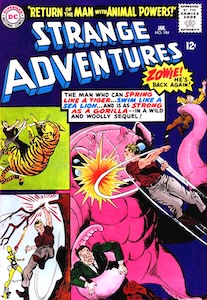
The “second adventure” refers to Strange Adventures #184 [pictured]. These images are not taken from any specific pages of that issue, but represents the battle Buddy had with the aliens and their Xtona creature. The ship in this panel much more closely resembles the ship in SA #184 compared with the depiction on page 34.
Page 37, panel 3
Buddy destroys the aliens’ “hate ray” weapon and expels the aliens in SA #184, page 16.
Page 37, panel 4
It sounds as though the aliens have manipulated Buddy into becoming a superhero.
Back Matter:
Letters:
There is an editorial at the beginning of the letters section (‘Secret Admirers’) that gives an overview of the previous appearances of Animal Man.
 Wild Planet