Animal Man #9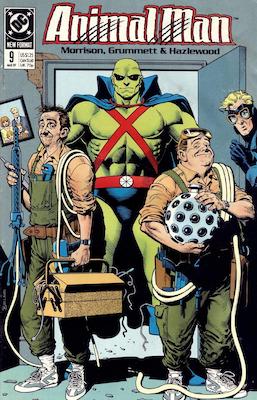
“Home Improvements”, March 1989
Credits:
Grant Morrison [writer]
Tom Grummett [penciller]
Doug Hazlewood [inker]
John Costanza [letterer]
Tatjana Wood [colorist]
Art Young [assistant editor]
Karen Berger [editor]
Brian Bolland [cover (uncredited)]
Front Matter:
Cover:
The cover shows Martian Manhunter entering the house of the Bakers flanked by two tradespeople with strange pieces of machinery.
Inside Cover:
There is no ‘DC Checklist This Week’ section, and the publishorial does not mention Animal Man.
Story:
Page 1
Job Number: G-4450 is mentioned within the indicia at the bottom of the page.
Page 2, panel 1
One of the bullies wears a Bon Jovi t-shirt. So far, the bands referenced in the series (Anthrax, Metallica) have had a heavier slant, but Bon Jovi was a much more moderate and mainstream band. I wonder if the author or artist’s tastes are being revealed by having Bon Jovi associated with an unlikable character.
Page 2, panels 3-4
As far as I can tell, the phrase “Clash of the Titans” was first used as the title of the 1981 film directed by Desmond Davis, which was loosely based on the Greek myth of Perseus. In the film, there are no “Titans” in the mythological sense (the Titans being the older generation of gods), and it’s Medusa and the Kraken who are referred to as being titans. Presumably the bullies are referring to Cliff and the sidewalk as the “Titans” who are about to have a confrontation.
Page 2
“See you later, alligator” is a hip way of saying goodbye that originated in the 1950s[1]. The phrase (and its response “in a while, crocodile”) was turned into the chorus of a song by Bobby Charles that was released in November 1955. The song became an even bigger hit for Bill Haley & His Comets a few months later. It’s the parting insult of the bullies to call Cliff, the “animal boy”, an alligator.
Page 3, panel 2
We learn that the kitten’s name is T.C. I don’t know what this might stand for – maybe “The Cat”? Maxine loves to draw animals and there are further examples on the wall.
Page 3, panels 3-4
Buddy’s teasing of the cat (“What d’you think you are? A Lion, huh?”) mirrors the teasing of Cliff by the bullies. Buddy has failed to help his son, and is also annoying his daughter and wife by ignoring them.
Page 3, panel 5
Ellen is holding a paintbrush, indicating that she was working when interrupted. Note also the boarded-up window in this panel and panel 1, which the Mirror Master was thrown out of in the last issue. The black squiggle over Ellen’s head (and a smaller one above Maxine’s in the previous panel) may be a variant of a grawlix and indicates anger and frustration.
Page 4
This is the title page. The credits show that this is the first issue that did not involve Chaz Truog. This is likely Tom Grummett’s first penciling assignment for DC, though he would soon be regularly involved with The New Titans and, from 1991, Adventures of Superman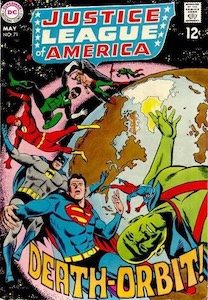 .
.
Martian Manhunter (real name J’onn J’onzz) first appeared near the beginning of the Silver Age in Detective Comics #225 (Nov. 1955). He was a Martian accidentally teleported to Earth and unable to return home. With an array of superpowers (including telepathy, flight, super-strength, and the ability to shapeshift) he decides to stay on Earth and fight crime in many further issues of Detective Comics until becoming an original member of the Justice League in The Brave and the Bold #28 (Jan. 1960). With powers similar to Superman, he was often used as a surrogate in Justice League of America issues when DC were reluctant to overuse Superman. In Justice League of America #71 (May 1969) [pictured] most of the population of Mars was killed by the dictator Commander Benn Blanx, and J’onzz left the League. After the Crisis, Martian Manhunter’s origin was changed and explained in a four-part miniseries in 1988. In that story, the Martians were wiped out thousands of years ago by a plague that was spread telepathically, and J’onzz only survived because he was pulled through time and space to 20th Century Earth.
Page 5, panel 2
The black mark behind Ellen may be a spot where Mirror Master’s laser burned a hold in the carpet.
Page 5, panel 5
After acting as the Justice League’s liaison with the United Nations, Martian Manhunter is handed leadership of the Justice League from Batman in Justice League International #7 (Nov. 1987). Justice League Europe, however, is headed by Captain Atom.
Page 6, panel 2
I’m not sure whether other Justice Leaguers have ever received this treatment, though I doubt that many are attacked in their homes due to their secret identities (which makes finding them difficult) and their advanced superpowers (which makes them dangerous).
Page 6, panel 3
The “millionaire playboy” is a reference to some Justice Leaguers (like Batman, Green Arrow and the Ted Kord Blue Beetle) being extremely rich and not really having any other superpowers.
Page 8, panel 3
Highwater’s lounge room includes a picture of a desert scene, which is the setting we first saw him in the previous issue.
Page 8, panels 4-5
Lewis Carroll’s Through the Looking-Glass… is also referenced in the previous issue. The cover of Highwater’s book actually says Alice in Wonderland but it may contain both of Carroll’s “Alice” stories.
The line “…you’re only one of the things in his dream” is spoken by Tweedledum to Alice about the Red King. By the end of the story, Alice awakens back in her house but she is still unsure if her adventures occurred in her dreams, or whether she and her adventures are a dream by the Red King.
Page 8, panel 6
The Psycho-Pirate is a villain who had an important part to play in the Crisis and who we shall meet soon.
Page 9, panel 3
The gene bomb affected many heroes in varied ways. Valentina Vostok, known as Negative Woman, lost her powers due to the gene bomb, while other characters (such as Maxwell Lord) gained powers. Some characters, such as Fire, had their powers radically altered. The aftereffects of the bomb resulted in the death of Scott Fischer (a.k.a. Scorch) of the Doom Patrol, while Metamorpho was resurrected from the dead.
Page 10
For readers who doubted that Buddy was good enough to make the Justice League, here J’onn J’onzz explains that he values Animal Man’s perspective and his defence of all life on the planet.
Page 11
This sequence will be explained later, in Animal Man #22.
Page 12, panel 4
It’s fair to say that not many superheroes had young children at this time, though Buddy would soon meet his JLE teammate Dmitri (Rocket Red) in Justice League Europe #1 and they bond over having young families.
Page 12, panel 6
The head of the Catholic Church at this time was Pope John Paul II, who was indeed born in Poland.
Page 13
The tradespeople find Buddy relatable as a superhero, and it’s what readers have found appealing about the character too. Elizabeth Sandifer notes the lighthearted tone of this issue, resembling the comedic approach of the Justice League titles written by Keith Giffen and J. M. DeMatteis at the time (including the imminent Justice League Europe series)[2]. I think pages 12-13 of this issue demonstrate that conversational, quippy style.
Page 14, panel 4
Note the warped ground beneath Buddy and the movement of the rocks. I don’t think Buddy is having any actual telekinetic affect on the environment, and this is just artistic license to illustrate the power emanating from Buddy.
Page 16, panel 2
In Invasion #3, Buddy complained of “animal thoughts invading my mind” soon after the gene bomb went off, when he previously hadn’t displayed any telepathic connection to animals.
Page 16, panel 4
Buddy mentioned receiving a letter from foxhunt saboteurs in the previous issue. He never does get to see Martian Manhunter’s doctor as Buddy is waylaid soon after returning from England.
Page 17
How did Blue Beetle get into the Justice League? In the Legends crossover event and miniseries (1986-1987), Doctor Fate brings together a number of heroes to defeat the New Gods Darkseid and Glorious Godfrey. Afterwards, several of these heroes (including Blue Beetle) form a new version of the Justice League.
Page 21, panel 1
We didn’t actually see Buckley steal Cliff’s bike, but the bullies are playing with it now.
Page 23, panel 1
Martian Manhunter’s shapeshifting abilities are without many limits. Here he shapeshift into creatures that are both smaller and bigger than his usual form, and are both real and imagined.
Page 23, panels 4-5
Yet again, Buddy has not been of any real help to his family, and it has been up to others to intervene and solve their problems.
Page 24
The mountain shown here is Kilimanjaro which means the village is near where B’wana Beast resides. The man’s words are cryptic at this stage, but the “gods” he refers to will be revealed in Secret Origins #39 and Animal Man #10.
Back Matter:
Justice League Europe advertisement:
This advert (illustrated by Bart Sears) for the new Justice League Europe series features Buddy and the rest of his new team.
Letters:
The letters here are written in response to issue #6. One of the letters is written by Grant Horwood from “Students for the Ethical Treatment of Animals” and outlines some arguments against animal testing.
References:
[1] Tréguer, Pascal. “‘See you later, alligator’ originated in U.S. teenagers’ slang”. Word Histories, 29 December 2017, https://wordhistories.net/2017/12/29/see-later-alligator/
[2] Sandifer, Elizabeth. “De-Imagine Detroit (Book Three Part 4: Justice League International and Secret Origins).” Eruditorium Press, 19 April 2021, https://www.eruditorumpress.com/blog/de-imagine-detroit-book-three-part-4-justice-league-international-and-secret-origins
 Wild Planet