Animal Man #8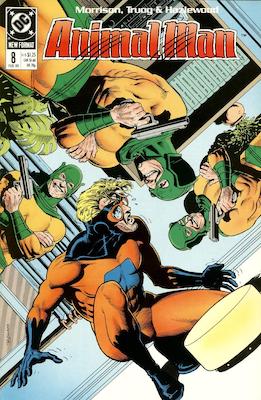
“Mirror Moves”, February 1989
Credits:
Grant Morrison [writer]
Chas Truog [artist]
Doug Hazlewood [artist]
John Costanza [letterer]
Art Young [assistant editor]
Tatjana Wood [colorist]
Karen Berger [editor]
Brian Bolland [cover (uncredited)]
Background:
This issue occurs after Invasion! #3 (in which Buddy suffers the effects of the gene bomb) and Justice League International #24 (when Buddy is accepted into the Justice League). More detailed synopses of those issues can be found on the Volume 1 page.
In a Facebook post later documented by the website Bleeding Cool[1], Chaz Truog shared some sketches of the original version of issue #8, which was then titled ‘Dominion’ – a reference to a race of alien invaders in Invasion!, but also to a class of angels in the New Testament of the Bible. The issue takes place after Buddy falls from the sky at the end of issue #7:
Buddy gets zapped by some kind of alien ray which drains him of his super powers, and spends the issue in a fever dream. It became a rant about extinction and animal rights, and the climax was Buddy getting skinned and worn by a runway model in a fashion show. It was pulled because either there wasn’t enough of a story there, or the image of a skinned Animal Man was too much (maybe both).
Truog completed the pencils for pages 1 and 3, and half of page 2, before the work was stopped. Page 3 (a splash page) was later inked and coloured and included as the title page (page 4) of Animal Man #25.
In a February 1989 article in Cut[2], the author mentions that “DC recently insisted that [Morrison] rewrite an entire issue of Animal Man because they thought he’d gone too far with his animal rights propaganda.” The reason for the rewriting of issue #8 is confirmed in Amazing Heroes #157, which explains that “Animal Man #8 […] will not be an animal rights issue, since Grant Morrison’s script for that issue was rejected as being a bit too strong.”[3]
Morrison later explained:
“There were only two stories that I couldn’t do. One was a really radical animal rights story. It was probably a bit over the score in terms of violence and shock-value for DC. And there was another crazy 60s plot which didn’t happen — although I was able to bring bits of it back later on. Apart from that they pretty much let me do what I wanted.”[4]
Front Matter:
Cover:
Buddy crouches on the ceiling of his living room while being confronted with duplicates of the Mirror Master holding a laser gun. The gun has a different design compared with how it appears within the issue. On Buddy’s shelf are multiple volumes or copies of a work titled The Animal Kingdom, which I don’t believe corresponds to a real publication.
Inside Cover:
The ‘DC Checklist This Week’ section includes the following description of Animal Man #8: “After INVASION! Animal Man needs some rest but is attacked in his own home by Mirror Master!”
Story:
Page 1
This page depicts the home of writer Grant Morrison, who soon becomes an active character in this series. In Supergods[5], Morrison mentions that their cats appeared in the pages of Animal Man.
The initials PCW on the computer stand for Personal Computer Word processor and suggests that this is a British-made Amstrad home computer – potentially a PCW9512 that was produced from the mid-1980s.
Regarding the Einstein quote “I cannot believe that God plays dice with the cosmos”, this paraphrases what Albert Einstein wrote in a letter to Max Born on December 4th 1926. It was a response to what was later referred to as the ‘Copenhagen Interpretation’ of quantum mechanics, of which Born was an adherent. Born’s belief was that the movement of particles were impossible for physicists to predict from causes, and that the best we could offer was the probability of an object being in a certain state. Einstein, however, believed that there must be some laws underpinning the behaviour of these particles.
Job Number: G-4457.
Page 2, panel 1
One of the letters displays the acronym ‘JLE’, for Justice League Europe.
Page 2, panel 2
Buddy is still feeling the effects of the gene bomb, which hospitalised many metahumans in Invasion! #3.
Page 2, panel 3
Animal Man first received an offer to join a branch of the Justice League based in Paris in Justice League International #24. The Justice League series was renamed Justice League International from issue #7 after the team was sanctioned by the U.N. as an international peace keeping force and allowed to operate independently of any governments. They soon opened embassies in New York, Moscow and Paris. After Justice League International #25, the name of the series changed to Justice League America (from #26, May 1989), while the adventures of the Paris contingent appeared in the series Justice League Europe (issue #1 was published in Apr. 1989).
Ellen’s quip about a “Secret Decoder Badge” refers to a popular toy that allowed children to code and decode messages. The badge or ring would help its users to apply a simple Caesar (or shift) cipher to a message so that the letter ‘D’ in a code may represent the letter ‘A’, the letter ‘E’ represents the letter ‘B’, and so forth. Ellen is implying that the superhero team is something childish presenting itself as something serious.
Page 2, panel 4
Animal Man’s powers are “screwed up” from the gene bomb. In Invasion! #3, his powers were so out-of-control that he had to be subdued by Blue Beetle and Booster Gold.
Page 3, panel 1
Buddy receives mail from animal rights groups asking for help. Foxhunt saboteurs attempt to disrupt foxhunts where hounds are used to track and kill foxes. Tactics include using sounds and scents to disorientate the hounds.
Page 3, panel 4
Presumably Buddy is thinking about changing his superhero name from the unglamorous ‘Animal Man’, not changing his real name from Buddy Baker. In the essay Ecce Animot, the authors speak to the redundancy of the “Animal Man” moniker:
We could ask what is added to or subtracted from the man called “Animal Man” given that, scientifically speaking, a man is already an animal? The name “Animal Man” is tautological, but at the same time it speaks to the binary thinking of animal and man.[6]
Page 4
This is the title page. The title ‘Mirror Moves’ is quite possibly a reference to the fourth studio album by English rock band the Psychedelic Furs, released in 1984.
This issue is dedicated to writers John Broome and Gardner Fox, artist Carmine Infantino, and the fictional character Barry Allen. These names are significant in the history of the Flash and DC continuity. Explained chronologically: Gardner Fox created the original version of the Flash (Jay Garrick) in Flash Comics #1 (Jan. 1940). Barry Allen was a new version of the Flash who first appeared in Showcase #4 (Oct. 1956), which was penciled by Carmine Infantino. This appearance often signifies the beginning of the Silver Age of Comic Books. In 1959, John Broome (a writer that Morrison frequently professed admiration for) and Carmine Infantino created the Mirror Master character. Fox and Infantino created the ‘Flash of Two Worlds’ story from The Flash #123 (Sept. 1961) where the Golden Age Flash (Jay Garrick) meets the Silver Age Flash (Barry Allen). This issue introduced the concept of the Multiverse to DC continuity. Infantino is also credited as a co-creator of Animal Man in 1965. Barry Allen is supposedly killed during Crisis on Infinite Earths (1985-1986).
Page 5, panel 5
The depiction of birds circling a character’s head is a variant of a squean that indicates dizziness or disorientation. Stars may signify the same thing, but birds seem more appropriate in this context.
Page 6, panel 6
“Howzitgaun, pal” = “How is it going, pal?”.
 Page 7
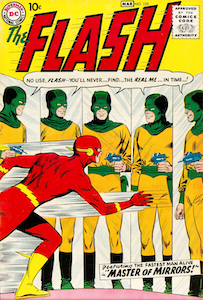
This is the first appearance of the post-Crisis Mirror Master Evan McCulloch. Mirror Master first appeared as an alias of Sam Scudder in The Flash #105 (Mar. 1959) [pictured] as an enemy of the title character. Scudder is killed during Crisis On Infinite Earths #10 (Jan. 1986), and McCulloch has apparently taken on his identity. Mirror Master’s powers include the ability to teleport using mirrors and to create holograms or duplicates of himself.
Page 8
Mirror Master has always carried a laser pistol. The use of mirrors is a method by which light can be amplified until it is concentrated into a laser beam.
The slang Mirror Master uses identifies him as being Scottish, like Grant Morrison. Kelvinside is a district of Glasgow, while a toley is Scottish slang for excrement. A toley-poker, then, is a homophobic slur.
Page 10, panel 1
“Sojies” appears to be a Scottish schoolyard game.
Page 11, panel 4
The Military Research Program McCulloch refers to is the weaponised anthrax being developed at S.T.A.R. Labs.
Page 11, panel 5
“Disny matter” = “Doesn’t matter”, in a Scottish accent.
Page 12, panel 2
The significance of this panel will not be revealed until Animal Man #22.
Page 13, panel 3
The existence of a Mirror World where Mirror Master can hide is first revealed in The Flash #126 (Feb. 1962).
Page 14, panel 1
“Wee bit too much of the bevvy?”: Bevvy = beverage, so Mirror Master is asking Buddy if he’s had too much to drink.
Page 14, panel 5
The kitten saved in Animal Man #4 can be seen on the couch.
Page 16, panel 4
While his duplicates disorient and distract Buddy, Ellen faces the real Mirror Master. A “stoatir” or stoater is slang for something that is wonderful, so McCulloch is expressing that Ellen is attractive.
Page 16, panel 6
Though we cannot see it leave his hand, the kick to the groin causes McCulloch to drop his laser weapon.
Page 17, panel 1
McCulloch’s injury also causes his duplicates to dissolve and for Buddy to fall from the ceiling.
Page 18
The laser gun lies at the bottom of the stairs in panel 1. The Baker’s house is number 403. The Bakers’ pet dog hasn’t been introduced yet but it can also be seen in the yard in Animal Man #1.
Page 19
In panel 1, Mirror Master holds a small mirror. In panel 2, we can see a silhouette of a Mirror Master reflecting the small mirror’s light onto Buddy, while another Mirror Master holds a large mirror. In panel 3, we can more clearly see the two Mirror Masters.
McCulloch makes reference to a “looking glass” (another term for a mirror), while the back of the mirror is labelled ‘Carroll & Co.’. This is a reference to Lewis Carroll’s story Through the Looking-Glass, and What Alice Found There, the 1871 sequel to Alice’s Adventures in Wonderland. In Through the Looking-Glass…, Alice enters a reverse-world through a mirror, similar to Mirror Master’s Mirror World.
Page 20, panel 1
“If I don’t see ye aboot, I’ll see ye a sannie!” – a “sannie” is Scottish slang for a sandshoe or plimsoll, while “aboot” is the word “about” in a Scottish accent. McCulloch’s farewell phrase then plays with the word “aboot” as meaning both “about” and “a boot”.
Page 20, panels 4-7
Buddy has become the reflection of those he comes into close contact with.
Page 21
The effect didn’t just “wear off”; Ellen has come to the rescue again by smashing the small mirror that was causing the effect. Panel 7 is very similar to page 12:2, which will be explained in Animal Man #22.
Page 22
McCulloch addresses three figures, whose identities will be revealed later in the series. McCulloch partially failed in his mission as none of the Bakers were supposed to have been harmed, but Buddy and Ellen were both assaulted.
The shadowy figures are standing in front of the Great Seal of the United States, first used in 1782. It depicts a bald eagle clutching an olive branch and arrows, representing peace and war. There are 13 arrows and usually 13 olives and leaves. The number 13 correlates to the original number of states in the US. The motto E Pluribus Unum (which has 13 letters) translates “Out of many, one” and refers to the uniting of the original colonies into one country. The appearance of the seal here suggests that the figures are somehow associated with the federal government.
Page 23
This is the first appearance of James Highwater, a Native American physicist who becomes a major character in the series. His narration explains that he feels newly created but has a full set of memories and a purpose. In context, his question of whether “Einstein was wrong” is a question of whether he (Highwater) merely feels this way because he is having an existential crisis, or whether he feels this way because “God is playing dice” and something weird is occurring in the universe.
Page 24
On the next page, the computer’s typist (Morrison) answers the question: Highwater’s existence feels strange but it’s not because God is playing a game – it’s because Morrison is.
Back Matter:
Letters:
The letters here refer to Animal Man #5 and offer various interpretations of ‘The Coyote Gospel’ story.
Letter 1 notes that the issue puts the trucker in the predator role usually occupied by Wile E. Coyote. The letter’s author also suggests that the creator depicted in the issue (presumably meaning the creator of Crafty’s universe) is Chuck Jones.
Letter 3 argues that the issue let us see the world from Wile E. Coyote’s perspective for the first time, revealing the coyote as a victim.
Letter 8 compares Crafty with other “Suffering Heroes” from mythology, namely Prometheus, Loki, Atlas and Jesus Christ.
Letter 10 notes the issue’s critique of cartoon violence, which is perpetrated by the creators.
Letter 11 sees Crafty as representing the voiceless, and the issue demonstrates the tragedy that will occur if we do not pay attention to them.
A few letters also make reference to Who Framed Roger Rabbit (1988): a recent crime film set in a world of cartoon characters. This film was adapted from a 1981 novel by Gary K. Wolf titled Who Censored Roger Rabbit?, which was instead set in a world of comic strip characters.
A letter that wasn’t printed is referred to by Morrison in an interview in Comics Journal:
“In Animal Man, we once had this religious nut write in, during the “Coyote Gospel” story. This letter came in from the American heartland, scrawled in crayon, he’s obviously done it with his feet. And he said, “You have profaned my God, and you will go to hell for this,” everything spelled wrongly.”[7]
References:
[1] Johnston, Rich. “The Lost Issue of Grant Morrison and Chas Truog’s Animal Man From 1988 – ‘Dominion'” Bleeding Cool, 7 Sept. 2019, https://bleedingcool.com/comics/the-lost-issue-of-grant-morrison-and-chas-truogs-animal-man-from-1988-dominion/.
[2] Denholm, Jane. “Scotch Myths.” Cut, Feb. 1989, p. 15. Scans available at https://sites.google.com/deepspacetransmissions.com/deepspacetransmissions/interviews/1980s/cut-february-1989.
[3] Jordan, Gil. “Animal Man.” Amazing Heroes, no. 157, 15 Jan. 1989, p. 22.
[4] “Grant Morrison”. Submedia, no. 1, 1999, p. 43.
[5] Morrison, Grant. Supergods: What Masked Vigilantes, Miraculous Mutants, and a Sun God From Smallville Can Teach Us About Being Human. Spiegel & Grau, 2011.
[6] Mahmutovic, Adnan, et al. “Ecce Animot: Or, The Animal Man That Therefore I Am.” ImageTexT: Interdisciplinary Comics Studies, vol. 8, no. 2, https://imagetextjournal.com/ecce-animot-or-the-animal-man-that-therefore-i-am/.
[7] Hasted, Nick. “Grant Morrison.” The Comics Journal, no. 176, Apr. 1995, p. 63.
 Wild Planet