Animal Man #7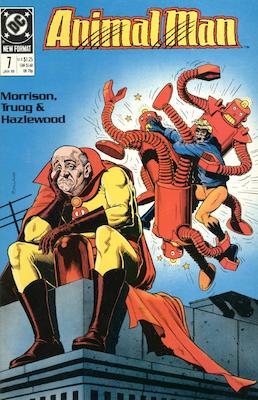
“The Death of the Red Mask”, January 1989
Credits:
Grant Morrison [writer]
Chas Truog [penciller]
Doug Hazlewood [inker]
John Costanza [letterer]
Tatjana Wood [colorist]
Art Young [assistant editor]
Karen Berger [editor]
Brian Bolland [cover (uncredited)]
Background:
This issue occurs after Invasion! #2, when the alien invasion is repelled by Earth’s heroes. A more detailed synopsis of that issue can be found on the Volume 1 page. Unlike Animal Man #6, issue #7 is not an official part of the Invasion! event but the invasion is referenced throughout, and the final page of this issue leads into Invasion! #3, which also features Buddy.
Front Matter:
Cover:
The cover depicts Animal Man fighting some robots, with the Red Mask in the foreground.
Inside Cover:
The ‘DC Checklist This Week’ section includes the following description of Animal Man #7: “The Mod Gorilla Boss takes on the mob in Miami with Animal Man caught between both sides”. However, this is not the synopsis for the issue that was published and refers instead to an earlier version of Animal Man #7 written by Morrison. That the synopsis of the original version was included in the ‘DC Checklist’ suggests that the change occurred at late notice.
The plot of issue #7 was originally intended to be quite different. In an interview with Mark Millar, Morrison explains:
“Issue 7, which I’m really pleased with, is written largely in the style of those awful 60’s comics in which middle-aged men try to write ‘teen’ dialogue with hilarious results. This one features the return of Scooter from DC’s ‘Swing With Scooter’ title.”[1]
Swing With Scooter was one of DC’s teen humour titles and ran between July 1966 and Nov. 1972. Scooter was a young British mod who (as his name suggests) rode a scooter and occasionally interacted with superheroes. Ben at the Deep Space Transmissions website[2] provides further details about the cancelled story, suggesting that the Mod Gorilla Boss (Animal Man’s foe from Strange Adventures #201, June 1967) would be involved. Ben also explains that the original script was rejected, and the story was then going to be told in a one-shot titled Gorillas-A-Go-Go but this never materialised either.
Story:
Pages 1-2
Page 1 shows splats of something red – possibly the blood shown in the sink on page 2, panel 3. However, the red splashes form an entirely red panel that transitions into the red helmet on page 2, so the splashes may be a reference to the red ink used to create the images, again drawing the reader’s attention to the creator’s role in this issue.
The character on page 2 is the Red Mask, seen for the first time in this issue. His featureless red helmet and red cape is identical to that worn by the character Red Hood. Red Hood first appeared in Detective Comics #168 (Feb. 1951) when it was revealed as a prior alias of Batman’s nemesis, the Joker. As that issue explains, Joker was wearing the mask when he fell into a vat of chemicals when attempting to escape Batman. This event altered his appearance and caused him to adopt the persona of the Joker. This version of Joker’s origin story was retold by Alan Moore in Batman: The Killing Joke (1988) with art by Animal Man‘s cover artist Brian Bolland.
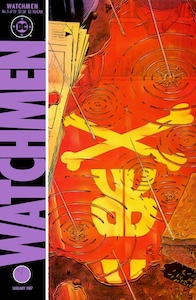 The logo on Red Mask’s costume depicts a red skull. The tractorforklift blog[3] points out that this logo is very similar to one that appears on the cover of Watchmen #5 (Jan. 1987) [pictured]. In that issue, the mirrored ‘R’ is the logo of a bar named the Rum Runner, and it’s symmetrical design is symbolic of the theme of symmetry in that particular issue. (The page layouts are mirrored throughout the issue, so that the first and final pages have the same layout and similar panel compositions. Even the name of the issue is “Fearful Symmetry”). The logo’s appearance in this issue of Animal Man is one of several references to the comics of Alan Moore. Given Morrison’s frustrations at being described as “the new Alan Moore” (judging from the interview with Mark Millar for FA #109)[4], I’m speculating that this issue was written as a sort of protest by Morrison after their own original story was rejected and they they were forced to create something new at short notice. Morrison may have whipped up something that was superficially Moore-esque, with a bunch of direct references included to let readers know that the swiping was a conscious in-joke.
Job Number: G-4141.
Page 3, panel 4
Red Mask checks his watch, though there is not really any reason for him to know the time before he is about to commit suicide. It could be another reference to Watchmen, where time and clock faces are a recurring motif.
Page 4
This is the title page. The title of the issue predicts the fate of the Red Mask. It’s also a play on the title of Edgar Allen Poe’s short story ‘The Masque of the Red Death’[5], published in 1842. In that story, Prince Prospero and other nobles have sealed themselves in Prospero’s abbey in an attempt to avoid a plague known as the Red Death. At a masquerade party in the abbey, a mysterious guest arrives dressed as a victim of the Red Death. Prospero dies suddenly while confronting the stranger, while the other guests intervene to find that its costume is “untenanted by any tangible form” (i.e. there is no body underneath the costume) and also subsequently die.
Page 5, panel 1
Pages 5-8 contain a flashback that takes us back up to page 4.
Page 5, panel 2
Judging from the shape of the instrument’s body, the guitarist on TV may be playing a Gibson Firebird or something modeled off of it.
Page 5, panel 3
Animal Man met Hawkman in Animal Man #6. Following this, Animal Man is shown on the cover of Captain Atom #24 (Jan. 1989) saluting Captain Atom who, in that issue, is given responsibility for coordinating the defence efforts of the superheroes against the aliens. At the end of that issue, superheroes begin converging on “NORAD mountain” – presumably the Cheyenne Mountain Complex in Colorado. This is later depicted in Invasion! #2, though Animal Man is not shown.
Page 5, panel 6
Metallica, along with the band Anthrax mentioned in issue #2, were one of the “Big Four” thrash metal bands of the era.
Page 5, panel 8
It is unclear how and why Animal Man has ended up in Miami as his last known location was Colorado if he was at NORAD with the other heroes. It’s notable that the original version of Animal Man #7 was set in Miami too according to the synopsis in the ‘DC Checklist This Week’. Animal Man is still in Miami during Invasion! #3. It’s possible that Invasion! #3 was already finished when the original script to Animal Man #7 was rejected, so Morrison had to set the new version of issue #7 in Miami too for reasons of continuity.
The bus in this panel seems to sport an advertisement for the radio station KRQS 92. This is a real station but is based in Minnesota, the home state of Chaz Truog. Call signs for radio stations that are west of the Mississippi river, including Florida, usually begin with a ‘W’.
Page 7, panel 5
If Animal Man is “passing by” Miami on his way home to California, he may have actually been fighting in Cuba against the Durlan invasion in the area. The police officer mentions the Khunds, who were another one of the races of alien invaders, but during the invasion they were primarily fighting in Australia and the South Pacific.
Page 10, panel 5
There was briefly a villain known as Doctor Fang in the DC Universe. He was a foe of Batman introduced in Detective Comics #536 (March, 1984) and then fatally shot in Batman #380 (February, 1985).
Page 10, panel 7
The term “Secret Origin” has a long history in comics, but it now commonly refers to a story that explains how a hero came to receive their powers. It’s first use was in the title of Wonder Woman #105 (Apr. 1959), in which Wonder Woman’s previously explained origin was retconned by a new, “secret” version[6]. In 1961, DC Comics released a Secret Origins comic book that reprinted and collected the origin tales of several superheroes, which brought the term into its current usage. There have been other Secret Origins comic series published since then. Note that Animal Man’s origin story (from Strange Adventures #180) was reprinted as part of Weird Secret Origins in Oct. 2004.
Page 11, panels 1-2
The Red Mask’s story is told in black, white and red. Coincidentally, when Brian Bolland recoloured Batman: The Killing Joke himself for a re-release in 2008, the Joker’s flashbacks are presented using this colour scheme. This revised colouring was not, of course, available to Animal Man‘s creative team in 1989.
Red Mask’s origin is similar to Buddy’s in that both were hunting when they discovered an object from space that bestowed powers upon them. That this occurred in 1945 when “a lot of guys were getting weird powers” identifies Red Mask as a character of comics’ Golden Age. The Golden Age of Comic Books describes the era roughly from 1938 (the debut of Superman) to 1956 (the debut of the new version of the Flash). Another story thread within Watchmen is the relationship between Golden Age superheroes and their modern counterparts. In Watchmen, the retired Golden Age hero Nite Owl recounts his story to a younger (but also retired) hero who had taken Nite Owl’s name in the 1960s and 70s. The Red Mask, in telling his story to Animal Man, continues that tradition of passing down tales of the Golden Age to a younger generation.
Page 12, panels 1-3
This conversation highlights the trope within superhero comics where a hero’s powers result from a freakish accident. Steven Zani suggests that “the functional message is to reveal to the readers that traditional comic elements are in place in this text, and yet their shortcomings are being exposed.”[7]
Page 12, panel 4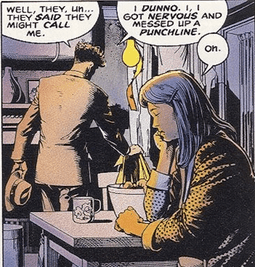
This panel again resembles the domestic scenes in flashback between the man who would become Joker and his wife in Batman: The Killing Joke [pictured].
Page 12, panel 5
The Red Mask mentions the Poe story as an inspiration, but also the 1964 film adaptation starring Vincent Price as Prospero. The film is quite different, presenting Prospero as a cruel Satanist who kidnaps some villagers to fight for the amusement of himself and his quarantined guests. As in the original text, Prospero and many of his guests die. Unlike the book, the Red Death is specifically revealed as anthrax rather than a fictional plague. I assume that the Red Mask identifies with the character of the Red Death in both the book and film versions, given his ability to kill in close contact.
Page 12, panel 6
The Veil is not a character that has previously appeared in any DC Comics but he will return later in Animal Man.
Page 13, panel 1
Captain Triumph was a Golden Age superhero who debuted in 1943 in comics published by Quality Comics, which was purchased by DC Comics in the 1950s. The Quality Comics titles that DC continued to publish after the buyout were mostly war-related comics, and these stories were explained to exist in an alternative reality to the main DC Universe. That is, until the Quality characters were folded into the main DC continuity by the Crisis. This appearance in Animal Man may be Captain Triumph’s first reference in the post-Crisis continuity.
Page 13, panel 2
The Veil’s fate is similar to that suffered by Mothman, who was institutionalised in Watchmen.
Arkham Asylum is a fictional psychiatric hospital for criminals based in Gotham and frequently holds the supervillains apprehended by Batman. The institution was first mentioned in Batman #258 (Oct. 1974) as Arkham Hospital. Grant Morrison had recently written a graphic novel set in the Asylum as one of their first works for DC, titled Arkham Asylum: A Serious House on Serious Earth (Oct. 1989).
Page 13, panel 4
The Red Mask’s status as a terminally ill, aging supervillain recalls the role of Moloch in Watchmen, who incidentally lives close to the Rum Runner bar and appears in Watchmen #5.
Timothy Callahan[8] points out that this is the third issue in a row where Buddy listens passively to the story of a minor, misunderstood character introduced for the first time: Crafty, Rokara Soh, and now Red Mask.
Page 16, panels 1-2
Red Mask may be claiming that villains are less obvious than they were in the Golden Age. It’s possibly true that, in the Modern Age of Comics Books, the motivations of villains and the flaws of heroes were now being explored more thoroughly, which served to blur the distinction between good and evil characters.
Page 16, panel 4
The Justice Society of America (debuting in All Star Comics #3, Winter 1940/1941) was the top superhero team of the Golden Age, and a precursor to the Justice League of the Silver Age (debuting in The Brave and the Bold #28, Jan. 1960).
Page 16, panel 5
President Harry S. Truman was in office between 1945 and 1953, suggesting that the mask was constructed in the years immediately after the Red Mask gained his power.
Page 17, panel 3
People do keep dying on Animal Man. So far, Animal Man has witnessed the deaths of Djuba and other animals at S.T.A.R. Labs, Crafty the coyote (and possibly the truck driver), and the Thanagarian artist Rokara. Buddy did manage to save the life of B’wana Beast.
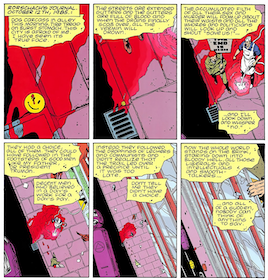 Page 21
This page mirrors the first six panels of Watchmen #1 (Sept. 1986) [pictured] but, instead of zooming out from the blood of the assassinated Comedian, Morrison and Truog zoom in on the blood of the Red Mask.
Page 23, panel 1
“If only I’d…” – Callahan[9] suggests that Buddy never learns of the Red Mask’s suicide, but this line might suggest that Buddy blames himself for the death of Red Mask after leaving him alone on the rooftop. To me, Buddy seems dejected throughout this ‘Epilogue’.
Page 23, panel 3
The headline on the front page of the Miami Herald newspaper on the street refers to the alien invasion.
Page 24
This page is printed in black and white with the colours reversed, which represents the detonation of the gene-bomb that occurs in Invasion! #3. Many of the Invasion! tie-in issues between Invasion! #2 and #3 end with a similar panel, or another indication of the gene-bomb explosion, though this issue of Animal Man was not listed as being a part of the event. Other issues that depict the gene-bomb detonation include: Checkmate! #12, Captain Atom #25, Firestorm the Nuclear Man #81, Justice League International #23, Manhunter #9, Wonder Woman #26, The Adventures of Superman #450, Power of the Atom #8, Starman #6, and Doom Patrol #18.
Back Matter:
Letters:
Most letters in the ‘Animal Writes’ column praise the first four issues of Animal Man.
The writer of the third letter sympathises with Buddy’s vegetarianism and provides addresses for a few animal rights organisations.
The writer of the fourth letter defends animal testing and decries the stereotyping of all scientists in these labs as evil. The writer also points out that the existence of zoos has not been criticised in the stories so far. Art Young responds to argue that only Dr. Myers was shown to be a bad guy, and to point out that there are positive representations of scientists in other comics.
Daily Planet advertisement:
Following ‘Animal Writes’ is another advert for the Invasion! event presented as an issue of the fictional newspaper Daily Planet – this being the equally meaningless “Issue Number MXLLLVI”. Animal Man is not mentioned in the ad.
References:
[1] Millar, Mark. “Grant Morrison Talks to Mark Millar.” FA, no. 109, Jan. 1989, pp. 33-37. Scans available at https://sites.google.com/deepspacetransmissions.com/deepspacetransmissions/interviews/1980s/fa-109-1989
[2] Hansom, Ben. “The Unpublished Grant Morrison – DC Comics”. Deep Space Transmissions. https://sites.google.com/deepspacetransmissions.com/deepspacetransmissions/universe-b-the-unpublished-grant-morrison/the-unpublished-grant-morrison-dc-comics
[3] “Grant Morrison Writes Spoofs About Alan Moore and Says Nice Things”, 23 Mar. 2019. https://tractorforklift.wordpress.com/2019/03/23/grant-morrison-writes-spoofs-about-alan-moore-and-says-nice-things/
[4] Millar 1989.
[5] You can read the short story here: https://poemuseum.org/the-masque-of-the-red-death/
[6] Cronin, Brian. “When Was The Comic Book Term ‘Secret Origin’ Coined?”. CBR, 30 Oct. 2017. https://www.cbr.com/secret-origin-comic-book-debut/
[7] Zani, Steven. “It’s a Jungle in Here: Animal Man, Continuity Issues, and the Authorial Death Drive.” The Contemporary Comic Book Superhero, edited by Angela Ndalianis, Routledge, 2008, p. 236.
[8] Callahan, Timothy. Grant Morrison: The Early Years. Sequart Research & Literacy Organization, 2007.
[9] Ibid.
 Wild Planet