Animal Man #6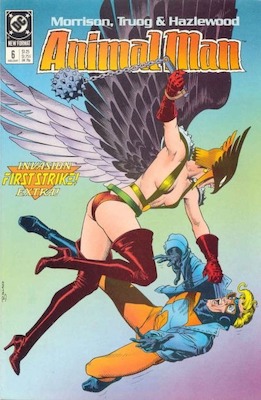
“Birds of Prey”, Holiday 1988
Credits:
Grant Morrison [writer]
Chas Truog [artist]
Doug Hazlewood [artist]
John Costanza [letterer]
Tatjana Wood [colorist]
Art Young [assistant editor]
Karen Berger [editor]
Brian Bolland [cover (uncredited)]
Background:
Animal Man #6 forms part of the Invasion! crossover event, which included a 3-part Invasion! miniseries and tie-in issues across many DC titles. Animal Man #6 takes place after or during Invasion! #1. In that issue, an alliance of warlike alien races, led by the Dominion, plan a takeover of Earth. The aliens fear the genetic anomaly in humans that has resulted in many people of Earth becoming super-powered, so the alliance plans to eradicate everyone on Earth. By the end of the issue, the aliens haven taken over Australia, set up a base in Melbourne, and have requested that the governments on Earth surrender all superheroes. The demand is refused.
In the Amazing Heroes preview of the Animal Man series[1], the article suggests that issues #5 and #6 will tie into the Invasion! event, while issue #7 will feature Justice League International. The timing of this prediction ended up being a little off, with issues #6 and #7 tying into Invasion!, and issue #9 featuring a JLI member.
Front Matter:
Cover:
Animal Man fights a female Thanagarian who is armed with a mace. The “Invasion First Strike! Extra!” caption appears on all of the tie-in issues set between Invasion! #1 and Invasion! #2. The Animal Man title logo doesn’t include the claw marks that have been present on the previous covers.
Inside Cover:
The ‘DC Checklist This Week’ section includes the following description of Animal Man #6: “Animal Man takes on a Thanagarian hawk-warrior who’s planted an atomic bomb at the San Andreas Fault.”
Story:
Page 1, panels 1-2
In Invasion #1, the spacecraft of many of the respective alien groups are introduced, though not the Thanagarian ships. Presumably the Thanagarians have the beaked ships as their culture uses a lot of bird imagery.
Thanagar is a planet first introduced in The Brave And The Bold #34 (Mar. 1961) and is home to police officers Katar and Shayeera Hol, who travel to Earth in that issue pursuing a fugitive. Thanagar is home to Nth metal (also known as Ninth metal) which is a gravity-defying substance that allows Thanagarians to fly.
The large ship and its smaller craft are decorated with the Eye of Ra symbol. In Egyptian mythology this symbol represents a violent goddess who is an extension of the power of Ra, the sun god. Thanagar had some relationship to ancient Egypt. An earlier version of the Hawkman character, Carter Hall (who first appeared in Flash Comics #1, Jan. 1940) was an archaeologist who realised that he was the reincarnation of Prince Khufu from ancient Egypt. In the post-Crisis retelling of the story (from Secret Origins #11, Feb. 1987), Hall may have rediscovered what he termed “Ninth metal” based on subconscious recollections from his time as Khufu in ancient Egypt. As Nth metal is native to Thanagar, it follows that Thanagarian and ancient Egyptian societies must have had some contact, and some cross-pollination of cultures may have occurred.
Job Number: G-4014.
Page 1, panels 3-4
Pictured are Thanagarians, who appear human-like but are often clothed in beaked helmets and wings that assist in flight.
Page 1, panels 5-6
The panels with brown borders throughout this issue indicate flashbacks: visions triggered by the globe that the male Thanagarian (Rokara Soh) is handling. The Khunds and Dominators are other alien races currently involved in the invasion of Earth. The Khunds first appeared in Adventure Comics #346 (July 1966), which was set in the 30th Century, while the Dominators first appeared in Adventure Comics #361 (Oct., 1967). Both races looked slightly different then to how they appear throughout Invasion!
Note the strange plant next to Rokara’s drinking vessel, which is the poisonous ‘hellshade’.
Page 2, panel 1
A female Thanagarian is introduced by the name of Skalla Kol. Neither she nor Rokara Soh had previously appeared in any comics.
Page 3, panels 1-2
In the flashback, Skalla says goodbye to Rokara. She is not the female Thanagarian currently travelling towards Earth with him.
Page 4
Kuzma notes the influence of Peter Singer’s brand of utilitarianism on the series, which expands the principle of equality to non-human animals. Both sides of Buddy and Roger’s argument on this page is consistent with utilitarian moral philosophy. Roger reasonably argues that, on the whole, the death of some rats is worthwhile if it saves a child’s life, while Buddy reasonably calls out Roger’s speciesist suggestion that a rat’s life is worth more than a human’s.[2]
Page 5
Roger’s exclamation that it’s “the Earthquake” reflects the longstanding concern about a major earthquake occurring on the San Andreas Fault in California.
Page 6
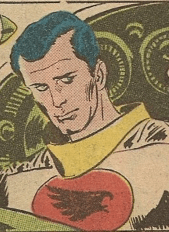 This is the title page. ‘Birds of Prey’ is a reference to the type of predatory bird that is hawk is – one that hunts vertebrates. There would later be a superhero team formed with this name, but that wouldn’t occur until 1996.
The right-facing hawk’s head on the bottom of the ship is reminiscent of a design seen on the costume of Katar Hol [pictured in his first appearance]. Sometimes the design is mirrored, with the hawk facing left. In this example, we see the hawk’s right eye, which corresponds to the Eye of Ra symbol that is also visible on the ship.
The quote is from Aleister Crowley’s Liber Legis, also known as The Book of the Law – the central text of Crowley’s religion Thelema. The text is said to have been dictated to Crowley by a being known as Aiwass over three days in April 1904. Though the two lines are in a different order and not adjacent in the original text, both appear in Chapter III, which is spoken by the deity Ra-Hoor-Khuit (or Ra-Horakhty in Egyptological pronunciation). Ra-Horakhty is the merging of the gods Ra and Horus, who are both represented as having the heads of falcons. It is unclear what Crowley (or Aiwass) meant by these lines but Morrison may have included these for their associations with the Hawkman character: the Golden Age Hawkman Carter Hall first appeared in the 1940s, while the current story and Thanagarian invasion is occurring in the 1980s.
Page 7
That Buddy’s costume is stored in the car rather than carried with him is a humorous and relatable detail that again highlights the normalcy of Buddy despite his ambitions as a superhero.
Page 8
Hadrack is apparently a famous artist on Thanagar (or greatly admired by Rokara, at least) but they are not mentioned in any other stories.
Page 9, panel 1
Rokara refers to Buddy as an animal of Earth, which is not incorrect, but it’s interesting that an alien species may not discern any meaningful differences between humans and non-human animals.
Page 9, panel 5
Buddy must have encountered Thanagarians before, or at least heard them speak. Buddy was onboard the Monitor’s ship in Crisis on Infinite Earths #5 (Aug. 1985) with the Golden Age (Earth-2) Hawkpeople Carter and Shiera Hall, but they are not from Thanagar and its not clear if Katar and Shayeera Hol (the Earth-1 Hawkpeople) were also present.
Page 10
The mace (typically made out of Nth metal) is a favoured weapon of Thanagarians.
Page 11
Buddy presumably takes on the abilities of a fish, which allows him to stay underwater.
Page 14, panels 1-4
The Hawkman character on Earth is able to communicate with birds and the bird speech is usually represented by “wheet, wheet” as it is here. Carter Hall learns the language of birds in Flash Comics #23 (Nov. 1941). Katar and Shayeera Hol also communicate with birds in their first appearance (Brave And The Bold #34), and they presumably learn this language from the ship’s computer during their approach to Earth.
Page 14, panel 5
This flashback shows Rokara in a field of purple hellshade blossoms.
Page 15
While Animal Man can take on the abilities of animals, he is not able to communicate with them except by using rudimentary calls (as seen in Strange Adventures #201, June 1967) so he is powerless to stop the birds’ attack.
Page 17
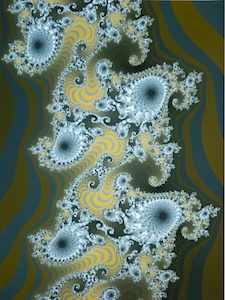
Rokara’s definition of a fractal will suffice here. Benoît Mandelbrot, who famously visualised a mathematical set in 1980 that would come to bear his name, defined a fractal as “a rough or fragmented geometric shape that can be split into parts, each of which is (at least approximately) a reduced-size copy of the whole.”[3] The detailed and beautiful images of the Mandelbrot Set were popular in the 1980s with a worldwide touring exhibition of fractal visualisations titled Frontiers of Chaos [pictured is an image from the exhibition].
Page 18, panel 1
Rokara plans to detonate the bomb on a Californian fault line to trigger “the big one” earthquake preemptively feared by Roger on page 5. There is also another mention of the Thanagarian artist Hadrak.
Timothy Callahan[4] points out that the idea that art can transform the world (or even destroy it, in this case) is something that Morrison revisits throughout their career.
Page 18, panel 2
The image seems to depict the destruction of San Francisco, with the Transamerica Pyramid building clearly visible, so this panel represents what may occur if the bomb detonates.
Page 18, panel 3
Animal Man seems surprised to hear of the alien invasion so, unless Buddy has been avoiding the news, this may occur partway through Invasion #1, before the aliens have destroyed the city of Melbourne.
Page 18, panel 6
The Chiricca set is fictional, but gives an indication of what a fractal looks like.
Page 19, panel 3
It’s at this point that Rokara dies and stiffens in place.
Page 20
The bomb continues to retrieve memories from Rokara’s life until it finds one that will trigger detonation. Though the memories it retrieves should be random, the bomb seems to show Rokara’s life in reversal chronological order back to his birth, and then chronologically forward again focusing on Rokara’s relationship with his father and art practice.
Page 24
Animal Man is saved by Katar Hol, the current Hawkman – or so contemporary readers and Grant Morrison would have thought. Hawkman and Hawkgirl/Hawkwoman have (in)famously convoluted histories caused by inconsistencies in their continuity at around this time. As previously explained, the original Golden Age Hawkman (Carter Hall) first appeared in 1940 and was an archaeologist and reincarnation of an Egyptian prince. The Silver Age Hawkman (Katar Hol) was a police officer from Thanagar and first appeared in the 1960s. In the subsequent years, these different versions of Hawkman were explained as being in separate realities (Earth-1 and Earth-2). The Crisis on Infinite Earths event (1985-86) saw the merging of these Earths so that both versions of Hawkman existed in the same timeline. The Crisis offered the opportunity for the origin stories of many superheroes to be retold. In 1989, a 3-issue mini-series titled Hawkworld was published that detailed the lives of Katar Hol and his colleague Shayeera on Thanagar before they travelled to Earth to pursue the fugitive Byth, which would have led up to their first appearance in Brave And The Bold #34 (Mar. 1961). However, due to the success of this series, DC editors decided to bring these characters into the present in an ongoing Hawkworld series in 1990. The problem was: if Katar and Shayeera are travelling to Earth for the first time in 1990, who were the Hawkpeople who were currently on Earth and had taken place in the Invasion! event of 1988? The answer offered was that the Katar Hol on Earth was actually a Thanagarian imposter named Fel Andar, who had infiltrated Earth’s superheroes ahead of the invasion. Hawkworld #23 (May 1992) shows Fel Andar killing his partner Sharon at the time of the Invasion (perhaps slightly after Animal Man #6). Its difficult to discern his truths from lies but, in that issue, Fel claims to be a double-agent secretly working for Earth and feeding false information to the Thanagarian invaders. That might explain why he defused the bomb for Animal Man. In short, while readers would have thought the Hawkman who appeared in this issue was Katar Hol (the then-current Hawkman), this appearance was retconned (a retroactive continuity was imposed) in 1992 to explain that the character in Animal Man #6 was actually Fel Andar. A similarly named Fell Andar appeared in the 1985 miniseries The Shadow War of Hawkman as a covert Thanagarian operative, but these appearances were soon erased from continuity by the events of the Crisis.
Back Matter:
Letters:
After a competition, the letter column is now titled ‘Animal Writes’, a pun on the term ‘animal rights’. The logo for the column was designed by Todd Klein, who was also responsible for the Animal Man logo on the front cover. The letters refer to the first three issues of Animal Man and many readers detail their first exposure to the character. The first letter also mentions that the Justice League International are undertaking a recruitment drive (as mentioned in Justice League International #19, Nov. 1988).
Daily Planet advertisement:
Following ‘Animal Writes’ is an advert for the Invasion! event presented as an issue of the fictional newspaper Daily Planet (though “Issue Number MXLLLV” is a nonsensical series of Roman numerals). The paper provides an update on the alien attacks around the world, with the update on California reading:
“Members of the alien invasion armada selected California’s San Andreas Fault as a focal point for the attack against the American West Coast. A being identified as a Thanagarian hawk-warrior threatening the fault on the California earthquake line with an atomic bomb has come up against stiff resistance from the West Coast hero, Animal Man…”
Animal Man #6 never mentions Rokara’s bomb being atomic in design, but the info in this ad aligns with the blurb in the ‘DC Checklist This Week’ at the beginning of this issue.
References:
[1] Mangels, Andy. “Animal Man.” Amazing Heroes, no. 145, 15 July 1988, pp. 25-26.
[2] Kuzma, Andrew. “The St. Francis of the DC Universe: How Animal Man Makes the Case for Pluralism in Animal Ethics.” Theology and the DC Universe, edited by Gabriel Mckee and Roshan Abraham, Lexington, 2023, p. 166.
[3] Mandelbrot, Benoît B. The fractal geometry of nature. Macmillan, 1983.
[4] Callahan, Timothy. Grant Morrison: The Early Years. Sequart Research & Literacy Organization, 2007.
 Wild Planet