Animal Man #5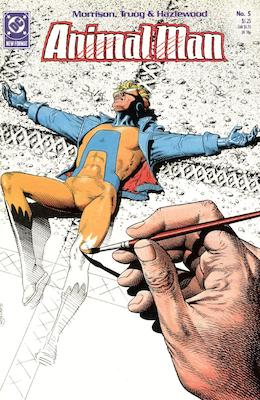
“The Coyote Gospel”, Winter 1988
Credits:
Grant Morrison [writer]
Chas Truog [artist]
Doug Hazlewood [artist]
John Costanza [letterer]
Tatjana Wood [colorist]
Art Young [assistant editor]
Karen Berger [editor]
Brian Bolland [cover (uncredited)]
Background:
Grant Morrison’s article at the end of issue #2 offers the following preview of the series from this point: “From #5 onward I hope I can try some more interesting and experimental stuff, all of which is going to lead up to a major reworking of Animal Man’s origin and abilities and an assault on the fundamental reality of the DC Universe.” Steven Zani[1] points out that Morrison refers to this as a “teaser” to promote future sales. In what is soon to be a very self-referential comic book title, Morrison is even revealing the motivations behind the editorial content.
At the end of #4, assistant editor Art Young summarises the plot and themes of issue #5 as the following: “Buddy stumbles upon a bizarre drama in the middle of the desert, in a unique tale that looks at the relationship between theology and violence”.
Front Matter:
Cover:
The cover shows Animal Man with arms outstretched, looking as though he has been crucified on a cross represented by tyre tracks. A hand in the foreground is in the process of colouring (and presumably inking) the image. The cover references the final page of the issue.
Inside Cover:
The ‘DC Checklist This Week’ section includes the following description of Animal Man #5: “Animal Man has his weirdest confrontation yet, as he stumbles upon a bizarre drama in the middle of the desert.”
Story:
Page 1, panel 2
Carrie, the 1976 film directed by Brian De Palma, is an adaption of the Stephen King story about a bullied high schooler with telekinetic powers.
Job Number: G-4013.
Page 1, panel 6
The man references Santa Monica Boulevard, implying that Carrie will prostitute herself on the streets of West Hollywood, though the strip may have been better known for male prostitution at the time.
Page 1, panel 8
“Dante’s goddamn Inferno” is a reference to the 14th century epic poem Divine Comedy by Dante Alighieri. The first part, titled ‘Inferno’, concerns a fictionalised version of Dante travelling through Hell.
Page 2
Carrie and the trucker are singing ‘Roadrunner’ by the Modern Lovers, released in 1976.
Page 3, panel 3
The Ajax Trucking Co. is fictional, but the Ajax brand comes up again in the story. The name Ajax may derive from the hero of Greek mythology.
Page 3, panel 4
This image is similar to page 1:1 except that the truck is driving on the opposite side of the road and moving away rather than toward the reader.
Page 4
In an article for Sequart titled ‘The Foucault Gospel: Grant Morrison, French Philosophy, and One Mangy Coyote’[2], Greg Carpenter draws attention to the many juxtaposing ideas presented throughout this issue. Carpenter is attempting to demonstrate one of the ideas of French philosopher Michel Foucault who argued that meaning is subjective and the way that anyone comes to understand anything is through observing the relationship between binaries, or opposites. The proliferation of these binaries within Animal Man #5 makes its overall meaning difficult to grasp, and this can be observed particularly in the competing representations of the coyote character as demon and angel. In regards to this page, Carpenter believes that the imagery evokes William Butler Yeats’s 1919 poem ‘The Second Coming’, which would equate the coyote with an antichrist figure, though the reference to the “miracle of the resurrection” is associated with the story of Jesus Christ.
Page 5
This is the title page. The job number G-4013 appears again. A gospel refers to both a Christian message, but also to each of the four written books of the New Testament of the Bible. The sun forms a halo behind the head of the coyote.
Page 6, panels 1-2
The TV depicts a “televangelist”, or television preacher, asking their followers for money. A connection is made here between the televangelist and Buddy’s extreme (or “radical”) behaviour in the kitchen. In the following pages, Buddy (a recent and overzealous convert to vegetarianism) demonises his family for being consumers of meat.[3]
Pages 7-8
Buddy wears a t-shirt with a paw print logo. A reader’s letter in the back of Animal Man #8 refers to this as a “Badger t-shirt”. The logo is similar to that of the superhero Badger, who appeared in The Badger series published throughout the 1980s initially by Capital Comics (the first four issues) and then First Comics. Though the logo isn’t an exact match, Badger could communicate with animals and would often go to their defence, so it would make sense that Buddy was a fan. Chaz Truog also illustrated one of the Capital Comics issues.
Carpenter notes the reversal of traditional gender roles between Ellen and Buddy on these pages, with Ellen in a business suit returning from work while Buddy wears casual clothes and is organising groceries.[4]
On the family’s vegetarian diet: in the introduction to the Animal Man trade paperback, Morrison mentions that they ate their “last ever steak” shortly after beginning work on Animal Man (which could mean soon after writing began but before the first issue was published). Morrison’s book Supergods[5] suggests that they became vegetarian after watching The Animals Film (1981, dir: Victor Schonfeld and Myriam Alaux). Buddy’s conversion to vegetarianism is chiefly a result of the suffering he witnessed (and felt, when absorbing powers from a sick dog) in the previous issues.
Page 10, panel 1
Billy was the trucker’s friend (and possibly partner) mentioned on page 1. The sign in the foreground shows that the man’s jeep is parked near a crossroads.
Page 10, panel 6
The paper tells us (and the trucker) that Carrie did resort to prostitution before her death.
Another headline reads “Scientist Missing”, which may be a reference to the disappearance of Dr. Myers. Usually B’wana Beast’s chimeras separate after a time, though this might not occur if the chimera was killed, and the Djuba/Myers creature may certainly have been killed and buried or cremated.
Another headline mentions a UFO. The DC Universe at the time was in a middle of an alien invasion (as seen in the Invasion! miniseries), which impacted many titles including Animal Man.
Page 12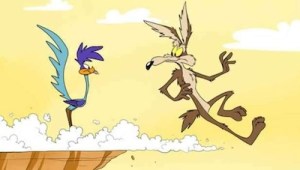 The coyote is a version of the Looney Tunes character Wile E. Coyote, an anthropomorphic coyote who is forever trying to catch and eat the Road Runner character. Looney Tunes was a series of cartoons produced by Warner Bros. Panel 2 mentions that the coyote’s “feet pedal empty air”, which references a running gag in the Road Runner/Coyote cartoons where Wile E. would accidentally run off a cliff but would not fall until he realised he was suspended in the air. The puff of dust (in panel 5) was also commonly seen when Wile E. would hit the ground after falling from a great height.
The trucker in this issue is taking on the hunter role traditionally occupied by Wile E. Coyote, even employing some of the same weapons that Wile E. would use against its prey, the Road Runner.
Note that the coyote here is an anthropomorphic caricature of an animal, appearing as something that is neither human nor animal to the characters in Animal Man, who are drawn with relatively realistic proportions. It’s unlikely that all coyotes would be drawn like this in the series.
Page 13
In the Road Runner cartoons, it was also common for the coyote to be crushed by a boulder, often after trying to kill the Road Runner by the same method.
Page 15
From Buddy’s aerial vantage point, we can see the crossroads. The coyote’s death by dynamite (usually represented by a bundle of red dynamite sticks, as depicted on page 10) was also common in the cartoons.
Page 16, panel 5
In Dante’s Divine Comedy, Purgatory a place between Heaven and Hell (the aforementioned Inferno). In Catholic doctrine, it is a place that spirits arrive in soon after death. Carpenter[6] points out that the smoke around the coyote resembles a halo and/or wings, giving the coyote an angelic quality while the text simultaneously refers to it as a devil.
On this page, as in the Road Runner cartoons, the hunter has been gravely injured by his own traps.
Page 17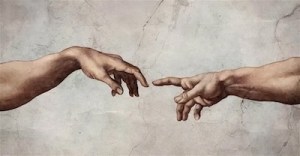
The coyote’s name is revealed to be Crafty, a synonym for wiley, from which the name Wile E. is derived.
In panel 6, Buddy and Crafty’s fingers nearly touch and the image closely resembles a detail [pictured] from Michelangelo’s ‘The Creation of Adam’ fresco which appears on the ceiling of the Sistene Chapel. Michelangelo’s painting depicts God (the hand on the right) passing the spark of life to Adam, the first man.
Page 18, panel 1
Crafty’s cartoon world is full of visual gags. In the first panel, the object on top of the world may be a red-and-white striped pole covered in snow, representing the North Pole. Note that the Earth has latitude and longitude lines, and the moon has a face. The milk bottles represent the Milky Way.
The DC Universe had at least one world of anthropomorphic cartoon animals, and this was designated as Earth-C before the Crisis. The superheroes of that world were known as the Zoo Crew. When the Multiverse was re-established, Crafty is shown in the world inhabited by the Zoo Crew (now designated as Earth-26). See Justice League Incarnate #3, Mar. 2022.
Page 18, panel 2
The cloud of dust with stars and fists protruding from it represents a brawl in cartoon iconography. The red vehicle may be a steamroller with the imprint of an anthropomorphic rabbit or another animal. Another creature has walked into a lamp post and bent it. A dog (with a bear trap on its tail) chases a cat, who chases a mouse that vaguely resembles Disney’s Mickey Mouse. A pig with a bowtie (again with a stick of dynamite) is reminiscent of the Looney Tunes character Porky Pig.
Page 18, panel 4
Ajax appears on many products in this world. In Looney Tunes cartoons, and particularly in the Road Runner series, the ubiquitous brand is Acme. In the 1999 autobiography of Chuck Jones, the creator of Road Runner and Wile E. Coyote, Chuck outlines a number of rules that must be followed in Road Runner episodes, which includes “Rule 7: All materials, tools, weapons, or mechanical conveniences must be obtained from the Acme corporation.”[7]
Page 18, panels 5-6
The Road Runner (not shown clearly, but represented by the spinning circle of motion) speeds past the coyote, causing the coyote to spin in place. Attack by cannon and death by cannonball was also exceedingly common in Looney Tunes cartoons.
Page 19, panel 3
The word ‘wept’ is emphasised. The phrase “Jesus wept” is a well-known phrase in the King James Bible, known for being the shortest verse. It relates to a story where Jesus meets the grieving family of his follower Lazarus, who has recently died.
Page 19, panel 4
In the New Testament, Jesus also travels into the desert and fasts for 40 days and nights. On this page, Crafty ascends to heaven in an elevator.
Page 19, panel 7
The God (stylised as GOD) in this comic is wearing modern clothes and a wrist watch, and has a paintbrush. It obviously refers to Crafty’s creator who, in a cartoon world, would be a cartoonist. (A letter at the end of Animal Man #8 suggests that this may be Chuck Jones, and the gingham pants – popular in the 1960s and 70s – would support this theory). The red river next to Crafty may be red paint but it also resembles blood. The creator’s chair is decorated with anthropomorphic animal characters, including one that resembles Looney Tunes’ Bugs Bunny. GOD wants to punish Crafty, presumably for questioning the creator’s plan of having his creations endlessly fight. Wallin thinks it notable that the GOD is a white human, and that the issue “articulates how we culturally legitimate violence against animals while imagining ourselves above and outside the consequence of such cruelty.”[8]
Some writers[9][10] have noted the apparent influence of Chuck Jones’ short animated film Duck Amuck (1953) on this issue. In that film, which is part of the Looney Tunes-related Merrie Melodies series, Daffy Duck confronts his animator. A paintbrush frequently intervenes to animate the world around Daffy and puts him in frustrating situations. At the end of that episode, it’s revealed that Bugs Bunny (not Chuck Jones) is the animator.
Page 20, panel 1
Crafty offers himself as a sacrifice for peace on his world, which again equates him with Jesus.
Page 20, panel 2
The reality that Animal Man resides in is described as a “hell above” the cartoon-world’s heaven.
Page 20, panel 7
The words “Flesh” and “Blood” are emphasised. Jesus asked his follows to eat his flesh and drink his blood (metaphorically) in the Bible.
This panel is a reference back to page 2:6-7 from an alternative angle.
Page 21
In this world too, Crafty seems to be immortal, but his recurrent destruction is painful and gruesome. Wallin[11] draws a parallel between the image of Crafty in panel 2 and the Greek Titan Prometheus, who stole fire from the gods and gave it to humanity in the form of civilisation. Prometheus’ punishment was to be bound to a rock and have his liver eaten by an eagle every day for eternity.
As a Jesus analogue, understands that his suffering is benefiting others but, unlike Jesus, he hopes to return to his heaven and overthrow the creator. This puts Crafty in both the role of Jesus and of Lucifer.
Buddy opened the scroll on page 17, and Crafty’s story commenced over the next few pages. The tragic twist is that Buddy was not understanding Crafty’s tale at the same time as the reader of the comic. While Crafty has a system of written language, he is unable to communicate his “gospel” (in both senses – his message, and the written form of his message) to Animal Man, though we (the readers) have understood his story. On this, Wallin writes: “The Western mytheme of sacrifice and salvation is herein deferred in the Coyote Gospel, where the sacrifice of ‘Crafty’ coyote occurs without salvation, intimating both the interminable state of violence against animals, but so too the ways in which the salvation mytheme is withheld from nonhumans, who are condemned to repeat the event of animal sacrifice upon which the emergence of culture is founded.”[12]
Page 22
To create the silver bullet, the trucker has melted down the Christian cross necklace shown in page 1:9. The mention of the inscription resembling “meaningless hieroglyphics” as it is being melted down is a reference back to Crafty’s gospel in the eyes of Buddy. In many folkloric tales, silver bullets can be used to kill supernatural creatures, particularly werewolves, which is why the man might be trying that method to rid the world of what he sees as the Devil and a bringer of misfortune.
Page 23
Unlike in the Road Runner cartoons, the reader is made to feel sympathy for the tragic coyote character, as we felt sympathy for the non-human characters in the first story arc. Though we may also feel some sympathy for the truck driver, who was misguided towards violence by his grief.
In a sense, the trucker did “save the world” by killing Crafty. As explained in the essay Ecce Animot[13], the presence of Crafty (who comes from a place with different physical laws) in the world of Buddy causes a shift in the fundamental reality of that universe, in the same way that Buddy appearing in our world would alter our understanding of our universe. The trucker has erased the anomalous presence, which he had identified as evil.
Page 24
Like the front cover, Crafty is lying with arms outstretched, looking at though he is crucified on a cross made by the crossed roads. A hand in the foreground is still colouring the image: panel 3 shows Crafty’s blood as without colour (white). The hand represents the creator. If the hand literally represented the colourist of Animal Man, it would be the hand of Tatjana Wood.
In the Looney Tunes cartoons (and presumably in Crafty’s world), the animals endure violence but do not bleed. In the DC Universe, Crafty “bleeds” and suffers temporary disfigurement, though this panel reminds us that even this blood is only a representation of blood using red ink. Morrison is drawing attention to the layers of reality between Crafty’s world, Buddy’s world, and our reality.
On his Comic Art Fans account, Doug Hazlewood uploads an original copy of this page, and comments on the visual relationship between Crafty and Wile E. Coyote:
They kept having me change the ears, etc. to make him look less like Wile E. I told them Warners [Warner Bros.] owns DC… you’re gonna fiddle with him so much it will dampen the effect.[14]
The final panel shows “The End, Folks!”. This is a play on the phrase “That’s All Folks!” uttered at the end of many Looney Tunes cartoons by Porky Pig.
Back Matter:
Letters:
The letters section remains unnamed. The readers’ letters are in response to issue #2. A couple of the letters suggest that Buddy would fit in with the JLI (Justice League International), with who he will soon be involved. A few readers tried to guess what animal abilities Buddy would draw upon to regenerate an arm in issue #3 but none guessed the earthworm. Art Young promises that Animal Man’s origin story will be told within the first year of the series.
References:
[1] Zani, Steven. “It’s a Jungle in Here: Animal Man, Continuity Issues, and the Authorial Death Drive.” The Contemporary Comic Book Superhero, edited by Angela Ndalianis, Routledge, 2008, p. 237.
[2] Carpenter, Greg. “The Foucault Gospel: Grant Morrison, French Philosophy, and One Mangy Coyote.” Sequart, 10 Feb. 2014, http://sequart.org/magazine/39828/the-foucault-gospel-grant-morrison-french-philosophy-and-one-mangy-coyote/.
[3] dos Santos Rodrigues, Márcio, and Matheus da Cruz e Zica. “Dilemmas of Animal Rights in the Animal Man Comic Book Series.” Superheroes and Critical Animal Studies: The Heroic Beasts of Total Liberation, edited by J.L. Schatz and Sean Parson, Lexington, 2018, p. 78.
[4] Carpenter 2014.
[5] Morrison, Grant. Supergods: What Masked Vigilantes, Miraculous Mutants, and a Sun God From Smallville Can Teach Us About Being Human. Spiegel & Grau, 2011, p. 217.
[6] Carpenter 2014.
[7] Jones, Chuck. Chuck Amuck: The Life and Times of an Animated Cartoonist. Farrar Straus Giroux, 1989, p. 225.
[8] Wallin, Jason. “Evolve or Die! Enmeshment and Extinction in DC’s Animal Man.” Closure: Kieler e-Journal Für Comicforschung, no. 7, 2020, pp. 25-26. https://www.closure.uni-kiel.de/closure7/wallin
[9] Jordan, Gil. “Animal Man.” Amazing Heroes, no. 157, 15 Jan. 1989, p. 22.
[10] Singer, Marc. Grant Morrison: Combining the Worlds of Contemporary Comics. University Press of Mississippi, 2012, p. 55.
[11] Wallin 2020, p. 27.
[12] Ibid., p. 28.
[13] Mahmutovic, Adnan, et al. “Ecce Animot: Or, The Animal Man That Therefore I Am.” ImageTexT: Interdisciplinary Comics Studies, vol. 8, no. 2, https://imagetextjournal.com/ecce-animot-or-the-animal-man-that-therefore-i-am/.
[14] https://www.comicartfans.com/gallerypiece.asp?Piece=1482681
 Wild Planet