Animal Man #4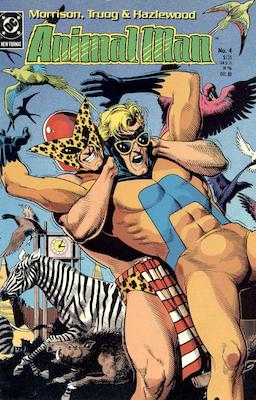
“When We All Lived in the Forest”, December 1988
Credits:
Grant Morrison [writer]
Chas Truog [artist]
Doug Hazlewood [artist]
John Costanza [letterer]
Tatjana Wood [colorist]
Art Young [assistant editor]
Karen Berger [editor]
Brian Bolland [cover (uncredited)]
Front Matter:
Cover:
The cover shows Animal Man succumbing to a wrestling hold known as a full nelson.
Inside Cover:
The ‘DC Checklist This Week’ section includes the following description of Animal Man #4: “The ultimate showdown between Animal Man and B’Wana Beast at the San Diego Zoo!”
Story:
Page 1
Buddy is reading While The Wild Things Are by Maurice Sendak, a picture book that Maxine had in the first issue (page 18).
Job Number: G-3777. This number has been incorporated into a picture of a tiger that Maxine has drawn. It’s the same job number as appears in issue #3. In the foreground of panel 3 is a teddy bear with a heart embroidery, similar to what you might find on a Care Bear, so this may be a Rainbow Bears toy.
Page 2, panels 1-2
Pages 2-20 show a flashback to what happened earlier that day, directly after the events of issue #3.
Page 2, panel 3
Both Animal Man and B’wana Beast were on the Monitor’s satellite. Animal Man’s presence was mentioned by Harbinger in History of the DC Universe #2 (1986), while B’wana Beast can be glimpsed in a couple of panels within Crisis on Infinite Earths #5 (Aug. 1985).
Page 2, panels 4-5
Buddy mentions a publication named Rovin’s Fifth International “Who’s Who” of superheroes. DC Comics did publish a series titled Who’s Who: The Definitive Directory of the DC Universe between 1985-1987. B’wana Beast’s entry appears in issue #3 (May 1985) of the real series. The entry does mention his ability to telepathically control and fuse animals, though it doesn’t mention “The White God” being a nickname. Rovin refers to Jeff Rovin, an editor at DC who compiled The Encyclopedia of Superheroes for the publisher Facts on File in 1985.
B’wana Beast’s photo in the publication that Buddy is reading is dated 1978, though I’m not aware of the character appearing in any comics around this time.
 Page 2, panel 6
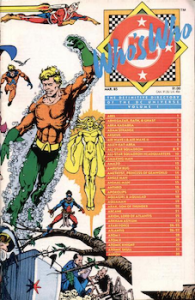
Animal Man’s Who’s Who entry appears in issue #1 (Mar. 1985) [pictured]. It doesn’t use the phrase “presumed retired” but it does say he was retired at one stage, and refers to some of the Forgotten Heroes as semi-retired.
Page 3, panel 1
Balboa Park is a large park in San Diego that contains the Zoo and several museums.
Page 3, panel 4
“Hill Street” refers to the police procedural TV series Hill Street Blues, which ran from 1981-1987.
Page 4
This is the title page.
Page 5, panel 1
The red swelling mark on the back of B’wana Beast’s hand is clearly visible.
Page 7, panel 3
Ellen may consider Violet Weidemeir a cat expert because she has several of her own (though one fewer after the murder of Sheba in the previous issue).
Page 8
The creature Buddy fights is a beaked and winged wolf, similar to a griffin except that it does not include any features of a lion.
The sections of the San Diego Zoo were once referred to as mesas and canyons, and one of the oldest areas was known as the Bird and Primate Mesa.
Pages 10-11
What Buddy sees is not a monorail (which is a train that runs on a single rail) but is an aerial tramway. The aerial tram at San Diego Zoo was built in 1969 and is known as the Skyfari.
Page 12
The glow from B’wana Beast’s hand indicates that he is preparing to using his chimera powers on an elephant.
Page 13, panel 3
B’wana Beast is sweating and struggling to speak.
Page 18, panel 3
A macrophage is a type of white blood cell that can remove microbes from the body that are capable of causing diseases. Polymorphs are also white blood cells that fight infection.
Page 18, panel 6
By not surrendering B’wana Beast to the authorities “like a good superhero”, Buddy believes he is making different decisions about justice than some of his peers.
Page 19
B’wana Beast’s abilities (now being used by Animal Man) allow him to separate merged animals safely.
Page 20
Regarding Myer’s description of Buddy as a “penny-ante superhero”: a penny ante is a card game played for very low stakes, so his suggestion is that the superhero work performed by Buddy is inconsequential.
Page 21, panel 2
The comment about Myer’s ability to torture and maim animals without consequence is fairly accurate as experimentation on live animals under the guise of science is usually legal, though often overseen by an ethics committee.
Page 21, panels 3-4
The myth of Pandora’s box originates from Hesiod’s c. 700 B.C. poem Works and Days. In that telling, the gods create Pandora to punish humanity, presenting her as a gift to Epimetheus, the brother of Prometheus. Pandora then opens a jar that releases evils into the world. Only “hope” remains in the jar, though the meaning of that detail has been the subject of debate.
Page 24
The Djuba-Myers hybrid’s pleas of “Murrs” and “Ma Urrs” is its attempt to tell the surgeons that it retains the consciousness of Dr. Myers.
In Storyworld/Umwelt: Nonhuman Experiences in Graphic Narratives[1], David Herman uses pages 23-24 to illustrate the difference between their definitions of anthropomorphism and zoomorphism, which the author places on a spectrum of strategies for representing non-human experiences in comics. Both strategies attempt to represent animal experiences with reference to human motivations, but anthropomorphism represents non-human animals as human-like (by giving them human speech, for example), while zoomorphism ascribes animal attributes to humans. As Herman explains: “If anthropomorphism involves familiarizing the nonhuman, zoomorphism involves defamiliarizing the human”. As examples of this “defamiliarization”, the Djuba-Myers creature is contrasted with the picture of human Myers and his family on page 24:2. Djuba-Myers also loses its capacity for human speech in this sequence. Generally speaking, whenever Buddy uses his powers and then makes choices based on his new animal abilities, it’s an example of zoomorphic representation.
Back Matter:
Letters:
This is the first letters column of the series so far, and assistant editor Art Young is the correspondent. The introduction to the section mentions a competition to name the letters column in future issues. Many of the letters are in response to Animal Man #1 and all have correctly guessed that B’wana Beast is the true identity of the mysterious antagonist. B’wana Beast was a fairly obscure hero, but had appeared in the popular Swamp Thing series within the previous year.
A couple of readers praise the depiction of Buddy as a regular guy with a realistic family. Art mentions that Morrison “specifically requested that Buddy not be drawn with exaggerated muscular proportions […] to emphasise his normality”. The first letter expresses hope that the family isn’t ultimately abused, while the final letter says “Ellen Baker […] is what Sue Dibny and Iris West could have been if they had been allowed to thrive or survive in the DC Universe.” Iris West was the wife of Barry Allen (The Flash) but was killed in The Flash #275 (July 1979). Sue Dibny was the wife of the Elongated Man at the time, and I don’t know what the writer is referring to in the letter, though it’s notable that, years later, she is remembered for her controversial death in Identity Crisis #1 (June 2004). The trope of having female characters abused, maimed or killed was later called out by Gail Simone in 1999 (several years prior to the death of Sue Dibny) on her website Women In Refrigerators. The name of the website is itself a reference to the gruesome murder of Green Lantern Kyle Rayner’s girlfriend Alexandra DeWitt in Green Lantern #54, Aug. 1994. Unfortunately, Buddy Baker’s family will not be safe from this disturbing trend.
In this section, Art Young also mentions that the Bakers are vegetarians. It is true that we only see Ellen prepare vegetables and an egg in Animal Man #1, but Art may be getting ahead of himself as Buddy’s insistence that his family reject meat is coming in the next issue…
References:
[1] Herman, David. “Storyworld/Umwelt: Nonhuman Experiences in Graphic Narratives.” SubStance, vol. 40, no. 1, 2011, pp. 156–81. JSTOR, http://www.jstor.org/stable/41300193. Accessed 10 Apr. 2024.
 Wild Planet