Animal Man #26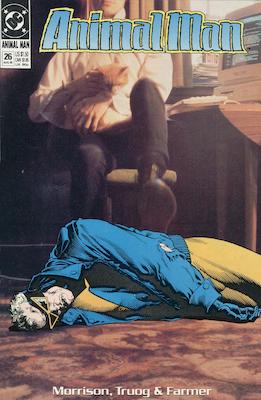
“Deus Ex Machina”, August 1990
Credits:
Grant Morrison [writer]
Chas Truog [artist]
Mark Farmer [artist]
John Costanza [letterer]
Tatjana Wood [colorist]
Art Young [associate editor]
Karen Berger [editor]
Brian Bolland [cover (uncredited)]
Background:
When we last left Buddy, he had finally come to face to face with his creator, Grant Morrison – a meeting that had been building for some time and had been foreshadowed in Animal Man #5 when Crafty confronted his cartoonist. As Morrison explains:
“I tried to make it almost impossible for someone else to do the book because I wanted to give the next writer a hard time. The whole thing was planned from issue #5, which was when I decided to do that stuff. It sounds mildly pretentious, but I wanted to do a post-modern comic. American novelists were introducing the idea of the author as part of the work. I wanted to do a comic that reflected that. I also had a heritage in comics to follow, because we used to have stories where the Flash would meet up with Cary Bates and Julie Schwartz. I wanted to apply some contemporary techniques to it.”[1]
Front Matter:
Cover:
The cover shows a photo of Grant Morrison with their foot raised above an illustrated Buddy lying on the floor of Morrison’s home. The room, including the Collins Dictionary-Thesaurus on the windowsill, was previously depicted at the beginning of Animal Man #19. The writing on the computer screen is too blurry to be read but it may be a comic script. Morrison is holding a cat that, in Supergods, Morrison identifies as their pet Vinegar Tom.[2]
Inside Cover:
Instead of a ‘DC Checklist This Week’, the inside cover displays an editorial by Art Young. In it, Art explains that this will be Morrison’s final issue but that the series will be continuing with a new writer, while Morrison will continue to be involved in Doom Patrol. Instead of signing off as “I’m outta here”, as Art usually does at the end of the ‘Animal Writes’ section, Art ends with “I’m … here”. From the next issue, Art will be the sole editor of Animal Man when Karen Berger leaves the title.
Story:
Page 1
Here we again see Morrison’s office, as previously depicted in Animal Man #19.
Page 2
This is the title page. The phrase Deus Ex Machina was coined in Ancient Greece from Latin words that translate to “god from the machine”. Originally, it referred to the practice of bringing gods (rather, actors playing gods) onto the theatre stage using some sort of mechanical apparatus (such as a crane) in order to conclude the narrative of the play. In modern usage, it refers to a plot device where a narrative is abruptly resolved by an unlikely occurrence. The title of this issue could be making reference to a few things, including Morrison being a god-like figure that has been constructed using a machine (the script is typed into a computer) to abruptly conclude their own story.
Callahan notes the contrast between Buddy’s colouring and the muted colours of Morrison’s world, which highlights that Buddy is a visitor from a different plane of reality.[3] Thoss goes into further detail, placing the three levels of reality in Animal Man on a spectrum of more-real to more-fictional (from Morrison’s world, to Buddy’s, to Crafty’s) and notes that “the reality-pole of the spectrum is marked by a dominance of hatching lines and subdued coloration, while the fiction-pole is marked by a dominance of line drawing, plane surfaces, and a more intense coloration.”[4] Unusually, the Glasgow that Buddy travels through at the end of Animal Man #25, and even Morrison when they answer the door, are rendered in vibrant colours. Perhaps this was not to spoil the surprise at the end of that issue.
On Morrison’s depiction of themselves in this comic:
“I’m aware of how easy it is to create a public persona […] So that was the whole thing with the black coat and the white shirt and the pale face. It was just this Satanic, Byronic figure I was trying to get across, and people have come to believe that’s me.”[5]
Sandifer notes the influence of Jorge Luis Borges on Morrison, and particularly his work ‘Borges and I’ (1960) in this context.[6] In that short story, Borges contemplates the famous version of himself that will outlive him. For example, he expresses that “I like hourglasses, maps, eighteenth-century typography, the taste of coffee and the prose of Stevenson; he shares these preferences, but in a vain way that turns them into the attributes of an actor.” Morrison also acknowledges the direct influence of Borges on their work in numerous interviews.[7]
Job Number: G-5654 appears within the indicia.
Page 3, panels 1-2
It’s true that Morrison did not create Buddy or the yellow aliens as they first appeared in Strange Adventures #180 and #195 respectively, so were created by Dave Wood, Carmine Infantino and Gil Kane.
Morrison refers to themselves as Demiurgic, from the Greek word originally referring to a craftsman. In Plato’s Timaeus, he refers to a Demiurge as a manipulator of the physical universe.
Page 3, panel 3
Morrison describes their role as a revisionist writer, spoiling the rosy worlds of superheroes created during the Golden and Silver Ages.
Page 3, panel 5
Notice that Morrison explains that they “write the wrongs of the world” (literally manifesting the conflict in Buddy’s world) rather than “righting the wrongs”.
Morrison begins to bring up Foxy, who they mentioned in Animal Man #10.
Page 5, panel 2
There is an Arkham Asylum… poster behind Buddy.
Page 6, panel 2
Buddy can’t enter Morrison’s world but Morrison can become a cartoon. How Morrison came to be able to interact with Buddy is explained in their book Supergods. Morrison mentions wanting to push the concept of “realism” beyond the current trend of showing superheroes as realistically flawed humans with superhuman abilities. Instead Morrison thought of superheroes and their world of existing in our “reality”, but only on the printed page. Morrison thus inserts themselves into the world of superheroes by creating (with Truog) a 2D, illustrated avatar and having this avatar interact with Buddy.[8]
Page 6, panels 3-6
Morrison’s approach differs from the earlier meetings between characters and their creators in DC Comics stories. As Callahan notes:
“Gardner Fox, the comic-book writer, played a role in the “Flash of Two Worlds” storyline. Yet, at the end of that storyline, the Golden Age Flash didn’t think of himself as a fictional character, he just thought of Gardner Fox as the chronicler of his true adventures”.[9]
The issue Buddy holds is Animal Man #19, which did have an advertisement for the 1989 Batman film on the back cover.
In the background of panel 5 is a print of Whaam!, the 1963 painting by pop artist Roy Lichtenstein, adapted (like a few other of Lichtenstein’s artworks) from a panel in All-American Men of War #89 (Feb. 1962).
Page 7, panels 1-2
Buddy is reading the final pages of Animal Man #19.
Page 7, panels 5-6
Morrison’s cats Jarmara and Vinegar Tom are named after familiars of an accused witch in Manningtree 1644, according to an account by Witchfinder General Matthew Hopkins, though these beings took the forms of a spaniel and greyhound rather than cats. Jarmara the cat was glimpsed at the very beginning of Animal Man #8.
Morrison asks “who do I complain to?”, forcing us again to think about our place in a hierarchy of realities.
Page 8, panels 2-3
This comic panel in the foreground, featuring Rebis and Crazy Jane, seems like it was taken from an actual Doom Patrol issue but I haven’t been able to identify it.
Page 8, panel 5
Buddy was underutilised by the writers of Justice League Europe (Keith Giffen and J.M. DeMatteis) but that may have been because his powers were not particularly useful compared with those of this team members.
Page 9
Buddy and Grant are walking along the Forth and Clyde Canal in Glasgow – an area we last saw in Animal Man #14.
Morrison points out some of the features of graphic storytelling in comics books, such as the time that is lost in the gutters between the panels, and the economic requirement for the narrative to fit within 24 pages. Highwater began noticing similar features about his reality earlier in the series. In Comics Journal #176, Morrison explains:
“… what I wanted to do was point out some things that maybe you don’t notice about how we exist ourselves, about how we go through programmed behavior patterns and to see it taken down a level, where I’m saying something to Animal Man about things which we accept as fundamental givens of reality which may [from] the outside not appear that way […] It was taking the world of comics as a functionality cosmology, and pointing out some of the mechanics of it, to someone existing within that cosmology, who wouldn’t otherwise have noticed the mechanics.”[10]
They continue:
“… there was also a thing I pointed out, which is that Animal Man will be around when I’m dead. Their world functions within its own parameters, and it has its own rules. And I wanted to actually get in there, and see what it was like to be in that, as a functioning universe. […] And their world is real, you know, it does exist, it can be experienced, despite all the efforts of DC to pretend that 30 years of continuity haven’t happened.”
This point is made by Highwater in Animal Man #24 when he asserts that the characters will never die as long as they continue to exist on the printed page and in the memories of the readers.
Page 11, panels 1-4
There are some odd things going on in the background here, presumably written into the script as something interesting for Truog and Farmer to illustrate.
Page 11. panel 5
As has previously been pointed out, Buddy was often an observer in his own series, passively listening to the stories of Crafty, Rokara, and the Red Mask before witnessing their deaths.
In the background is the Cheshire Cat from Alice’s Adventures in Wonderland.
Page 12, panel 1
Buddy and Grant are passing the Gasometers that we saw in issue #14. The new writer that Morrison mentions will be Peter Milligan.
 Page 12, panel 3-5
They are again at the Lock 27 pub, which is located near the Gasometers in Glasgow. [pictured in 2016]
Buddy was never a vegetarian until Morrison began to write him, though Buddy may have also influenced Morrison’s diet. See the annotations for Animal Man #5, pages 7-8. Morrison mentions that someone else will soon be writing Buddy’s life, and that “they might do the obvious and go for shock by turning you into a meat-eater”. In the first Peter Milligan issue, Buddy kills a horse by biting into its neck.
Page 13, panel 1
“The Lord giveth and the Lord taketh away” is from the Book of Job. God tests Job’s faith by allowing Satan to take away Job’s wealth and kill his children, but Job still praises God. Morrison is more like Satan, disrupting Buddy’s life for the benefit of the readers, and Morrison looks at the reader while speaking this quote.
Page 13, panels 2-3
Morrison wanted to change the world with their writing, but is also concerned about coming off “preachy”. There also seems to be a conflict between expressing an admiration for the old fashioned and playful characters and deriding modern “serious” takes on old characters, while simultaneously trying to make a serious statement using one such character.
I don’t feel that there were too many “animal abuse of the month” issues in the serious. Moral questions around vivisection, fox hunting, and whale slaughter were raised, but anthropocentric social issues and metatextual themes were explored in equal measure.
Page 13, panel 4
“Might makes right” is an aphorism that suggests that those in power (in this case, humans in relationship to other animals) get to decide what is morally right.
Page 13, panel 6
Morrison seems to be being sarcastic when they say they can’t help Buddy because it wouldn’t be “realistic”, passively expressing frustration at the constraints of the comic book writer in the Modern Age.
Page 14, panel 4
A reader in the letters pages of Animal Man #13 suggested some villains for Buddy to fight (perhaps unironically).
Page 15, panels 1-4
The Shark is an existing character, first appearing in Green Lantern #24 (Oct. 1963) as a shark mutated by radiation into an amphibious monster with telepathic abilities. He made several more appearances, mostly as an enemy of Hal Jordan. Slaughterhouse, however, is a character introduced here for the first time.
Page 15, panel 5
Morrison has taken away Buddy’s powers and has forced him to physically fight to settle a “moral argument” – reiterating the “might makes right” point that was made earlier, with Buddy representing the powerless animals on the receiving end of violence. In Ecce Animot, Mahmutovic notes that Buddy has been powerless through the whole series to an extent, because his words and thoughts are not his own.[11]
Page 16, panel 3
Morrison seems to confirm that there wasn’t much dialogue between the writer and the artists, as was also mentioned by Truog.[12] Several other interviews with Morrison suggest that sending scripts to artists without any additional communication was their usual way of working.
Page 17, panel 2
Morrison gives thanks to several contributors to ‘Animal Writes’: Charles Sperling (whose letters were published in issues 10, 12, 14-16, 18-20, 22), Charlie Harris (issues 5, 7-8, 10, 12, 16-17, 23), Malcolm Bourne (issues 10, 14, 16-17, 21-24) and Mark Lucas (issues 5, 7-8, 11-12, 14, 18, 20-23, 26).
Page 19, panel 4
“Forget we ever met”: time will tell whether this meeting with Morrison becomes part of Buddy’s memories and future continuity. Morrison fades away to pencil outlines, as other characters have done in this series.
Page 20, panel 5
Buddy is surprised to see that T.C. has come back to life.
Page 22
Despite saying they weren’t going to bring the Bakers back to life, Morrison did, fulfilling the earlier criticism that nothing ever changes; that “it all just comes back, good as new”. David Fiore notes that Morrison has done for Buddy what Prospero asks his audience for at the end of The Tempest (quoted in the annotations for Animal Man #25, page 1), which is to be freed from the constraints of the story.[13]
Page 23, panels 1-2
Morrison’s story about Foxy was previously told in Animal Man #10. They use the word “flashlight” in the story originally, but Morrison corrects themselves here and uses the British terminology “torch”. Angus Oval is on a hill and would have been the site of Cardonald Primary School while Morrison was a child.
Page 24
Zani suggests that the Foxy scene (particularly Foxy’s response) illuminates a purpose of the series, which is to “reveal the loose threads and forgotten products of our imagination”, in opposition to the Crisis series that is an attempt to rewrite memories and introduce forgetfulness.[14]
Morrison admits:
“I actually did what I do at the end of Animal Man. I believed as a child that the fox lived out in the hills, and I would go out there and signal to it. And I actually went back and did this. And, as happened in the strip, got no reply at all.”[15]
Back Matter:
Letters:
The letters are mostly written in response to Animal Man #22. Some readers mention going back and re-reading issue #14 after the events of #22. The writer of the seventh letter correctly guesses that Buddy will directly appeal to Grant Morrison. In one response, Art Young promotes the work of Peter Milligan.
Animal Man #27 Preview:
There is a six-page preview of Animal Man #27, presenting pages 1-3, 12, 14, and 17 from that issue.
Inside Back Cover:
The inside back cover shows a black and white but inked image of the cover of Animal Man #27 by Brian Bolland.
Back Cover:
The back cover displays another illustration by Bolland of Buddy looking on disapprovingly as a boy prepares to bite into a hamburger.
Afterword:
Further letters:
Fans would continue to write into the ‘Animal Writes’ letters column about the Grant Morrison issues.
The letters in Animal Man #27 were mostly in reference to issue #23. A couple of readers questioned the morality of Buddy’s murderous revenge, and asked what might be the psychological consequences for Buddy even if he were able to reverse his actions through time travel. Another reader notices the similarities between Animal Man and the Flash comics written by Julius Schwartz and Cary Bates (which Morrison has noted were an influence).
There was no ‘Animal Writes’ section published in Animal Man #28, but the letters in issue #29 related to Animal Man #25. One reader suggested that the chimp represents the randomness behind the events in every person’s story. Another predicts that Morrison will make readers happy by restoring Buddy’s family, thus becoming the hero of the series.
The letters in Animal Man #30 relates to the final Grant Morrison issue, and these correspondences are excerpted. One reader wonders whether Grant Morrison (the two-dimensional comic book character) has become the property of DC Comics. Another calls into question Morrison’s ethics when it comes to pet ownership. One reader highlights the theme of miscommunication or missed signals throughout the series – from Buddy not being able to understand Crafty’s message, to the scenes when Buddy is not able to warn his past self, and then the case of Morrison missing Foxy’s response on the final page of issue #26.
Ongoing relationship between Buddy and Grant:
Grant Morrison (the two-dimensional comic book character) appeared again in Suicide Squad #58 (Oct. 1991) with the ability to control future events by writing a script on a laptop. However, they were killed in the same issue when they suffered spontaneous writer’s block and couldn’t save themselves from being killed by a monstrous beast.
Later, in 1992, Morrison (the author) teased that they would briefly return as the writer of Animal Man:
“One of the things I’ll be doing when I come back is six issues of Animal Man again [following on from Jamie Delano, who was originally only going to write six issues]. That’s something I’m looking forward to. I’ve got good ideas for that, and they’re going to be very different from the stuff I did before. I’ll probably start writing them at this year’s end”.[16]
While this return didn’t eventuate, Animal Man did show up at the end of Grant Morrison’s run on JLA (issues #40-41, 2000) and as a major character in the series 52 (weekly through 2006-2007), which was co-written by Morrison.
References:
[1] Nazzaro, Joe. “Doomsayer.” Comics Scene, no. 28, Aug. 1992, p. 55+
[2] Morrison, Grant. Supergods: What Masked Vigilantes, Miraculous Mutants, and a Sun God From Smallville Can Teach Us About Being Human. Spiegel & Grau, 2011, p. 286.
[3] Callahan, Timothy. Grant Morrison: The Early Years. Sequart Research & Literacy Organization, 2007.
[4] Thoss, Jeff. “Unnatural Narrative and Metalepsis: Grant Morrison’s Animal Man.” Unnatural Narratives – Unnatural Narratology, edited by Jan Alber and Heinze Rüdiger, De Gruyter, 2011, p. 195.
[5] Hasted, Nick. “Grant Morrison.” The Comics Journal, no. 176, Apr. 1995, p. 62.
[6] Sandifer, Elizabeth. “With His Blue Cock on Proud Display (Book Three, Part 8: Grant Morrison).” Eruditorium Press, 17 May 2021, https://www.eruditorumpress.com/blog/with-his-blue-cock-on-proud-display-book-three-part-8-grant-morrison
[7] For example: Maddox, Mike. “Arkham’s architect.” Amazing Heroes, no. 176, February 1990.
And: Accorsi, Andrés. “Reportajes: Grant Morrison.” Comiqueando, no. 24, 1996.
[8] Morrison 2011, pp. 217-219.
[9] Callahan 2007.
[10] Hasted 1995, p. 61.
[11] Mahmutovic, Adnan, et al. “Ecce Animot: Or, The Animal Man That Therefore I Am.” ImageTexT: Interdisciplinary Comics Studies, vol. 8, no. 2, https://imagetextjournal.com/ecce-animot-or-the-animal-man-that-therefore-i-am/
[12] Ah-Sen, Jean Marc. “‘If I Could, I’d Completely Redraw It’: An Interview with Chaz Truog.” The Comics Journal, 20 April 2022, https://www.tcj.com/if-i-could-id-completely-redraw-it-an-interview-with-chaz-truog/
[13] Fiore, David. “Councils of Perfection: Genre and Generosity in Animal Man”. Days of Presents Past: A Motime like the Present Archive, 4 January 2007, https://motimelikethepresent.wordpress.com/2007/01/04/councils-of-perfection/
[14] Zani, Steven. “It’s a Jungle in Here: Animal Man, Continuity Issues, and the Authorial Death Drive.” The Contemporary Comic Book Superhero, edited by Angela Ndalianis, Routledge, 2008, p. 246.
[15] Hasted 1995, p. 54.
[16] Nazzaro 1992, p. 58.
 Wild Planet