Animal Man #25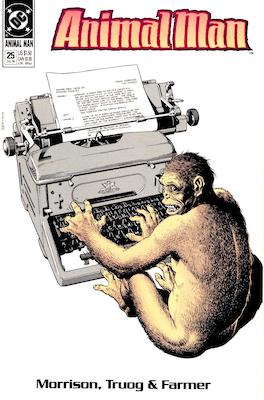
“Monkey Puzzle”, July 1990
Credits:
Grant Morrison [writer]
Chas Truog [penciller]
Mark Farmer [inker]
John Costanza [letterer]
Tatjana Wood [colorist]
Art Young [associate editor]
Karen Berger [editor]
Brian Bolland [cover (uncredited)]
 Front Matter:
Cover:
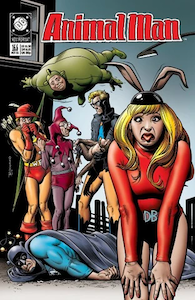
A chimpanzee is typing on a typewriter emblazoned with the word “Lloyd”, though I haven’t been able to find anything about this brand. The paper in the typewriter is the script for this issue of Animal Man and its text describes the first two panels of the first page. In several interviews, Brian Bolland cites this as one of his favourite covers. [pictured left is an alternative cover that Brian Bolland finished about 30 years after the issue’s publication][1]
Inside Cover:
There is no ‘DC Checklist This Week’ section.
Story:
Page 1
As described in the script that appears on the issue’s cover, the chimpanzee is typing the final lines of Shakespeare’s The Tempest, in which Prospero appeals to the audience to applaud the play and free him. The final word of the monologue that we don’t see the chimp type is “free”.
The image of a primate typing Shakespeare on a typewriter is a reference to the infinite monkey theorem – the idea that a monkey randomly hitting keys on a typewriter will probably produce the complete works of William Shakespeare (nearly 900,000 words) given an infinite amount of time. The concept basically argues that an event with a non-zero probability will occur when time is not a consideration. That idea has been expressed in different ways since antiquity, but the ‘monkey’ and ‘typewriter’ analogy is a 20th century version of the theory. Recent research suggests that the universe would die before any monkey would be able to achieve this, typing one word a second for its lifespan, even if there were more monkeys tackling the problem than atoms in the universe.[2] As the chimp here is writing the final words of Shakespeare’s final play, presumably it has just completed the “complete works”.
Job Number: G-5653 appears within the indicia.
Page 2
The chimp is on a hill overlooking the cemetery outside of Buddy’s house. The cemetery includes memorials for extinct prehistorical animals Tyrannosaurus rex and Smilodon.
Page 4
This is the title page. A “monkey puzzle” is the popular name for a species of tree native to South America.
Mark Farmer is the new inker. This page was originally illustrated for an earlier version of Animal Man #8. See the ‘Background’ annotations for that issue.
Here we see references to additional extinct animals such as the dodo and the great auk – both flightless birds that were hunted to extinction by humans within the last 400 years. There is also a whale statue in the foreground.
Page 5, panel 1
There is a tiger statue next to open grave. It may be an extinct species of tiger (such as the Caspian tiger) or the grave may be getting prepared for a critically endangered species of tiger. There is an elephant in the foreground.
Page 5, panel 3
Buddy comes across a statue of an angel with a flaming sword, which in the book of Genesis is associated with the angels responsible for preventing Adam and Eve from returning to the Garden of Eden. If Buddy has a connection to the Biblical Adam, as he did at the beginning of the series, the statue may symbolise that he is now trespassing in a place he does not belong.
Page 5, panel 5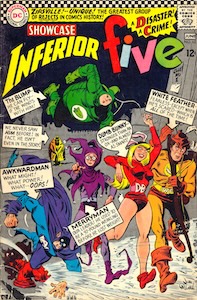
Merryman is the leader of the Inferior Five, who first appeared in Showcase #62 (May–June 1966) [pictured] as a parody superhero team. They soon appeared in their own series in the late 1960s before disappearing from comics.
Page 6, panels 1-2
Buddy was in Limbo throughout the 1970s before he returned in the pages of Wonder Woman #267-268 (1980) and as part of the Forgotten Heroes. Morrison explained this in their piece at the end of Animal Man #2.
Page 6, panel 4
By “dumb” and “old-fashioned”, Merryman may be referring to characters that readers can no longer take seriously (such as Ten-Eyed Man), or that are not politically correct (B’wana Beast is probably an example of this).
Page 6, panel 5
Morrison is making fun of comic book illustrators when Merryman says he is glad that he isn’t real because his occupation (comic book artist) is pathetic.
Page 7, panel 1
Merryman struggled with the gate because he is known for being exceptionally weak. A description of the character in Showcase #62 mentions that he “used to be a 97-pound weakling before he lost weight!”.
Page 7, panel 2
Merryman is intelligent and somewhat self-aware. In Showcase #62, he chooses the jester outfit for himself because he felt foolish becoming a costumed hero.
Page 7, panel 4
Here are the rest of the Inferior Five: Dumb Bunny (who is stupid but strong), The Blimp (who is inflatable), White Feather (who is perpetually afraid, and here seems to be reacting to the rabbit) and the clumsy Awkwardman.
Page 8, panel 1
The chimp is beginning to type the first page of script that we saw on the cover.
Page 9, panel 1
Leander is the real name of Awkwardman.
The damaged vehicle in the foreground is the original design of the Jokermobile, which debuted in Batman #37 (October 1946) and made increasingly infrequent appearances up to the 1980s.
Page 9, panel 5
B’wana Beast and Brother Power fit the description of “old-fashioned” and “dumb” characters. Both appeared in issues of Swamp Thing (the 1987 and 1989 Annuals respectively) before their mentions in Animal Man.
Page 9, panel 6
Merryman is making reference to the fact that, should the Inferior Five be written out of Limbo, they would probably be utilised to make a serious statement.
Page 10, panels 1-2
The silhouetted character is Captain Carrot who, along with his “His Amazing Zoo Crew!”, first appeared in an insert within The New Teen Titans #16 (Feb. 1982) as anthropomorphic animal superheroes. In Captain Carrot and His Amazing Zoo Crew #14 (Apr. 1983), the world they inhabited was described as Earth-C. In the Official Crisis on Infinite Earths Index (Mar. 1986, published by ICG) it’s noted that this world wasn’t destroyed during the Crisis as its an alternate dimension rather than a distinct world within the Multiverse.
Pursuing Captain Carrot is a dog with a ‘bat symbol’ around its collar, identifying it as Ace the Bathound – Batman’s dog who first appeared in Batman #92 (June 1955) but disappeared from comics after 1964.
Page 10, panel 5
The gate is inscribed with the latin text “Facilis descenus averno”. There is a mistake and the middle word should read “descensus”. The line is from Virgil’s epic poem Aeneid and translates to “the descent to Avernus [the underworld] is easy”. Callahan suggests that Merryman is the Virgil to Buddy’s Dante.[3]
The gate is also graffitied with several phrases, a swastika, and the name of Brother Power The Geek who we learned once resided in Limbo.
 Page 11, panel 1
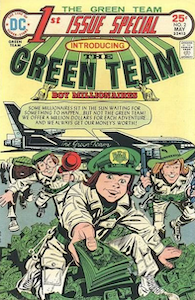
The rich children are the Green Team, rich boy adventurers (from left: Cecil Sunbeam, Commodore Murphy, Abdul Smith and J.P. Huston). Their first appearance was in 1st Issue Special #2 (May 1975) [pictured]. Two further issues were then created for an ongoing series but were unpublished before the “DC Implosion” of 1978, when the company’s financial troubles forced the cancellation of many ongoing comic titles, and the abandoning of planned and potential series. Those two Green Team issues did see release as part of Cancelled Comics Cavalcade later that year: a two volume photocopied collection of unpublished material, released in a limited run of 35 copies in order for DC to guarantee the copyright to the material.
The sign in the background makes reference to “Doiby” Dickles, whose nickname is derived from his trademark derby hat (which is also pictured). In the Golden Age, Doiby was a taxi driver and assistant of Green Lantern Alan Scott and first appeared in All-American Comics #27 (June 1941). He made appearances only very infrequently after the 1940s.
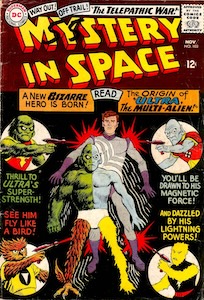 Page 11, panel 2
This is Ultra, the Multi-Alien who Ellen mentioned in Animal Man #18. He first appeared in Mystery in Space #103 (Nov. 1965) [pictured] as the lost Earth spaceman Ace Arn who was transformed into four different aliens with four different abilities. Each quadrant of his body looks like a different alien species. After appearing in five consecutive Mystery In Space issues in 1965-66, he had never appeared again.
Page 11, panel 3
In the yellow frock is Ma Hunkel, who first appeared in All-American Comics #3 (June 1939) as a supporting character in the Scribbly strips. In All-American Comics #20 (Nov. 1940), she began a superhero career as the first Red Tornado, occasionally encountering the Justice Society of America. Her adventures continued until the mid-1940s when the publisher All-American Publications merged with Detective Comics in 1947 to become National Comics (later DC Comics).
Page 11, panels 4-5
As mentioned in the dialogue, the dogs are Space Canine Patrol Agents. They first appeared in Superboy #131 (July 1966) and only appeared a couple more times, within the space of a year. SPCA, visible on one of their collars, is the acronym for the group but also refers to the Society for the Prevention of Cruelty to Animals. Bull Dog is easily identified as the bulldog with horns but I’m not sure if the other dogs are specific characters.
Page 12, panels 1-2
In the captions, Morrison is expressing nostalgia and true fondness for these characters dating from childhood.
Page 12, panel 3
If the Space Canine Patrol Agents are supposed to represent specific characters, the bright red dog could be Hot Dog.
Page 12, panels 4-5
The characters are in Limbo because they are not appearing in any stories, so it would make sense that Limbo was also devoid of stories. Of course, Buddy’s intrusion into that world means that they have now become part of the story of Animal Man #25. As we saw the chimp begin to write the script for issue #25, the legend mentioned on page 9 (“one day the monkey will write us all out of limbo”) is seemingly coming to pass.
Page 12, panel 6
The characters here are Quicksilver, Gay Ghost, Jemm, and Hercules.
Quicksilver first appeared in National Comics #5 (November, 1940), published by Quality. He was initially a speedster like The Flash, but that ability was downplayed until he became an acrobatic hero. He appeared in issues of that series through the 1940s until Quality sold its characters to the publisher National Comics (later DC Comics). He only made a few post-Crisis appearances for DC (including this one) and by 1993 became the inspiration for the character Max Mercury, as Quicksilver was already the name of an active Marvel Comics hero.
Gay Ghost (a crime fighting ghost) first appeared in Sensation Comics #1 (Jan. 1942), published by All-American Publications. He appeared in further Sensation Comics issues for the next few years but then disappeared until a retelling of his origin story in Secret Origins #42 (July 1989), where he was referred to as the Grim Ghost.
Jemm first appeared in Jemm, Son of Saturn #1 (Sept. 1984) as a Saturnian analogue of the Martian Manhunter with similar powers. His series ran for 12 issues and he hadn’t appeared in very much since.
Hercules, from Hercules Unbound, appeared in the previous issue. See the annotations for Animal Man #24, page 3:4.
Page 13, panel 2
At the time the Gay Ghost appeared in comics, “gay” meant cheery and lively. However, by the 1980s it was a reference to homosexuality, hence the name change to Grim Ghost in reprints. It’s another example of an “old fashioned” character in that the term “gay” had undergone a change of meaning.
Page 13, panel 3
Gay Ghost is obviously aware of what his name now implies.
Page 13, panel 5
Atlas and Warren refer to old comic book companies. Atlas Comics succeeded Timely Comics from 1951 and was itself rebranded as Marvel Comics in 1961. During its time, it tried to move away from superhero comics but had already inherited characters such as Captain America, Human Torch and Sub-Mariner from Timely. Warren Publishing was primarily a horror publisher between 1957 and its bankruptcy in 1983, publishing such titles as Creepy, Eerie and Vampirella.
Page 14, panel 1
The descriptions employed here make reference to materials used for illustrating comics.
Page 14, panel 2
The man on the motorbike is Jason Grant from the ‘Jason’s Quest’ storyline that run from Showcase #88-#90 in early 1970. In those comics, Jason is searching for his estranged twin sister while being pursued by assassins.
The semi-buried Statue of Liberty likely references the twist at the end of the 1968 film The Planet of the Apes.
Page 14, panel 5
The Red Bee is a hero who first appeared in Hit Comics #1 (July 1940), published by Quality Comics, and continued to appear in that title until Hit Comics #23 (July 1942). He only made a few appearances for DC as an Earth-2 character in All-Star Squadron #31-#35 (1984), when he is killed by Baron Blitzkrieg.
Page 15, panel 1
Seemingly dead characters are often brought back to life in the DC Universe so the Red Bee is hoping for this. Though it sounds ridiculous, he did fight crime with the assistance of trained bees he kept in his belt.
Page 15, panel 6
It’s not clear why he is so mean to Buddy here but perhaps he was just desperate for Buddy’s “Truog” jacket.
Allen Sallee notes that, “minus the jacket, his hair shaped in a buzzcut, Animal Man looks exactly as he did in the 1960’s.”[4] Actually, Buddy looks more like the representation of the Pre-Crisis Animal Man that has appeared in this series. See the annotations for Animal Man #19, particularly page 9:1.
Page 16, panel 5
Mister Freeze first appeared in Batman #121 (Feb. 1959) as Mr. Zero – a criminal who is forced to remain in a sub-zero environment for his own survival. A similar character named Mr. Freeze then appeared In the seventh episode of the Batman television series, which aired in February 1966. Mr. Freeze’s first comic appearance was in Detective Comics #373 (Jan. 1968), which established that Misters Zero and Freeze were the same person. He appeared a little more frequently in the late 1970s and 1980s but remained a fairly obscure villain at the time of Animal Man #25. However, he was a major character in the television series Batman: The Animated Series, which began airing in 1992, and in the live action feature film Batman & Robin (1997).
Page 17
The character that Buddy encounters here is Nightmaster, whose appearances to date came in Showcase #82-#84 (1969). He was a rock musician who was transported to a fantasy world and obtained the enchanted Sword of Night.
Page 18
This is Buddy’s house but there is no longer a graveyard outside.
Page 21
On page 8, we only saw the chimp type the beginning of the script before it keeled over, but apparently the chimp completed the whole issue.
I’m not sure about the significance of the paper key in this scene, but it could be noted that Buddy’s world is entirely made out of paper so it makes sense that a paper key could open a paper door. Perhaps this action forces Buddy to acknowledge this aspect of his reality before he can continue on his journey.
Page 24
Here Buddy’s creator is explicitly introduced as Grant (Morrison).
Back Matter:
There is no ‘Animal Writes’ letters section in this issue.
References:
[1] From https://theshift.store/blogs/judge-dredd-and-2000ad-creator-interviews/my-lengthy-discussion-with-brian-bolland-in-progress
[2] Woodcock, Stephen, & Falletta, Jay. “A numerical evaluation of the Finite Monkeys Theorem.” Franklin Open, vol. 9, Dec. 2024, https://doi.org/10.1016/j.fraope.2024.100171
[3] Callahan, Timothy. Grant Morrison: The Early Years. Sequart Research & Literacy Organization, 2007.
[4] Sallee, Allen. “Animal Man.” Critical Survey of Graphic Novels: Heroes & Superheroes, edited by Bart H. Beaty and Stephen Weiner, 2nd ed., vol. 1, Salem Press, 2018, pp. 38-41.
 Wild Planet