Animal Man #24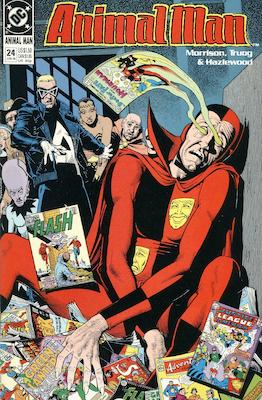
“Purification Day”, June 1990
Credits:
Grant Morrison [writer]
Chas Truog [artist]
Doug Hazlewood [artist]
John Costanza [letterer]
Tatjana Wood [colorist]
Art Young [associate editor]
Karen Berger [editor]
Brian Bolland [cover (uncredited)]
Front Matter:
Cover:
The cover shows Animal Man and a number of onlookers (including Red Mask) watching comic books emerge out of the eyes of Psycho-Pirate. The comics include the following key issues:
- Showcase #56 (June 1965), the first appearance of the Silver Age Psycho-Pirate Charles Hayden, is still materialising out of Hayden’s eyes.
- The Flash #123 (Sept. 1961) is falling to the ground. This issue includes the ‘Flash of Two Worlds’ story where the Golden Age Flash (Jay Garrick) meets the Silver Age Flash (Barry Allen).
- Below that, a partial cover for Brother Power The Geek #1 (Oct. 1968) can be seen. This is was a Frankenstein-type story about a mannequin that comes to life as a hippy, and the series only lasted two issues. The character had briefly returned recently in Swamp Thing Annual #5 (Oct. 1989) and Chaz Truog may have been working on a new Brother Power series at around this time with Stefan Petrucha that was ultimately abandoned in 1991.[1]
- The Brother Power comic is covering a copy of Inferior Five #1 (April 1967). This featured a parody superhero team who Buddy will meet in the next issue.
- Above that, Wonder Woman can be glimpsed on a cover, looking similar to how she appeared on the cover of her first appearance in Sensation Comics #1 (Jan. 1942).
- My Greatest Adventure #80 (June 1963) is partially covering Brother Power The Geek and features the first appearance of Doom Patrol. Grant Morrison was writing a Doom Patrol series at the time.
- Green Lantern #40 (Oct. 1965) is in Hayden’s hand. It is an early (but not the first) meeting between the Silver Age Green Lantern Hal Jordan and his Golden Age counterpart Alan Scott, and expanded on the concept of a Multiverse.
- To its left is Action Comics #277 (June 1961), the first appearance of the Legion of Super Pets.
- Swing With Scooter #1 (July 1966) is in the centre. Like Leave it to Binky, this was another teen comic. Morrison had planned to include Scooter in an issue of Animal Man but this never happened. See the inside cover annotations for Animal Man #7.
- Flash #163 (Aug. 1966) is below that. In this issue, Flash begins to fade from existence until he convinces the population to believe in him. On the cover of this issue, Flash breaks the fourth wall and addresses the reader, asking for help.
- On top of the Flash comic, the corner of an unidentified 10c Green Lantern comic can be seen.
- The yellow comic is Adventure Comics #288 (Sept. 1961), the first appearance of the planet known as Bizarro World, or Htrae.
- Justice League of America #21 (Aug. 1963) is clearly visible. This issue features the first team-up between the Golden Age Justice Society of America and the Silver Age Justice League of America, with Alan Scott and Hal Jordan meeting for the first time.
- Underneath this is a green cover with some text barely visible. This is Strange Adventures #201 (June 1967), in which Buddy fought the Mod Gorilla Boss. Morrison planned to reintroduce this character but that never happened. Again, see the inside cover annotations for Animal Man #7.
Story:
Page 1
We are reading a script that describes the images and dialogue that we are seeing simultaneously. Animal Man #18 features a similar effect.
Job Number: G-5652 appears within the indicia.
Page 2, panels 3-4
Animal Man encountered the white space in Africa (within the Traveller in Animal Man #12) and during his Peyote trip in Arizona in Animal Man #19. Previously the light was explained as an absence onto which Buddy’s world is created, but here the alien adds that the white space (which also exists between the panels) is located between Buddy’s reality and the reader’s. Ultraman created the hole in the panel wall in the previous issue.
Page 3, panel 4
The shirtless man is Hercules from Hercules Unbound, a series that ran from 1975-1977 featuring the mythological figure in a post-apocalyptic world. Chaz was also trying to get a reboot of this series to happen around this time.[2]
There is a mohawked character in the background. If it’s the same guy from the last issue, it’s probably just a generic punk and not Nuklon after all.
Page 3, panel 6
That may be Dorothy and her dog Toto from the Wizard of Oz film (1939), based on the 1900 children’s novel The Wonderful Wizard of Oz by L. Frank Baum.
Page 4
This is the title page. The term ‘Purification Day’ relates to the day of judgement in Hopi mythology. See the annotations for Animal Man #18.
Page 6
Psycho-Pirate argues that the readers just want to see violence. This isn’t the first criticism of superhero violence that Morrison has put forward via the characters in this series. Callahan notes that the fight that dominates the next several pages “becomes […] a commentary of super-hero conventions, a commentary on the absurdity of a universe where characters solve problems exclusively through violence”. [3]
Page 7, panel 5
The titles of some comics can be read but they don’t seem to exist outside of this issue. One is titled Flatulence, and another is Spam Man: possibly referencing a Monty Python sketch first televised in 1970 and the origin of the term ‘spam’ for unsolicited emails.
 Page 7, panel 6
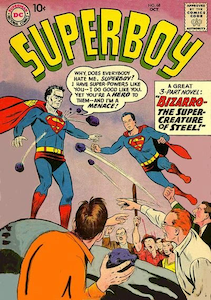
This is Bizarro, who first appeared in Superboy #68 (Oct. 1958) [pictured] as an imperfect and “dimwitted” duplicate of Superboy. An imperfect duplicate of Superman is also created in Action Comics #254 (July 1959). In Action Comics #263 (Sept. 1961), Bizarro makes many imperfect copies of himself and Lois Lane and they settle on an uninhabited planet, where they establish a culture and language that is opposite to Earth in many ways. Bizarro appears in the background of the previous panel saying “Goodbye”, which in his language means “Hello”. From Adventure Comics #294 (Mar. 1962) onwards, the logo on Bizarro’s costume was a mirror version of Superman’s ’S’, though in this issue he wears the same costume as Superman. Bizarro’s post-Crisis appearance in Man of Steel #5 (Dec. 1986) establishes a new origin story and kills the character within the same issue, which may be why he appears here amongst the other resurrected characters.
Page 8, panel 2
Power Ring is reading Justice League of America #30 (Sept. 1964), which depicts him fighting Hal Jordan on the cover.
Page 8, panel 3
Highwater seems to be reading a contemporary Superboy comic. That series briefly ran with the subtitle “The Comic Book” for 10 issues until Nov. 1990. Highwater’s comic seems to have that subtitle, but otherwise does not resemble any of those 10 issues.
That’s Angel Love reading an Angel Love comic. Her series ran through 1986-1987 and was stylised as a teen humour comic (like the Binky and Scooter titles) but tackled more adult themes.
Sunshine Superman is reading a Magic Lantern comic (which is not a real title) about his world.
Page 9, panel 2
A one-armed bandit is a colloquial term for a slot machine.
Page 9, panels 5-6
Buddy evades the fight by remaining outside of the panels.
Page 10, panel 4
The character in the orange and purple is Krona, who first appeared in Green Lantern #40 (Oct. 1965). He is a scientist from the planet Oa. During the Crisis, it is explained that he accidentally created the Multiverse. Krona is practically immortal so he is not here because he is dead, but hadn’t made any post-Crisis appearances so there may have been the assumption that he had been removed from continuity.
Page 11, panel 1
Psycho-Pirate’s “I will make the dead to rise…” quote repeats his earlier ramblings from Animal Man #20, page 11. See those annotations for the origin of this quote.
Similarly, his quote about “Ess and Ex…” refers to the universes destroyed during the Crisis and is repeated from an earlier issue. See the annotations for Animal Man #10, page 11:2.
Page 11, panel 3
During the Crisis, Earth-Prime was destroyed but not as a result of a nuclear war. There was a pre-Crisis storyline where Per Degaton and the Crime Syndicate changed the timeline, resulting in the Cuban Missile Crisis escalating to a nuclear war on Earth-Prime (see Justice League of America #207, Oct. 1982) but these events were reversed when a number of heroes apprehend the villains in the 1940s before they could alter history.
Page 12, panel 1
Tweedledee and Tweddledum are identical-looking cousins and Batman villains who first appeared in Detective Comics #74 (April 1943). Like Mad Hatter (but predating that character), they are based off of Lewis Carroll characters, specifically from Through the Looking Glass… In this panel, Tweedledee is quoting from that book, and the line takes place almost immediately after Tweedledum suggests that Alice is “only one of the things in [the Red King’s] dream”, which was quoted in Animal Man #9. Tweedledum and Tweedledee appear in Morrison’s Arkham Asylum… where they are depicted as being connected by electrodes on their heads, which is also how they appear here.
Page 13, panels 3-5
A very faint image of a person can be seen. This is the Veil, mentioned in Animal Man #7 as an associate of the Red Mask who went insane and was locked in Arkham Asylum. Here, the Veil helps pull Overman out of the panel border.
Page 14, panel 2
The Veil removing his own eyes was mentioned in Animal Man #7. Aside from this extreme act of self-mutilation, he was deemed insane because he could see things that others couldn’t. Here it is suggested that he could see another level of reality.
Page 14, panel 3
The Veil’s assertion that the creators/readers “are not real either” is Morrison again extrapolating that the relationship between our world and Buddy’s is similar to that between a higher level of reality and ours.
Page 15, panel 2
Overman’s pleas of “I’m real! I’m realistic!” as he is crushed by the panel borders is another critique of modern superhero comics, where “realism” was being equated with mature themes and violence. Singer notes that this is another visual gag borrowed from the Chuck Jones animation Duck Amuck (see also the annotations for Animal Man #5, page 19:7).[4]
Page 16, panels 5-7
Highwater argues that the characters from other worlds never really die because they continue to exist in the reader’s memories, in the same way that their survival within Hayden’s memories allowed them to return to the DC Universe.[5] The characters are essentially immortal – a point made again in the following issues.
Highwater is holding up an issue of Justice League America but I couldn’t identify which one.
Page 17, panels 1-3
Power Ring of the Crime Syndicate is from the Silver Age and is obviously uncomfortable in the Modern Age. He then seems to dissolve into green and white coloured confetti representing the coloured inks that have rendered him.
Page 17, panels 6-7
Highwater discovers that the characters have retreated into the mask and the alien compels him to become the “sacrificial eagle” that will keep them contained. In Hopi culture, there is a practice of raising golden eagles from eggs and keeping them captive until ceremonially smothering them to death. The eagle is Highwater’s totem, and he witnessed a bleeding eagle during his peyote trip.
Page 18, panels 5-8
Buddy learned the trick of switching off the bomb back in Animal Man #6.
Page 19, panel 1
The alien is quoting from Meditations With The Hopi by Robert Boissiere. It was last quoted by the katsinam in Buddy’s vision in Animal Man #18, page 20. In that text, the prophecy suggests that the Pahana (the white brother) will return and will purify the Hopi by opening their minds, and this will set in motion the coming of Purification Day.
Page 19, panel 2
The alien suggests that the post-Crisis continuity has been restored but immediately notices a butterfly that seems to be out of place. Earth-14 is not a known pre-Crisis world. This is a different butterfly from those we’ve seen in the previous issues.
Page 19, panel 3
Buddy feels like someone is missing, and he may be referring to Highwater who has disappeared.
Page 19, panel 6
Pyscho-Pirate here is expressing the opinions of Morrison and some readers; that it’s a shame that some of those weird characters were erased by the Crisis.
Page 20, panels 4-5
The quote is from Act IV of Shakespeare’s The Tempest. The magical Prospero holds a masque (a form of dramatic, costumed entertainment) commemorating the marriage of his daughter to Ferdinand but stops it when he remembers the plot against his life. Buddy’s adventures in this issue were hardly “revels” but the aliens are preparing him for the difficult reality that he must soon face.
Page 21, panel 2
George is an Arkham orderly we haven’t met before.
Page 21, panels 4-6
Huntoon is getting Dustin Hoffman mixed up with the autistic character Hoffman plays in the film Rain Man (1988). Huntoon and George wonder whether the silent Highwater is holding something back, emotionally, while he is actually the only person preventing the forgotten characters from returning.
Page 21, panel 7
Highwater first heard the beating wings of Kwahu, the giant eagle spirit, during his peyote trip in Animal Man #18.
Page 22, panel 2
The aliens again reiterate that Purification Day is still to come.
As noted by Callahan, Buddy has now symbolically changed out of his dark, modern costume and is back in the “Truog” jacket for the first time since issue #17.[6]
Page 22, panels 4-5
Buddy decides that, if he is just a creation, than his creator may have answers about his life’s purpose. The aliens quote the same line from Shakespeare’s The Tempest again.
Page 24
Buddy finds that his front door now opens onto a foggy cemetery, which obviously wasn’t there before. The newspaper reads “DH bids adieu” as this is the final issue inked by Doug Hazlewood.
Back Matter:
Letters:
The letters are written in response to Animal Man #20. The writer of the first letter doesn’t want the Baker family to return and have the impact of their deaths lessened, but other letters want the Baker family brought back to life.
The writer of the second letter notes that it’s ironic that the assassin entered the house through the Justice League transporter tube after the League were responsible for adding security features to the house.
Several letters mention Buddy’s realistic display of grief, and note his suicidal thoughts after the death of his family, and the sixth letter praises Buddy for “heroically” overcoming these inclinations.
The final letter jokes that Morrison should bring back Earth-H – a world featured in 1970s Hostess adverts where criminals were defeated by having cakes thrown at them. Zani notes that the inclusion of this letter makes the reader recall that the purpose of comics is largely to generate revenue for the publishers and advertisers. “Despite the restructuring that occurred in the Crisis series, the DC Universe is not an entity with a singular timeline, agenda, or meaning [and] their meaning must be at least partially understood in terms of the network of capital in which they are distributed.”[7]
DC Checklist:
The section providing DC Comics publishing updates and the ‘DC Checklist’ appears at the back of the issue this month. The ‘DC Checklist This Week’ section includes the following description of Animal Man #24: “Can Animal Man straighten out the chaos at Arkham Asylum? And what is the fate of the Psycho-Pirate?”
References:
[1] Ah-Sen, Jean Marc. “‘If I Could, I’d Completely Redraw It’: An Interview with Chaz Truog.” The Comics Journal, 20 April 2022, https://www.tcj.com/if-i-could-id-completely-redraw-it-an-interview-with-chaz-truog/
[2] Ibid.
[3] Callahan, Timothy. Grant Morrison: The Early Years. Sequart Research & Literacy Organization, 2007.
[4] Singer, Marc. Grant Morrison: Combining the Worlds of Contemporary Comics. University Press of Mississippi, 2012, p. 62.
[5] Zani, Steven. “It’s a Jungle in Here: Animal Man, Continuity Issues, and the Authorial Death Drive.” The Contemporary Comic Book Superhero, edited by Angela Ndalianis, Routledge, 2008, p. 240.
[6] Callahan 2007.
[7] Zani 2008, p. 242.
 Wild Planet