Animal Man #23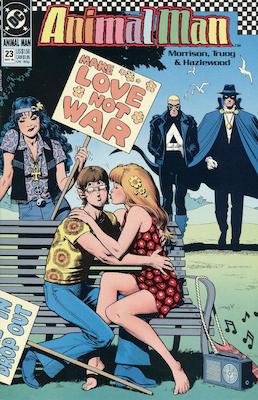
“Crisis”, May 1990
Credits:
Grant Morrison [writer]
Chas Truog [artist]
Doug Hazlewood [artist]
John Costanza [letterer]
Tatjana Wood [colorist]
Art Young [associate editor]
Karen Berger [editor]
Brian Bolland [cover (uncredited)]
Front Matter:
Cover:
In the background, Buddy walks alongside the Phantom Stranger. In the foreground are three hippies. As we discover within the issue, the boy may be Binky Biggs from the comic series Leave It To Binky, which may make the blonde girl his girlfriend Peggy. A girl with dark hair (who could be Binky’s sister Lucy) wears a necklace featuring an ankh (an ancient Egyptian symbol meaning “life”) and another necklace with a peace sign (originally designed in 1958 as the logo for the British Campaign for Nuclear Disarmament). She also wears a belt buckle with a taijitu diagram representing the principle of yin and yang in Chinese philosophy. The placard partially visible on the ground likely reads “Turn on, tune in, drop out” – a catchphrase popularised by psychedelic drug advocate Timothy Leary.
Inside Cover:
The ‘DC Checklist This Week’ section includes the following description of Animal Man #23: ”Trapped in the midst of insanity, Animal Man attempts to sort out his life.”
Story:
Page 1, panels 1-2
This is the Medusa Mask that the Psycho-Pirate hasn’t possessed all series, and possibly not since he was institutionalised in the Infinity Inc. Special (1987). See the annotations for Animal Man #10, page 11:1. Hayden has the ability to project emotions onto others even without the mask, but the mask helps him to recharge these abilities.
Page 1, panel 3
Psycho-Pirate addresses the reader.
Page 1, panel 5
Many objects have appeared in Hayden’s cell. These include:
- Wanted posters for Ultraman and Abraham Lincoln, which would be from Earth-3 where supervillains rule the planet. In that universe, Lincoln assassinated President John Wilkes Booth (as explained in Justice League of America #29, Aug. 1964).
- A partially covered sticker that probably reads “Shit happens!”, a phrase that gained popularity in the 1980s.
- A poster depicting Hitler as a leader of the United States, referencing Earth-X.
- Leonardo Da Vinci’s painting titled Mona Lisa (painted in the early 16th century) and a marble bust.
- Near the bottom left corner is a copy of Watchmen #1 (Sept. 1986). Watchmen takes place on an alternate Earth, with characters based on those found in the pre-Crisis Earth-4, but one without a numeric designation of its own.
- Below that is the copy of The Flash #123 (Sept. 1961) that appeared in the previous issue.
- There are some vinyl records (probably singles) by the US New Wave band Devo on the ground.
- There is a copy of the Daily Planet (a publication that exists within the DC Universe) announcing “Mondale Wins” suggesting that, in an alternate reality, Walter Mondale won the US presidency over Ronald Reagan in 1984.
- Barely visible on the right, near the violin and iron, is a copy of a Green Lantern comic. The logo and caped hero on the front suggests that it’s an issue from the first Green Lantern series, which ran throughout the 1940s. The Golden Age adventures of the Green Lantern Alan Scott were later explained as having taken place on Earth-2.
Page 2, panel 1
Wandering the halls of the Asylum is Owl-Man, a member of the Crime Syndicate of Earth-3 and evil counterpart to Batman.
Page 2, panels 2-3
Streaky the Supercat was a pet of Supergirl who first appeared in Action Comics #261 (Feb. 1960). It gained its powers from a form of kryptonite called X-Kryptonite. Streaky last appeared in Adventure Comics #394 (June 1970) and became depowered when X-Kryptonite was abandoned as a concept in the early 1970s.
Page 2, panel 6
Several inmates in their cells are yelling out.
The inmate in the closest cell is alternating between saying “Let me out” and “Don’t let me out”, so it could be someone with a multiple personality disorder like the Batman villain Two-Face.
The inmate in the middle cell is quoting Lewis Carroll’s Through the Looking-Glass… so it is possibly Mad Hatter, who Highwater met in Animal Man #9. However it could also be the identical supervillains Tweedledum and Tweedledee, who are also based on Lewis Carroll characters and appear in the next issue.
I’m not sure who is yelling “My head is haunted”. Jonathan Woodward[1] suggests that this may be Black Mask or Doctor Destiny, both of whom appear in Morrison’s Arkham Asylum: A Serious House on Serious Earth, though I’m not sure what the inmate is referring to.
Page 3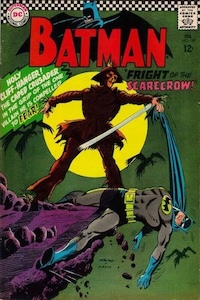
In the cell is Jonathan Crane, better known as the Batman villain Scarecrow. He first appeared in World’s Finest Comics #3 (Sept. 1941) as a bullied university psychology professor who begins terrorising others for money. His first Silver Age appearance in Batman #189 (Feb. 1967) [pictured] introduced the idea of Scarecrow being able to induce fear in his victims through use of a device – in this case, a toxin applied through the smoke from a pipe. In later appearances, Scarecrow used pills, an injectable serum, an electronic emitter of frequencies, and gas to instill fear.
Page 4
This is the title page. The title font includes a stone column for a letter ‘i’ and a snake for a letter ’s’.
Job Number: G-5496 appears within the indicia.
The characters in the foreground include Power Ring, Ultraman and Johnny Quick, who (with Owl-Man) are members of the Crime Syndicate of Earth-3. These are villainous versions of Green Lantern, Superman and the Flash respectively. They first appeared in Justice League of America #29 (Aug. 1964) and had conquered Earth-3 but this universe was destroyed during the Crisis.
Also in the foreground is Detective Chimp who first appeared in Adventures of Rex the Wonder Dog #4 (July/Aug. 1952) as a superintelligent, crime solving chimpanzee. He continued to appear in many issues of that series until 1959, but then didn’t make another appearance until the 1980s. This is one of his first appearances after the Crisis. In the following years, he developed the ability to speak to all creatures. It’s unclear why he appears here. Unlike the other characters, his existence in the post-Crisis continuity was confirmed by his appearance in Secret Origins #40 (May 1989).
In a more ghosty appearance in the background are:
- The strange looking man in the top left is Bug-Eyed Bandit. He made a couple of appearances as an insect-controlling enemy of The Atom (first appearing in The Atom #26, Aug./Sept. 1966), before he was killed in Crisis on Infinite Earths #12 (Mar. 1986) by the Anti-Monitor’s shadow demons.
- The hero in ancient Roman garb is Son of Vulcan, wearing the same outfit as shown in Who’s Who: The Definitive Directory of the DC Universe #21 (Nov. 1986). Though similar in appearance to the Golden Age hero Golden Gladiator, Son of Vulcan was a Charlton Comics character who first appeared in Mysteries of Unexplored Worlds #46 (May 1965). The Charlton Universe (Earth-4) was subsumed into the new Universe during the Crisis (Son of Vulcan appeared in Crisis… #12), and the aforementioned Who’s Who issue confirmed the Son’s place in the current continuity, so again I’m not sure what he is doing here.
- The winged horse may be the Shining Knight’s steed Winged Victory. Both characters first appeared in Adventure Comics #66 (September 1941) and soon joined the superhero team The Seven Soldiers of Victory in Leading Comics #1 later that year. These adventures were later explained as taking place on Earth-2. The post-Crisis existence of Shining Knight and Winged Victory had been well established by this point, most recently in Swamp Thing #87 (June 1989).
There are some other unidentified characters: a moustached, Western sheriff; a hippy woman; a black man; and a little boy in a stripy shirt.
There are at least three people talking. Someone is looking for a character named “Reed”. Another is talking about a “hand in the snow”. And another is speaking about there being “three of me” – perhaps referring to different versions of themselves from different universes, or possibly three personalities within the one body.
Page 5, panel 3
The “wall of whiteness” that Ultraman describes is the wave of Antimatter that destroyed Earth-3 (and other worlds) in the Crisis. Ultraman and the rest of the Crime Syndicate can be seen being enveloped by the Antimatter Wave in Crisis on Infinite Earths #1 (Apr. 1985).
Page 5, panels 4-5
All of the characters are now smiling on account of Pyscho-Pirate’s powers. Tula (Aquagirl), who also died during the Crisis, can be seen in the background.
Page 5, panel 6
As explained in the annotations for issue #10, at the very end of the Crisis… miniseries, Hayden has been institutionalised in Arkham as the only person who remembers the prior existence of the Multiverse. He lost his memories of the Crisis at around the time of Infinity, Inc #32 (Nov. 1986) but those memories returned in the pages of Animal Man.
Page 6
The aliens reiterate to Highwater that he is in a comic story, which he should have understood during his peyote trip.
Page 7, panel 1
A few comic books float around, one being a (fictional) issue of Warhund. This character appeared in one Charlton comics issue (Charlton Bullseye #5, Jan. 1982) and never had his own series. The Bullseye series was published through an unusual model where creators were not paid but they retained the original art and the rights to any characters they created. Because of this, DC would not have acquired Warhund when it purchased the other Charlton Comics characters. However, Warhund was created by Chaz Truog so he would have had the rights to include the character here.[2]
Page 7, panel 2
These images of Arkham Asylum are supposed to represent versions of the hospital from different worlds. I’m not sure if any of these versions (particularly the brutalist Asylum) have previously appeared in any comics. Note that Arkham Asylum (originally Arkham Hospital) was based on the Arkham sanatorium mentioned in works by supernatural fiction author H.P. Lovecraft. This institution was in turn inspired by the Danvers State Hospital in Danvers, Massachusetts, which did have a steeple, but still didn’t quite look the same as the building shown here.
Page 7, panel 4
This is Owl-Man again, grappling with his own existence.
Page 7, panel 6
The term bedlam comes from Bethlehem hospital in London, colloquially known as Bethlem or Bedlam. It became a psychiatric institution as early as the late 14th Century, and the word Bedlam became a synonym for chaos. The aliens here use the term Bedlam in both senses – as a chaotic place and as an asylum.
Page 8, panel 1
Buddy is still in around the year 1969. The film Barbarella (a sci-fi film based on the 1960s French comic character) was released in late 1968.
Page 8, panel 2-3
The John Bunyan quote is from the novel Pilgrim’s Progress, originally titled The Pilgrim’s Progreſs from This World, to That Which Is to Come and first published in two volumes in the late 17th century. The story concerns the journey of a man and his family to Heaven. If Phantom Stranger heard Bunyan preach in 1672, it would have been before this work was published and just after Bunyan was released from prison in Bedford, north of London.
 Page 8, panel 4
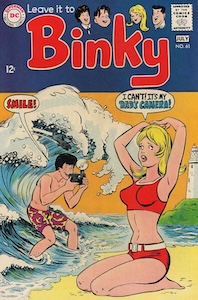
This panel is similar to the cover image, but here the male hippy on the bench is explicitly identified as Binky Biggs from the teen humour comic series Leave It To Binky. This title premiered in February 1948, possibly as an attempt to compete with the popular Archie Comics title by the publisher of the same name. Following a 10 year hiatus, the Leave It To Binky series resumed with issue #61 in July 1968 [pictured]. Again, the woman on the bench may be Binky’s girlfriend Peggy Baxter, which might make the redheaded woman someone who was involved with Binky and didn’t know about Peggy.
Page 8, panels 5-6
Phantom Stranger is meeting other immortals. Vandal Savage is not in attendance, but is a Golden Age villain who first appeared in Green Lantern #10 (Dec. 1943). Buddy and the Forgotten Heroes fought Savage in Action Comics #552-553 in Feb./March 1984.
The cult in the desert may refer to the Manson family. Charles Manson and his followers located to Spahn Ranch in 1968, and the followers would commit their infamous murders in 1969.
Page 9, panels 2-3
The Immortal Man first appeared in Strange Adventures #177 (June 1965), a few months before Animal Man’s first appearance in the same title. His powers stipulate that, upon each death, he is reincarnated as a new fully-grown person elsewhere on Earth. In Action Comics #552-553, it is explained that Immortal Man is an associate of Vandal Savage and he forms the Forgotten Heroes (including Buddy) to oppose him. Apparently in the late 1960s the pair are at least on speaking terms.
Page 9, panel 4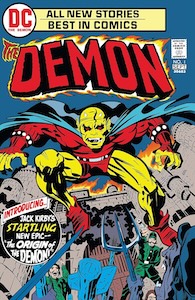
Jason Blood first appeared in The Demon #1 (Sept. 1972) [pictured] as a demonologist. In that series, he remembers that he is actually an immortal being from the time of King Arthur who can transform into a demon named Etrigan. In his post-Crisis series (commencing in Jan. 1987), it is made clearer that Blood and Etrigan are actually different beings that switch places rather than transform. In his post-Crisis continuity, Blood may not have ever forgotten about his condition, which could be why he is aware of his immortality in 1969.
Page 10, panels 1-2
The Electric Prunes are a Californian psychedelic rock from from the 1960s. “I Had Too Much to Dream (Last Night)” was a hit song released in 1966 about someone dreaming about an ex-lover.
Timothy Leary and Ken Kesey were both advocates of psychedelic drug use based on the East and West coasts of the U.S. respectively. In the 1960s Leary researched psychedelics as a therapeutic tool. At a similar time, Ken Kesey, a hospital aide in a mental health facility, was unwittingly drafted into the CIA’s MKUltra program to secretly test the effects of psychoactive drugs on patients. Kesey wrote One Flew Over The Cuckoo’s Nest (published in 1962) inspired by his experiences in the hospital. Kesey and Leary met in 1964 when the former travelled to New York.
Page 10, panel 3
Buddy is echoing the De-Evolution philosophy of the band Devo, who were referenced on page 1.
Page 10, panel 5
Perrier is a brand of bottled mineral water, originally obtained from the Vergèze spring in France. It was the most popular imported water brand in the US by the late 1980s, but didn’t open its first office there until 1976 so the Immortals may not have been aware of the brand.[3] Perrier may have been in Morrison’s mind at the time of writing because the carcinogenic chemical benzene was found in a batch of bottles and millions of bottles were withdrawn from sale in February 1990.
Page 11, panel 1
This panel includes additional characters:
- An unidentified character with a Green Lantern symbol on its head. Given that Green Lanterns exist all through the universe, this could represent any alien species.
- Another bald character with odd proportions who may be another alien.
- Icicle, who first appeared All-American Comics #90 (Oct. 1947) as a Green Lantern villain who used a cold ray gun and could travel between Earth-1 and Earth-2. Icicle died in Crisis On Infinite Earths #10 (Jan. 1986) when a group of villains raided Krona’s lab and it exploded.
- Psimon first appeared in The New Teen Titans #3 (Jan. 1981) as a powerful telepath who was part of the villainous group the Fearsome Five. Psimon was killed by Braniac in Crisis On Infinite Earths #10.
- The silhouette of someone with a visor.
- Ten-Eyed Man first appeared in Batman #226 (Nov. 1970). Blinded in an explosion, he underwent an experimental procedure that allowed him to see through his fingertips. His entry in Who’s Who: The Definitive Directory of the DC Universe #23 (Jan. 1987) mentions that he was accidentally killed during the Crisis, and other sources note that this happened during Crisis… #12, though I don’t see that his death is actually depicted in that issue.
- Maaldor first appeared in DC Comics Presents #56 (April 1983) as a powerful being from another dimension. He was killed (along with Icicle and the original Mirror Master) in the raid on Krona’s lab in Crisis on Infinite Earths #10.
Callahan notes:
The cast of characters [Morrison/Psycho-Pirate] chooses to rescue from the void shows [their] preference for the odd, the fantastic, and the awkwardly-dated creations of the past […] These Silver Age characters were removed from DC continuity because they didn’t fit in with the grim-and-gritty, mid-to-late 1980s conception of the DC Universe.[4]
Page 12, panels 1-2
Ronald Reagan was originally known as an actor but had moved into politics by the mid 1960s and was governor of California at the time of this meeting in 1969. He was President for two terms from 1981-1989 before being succeeded by George Bush.
Page 13, panel 3
A (different) butterfly was last seen in Animal Man #17 (see the annotations for that issue, page 17). In Ray Bradbury’s short story A Sound of Thunder, the killing of a butterfly in the past has significant consequences for the future.[5] Jason Blood is unconcerned with the risks of his actions on Buddy’s future.
Page 13, panel 4
Buddy still cares for animals and is upset about the senseless killing.
Page 13, panel 6
Jason Blood’s counterpart Etrigan is a demon who resides in Hell.
Page 14, panels 1-3
Here we are introduced to more characters, some of them appearing for the first time:
- This Spectre looks much different from the known DC character – a divine entity who first appeared in More Fun Comics #52 (Feb. 1940). This version of the Spectre may be from another Earth.
- Uberman seems to be a version of Übermensch from the villainous team Axis America, though the latter was bald. Axis Amerika first appeared as evil counterparts to the Young All Stars in Young All-Stars #1 (June 1987), which takes place during World War II.
- These are alternate versions of Batman and Robin.
- The Love Syndicate are new characters. They all have names associated with recreational drugs. The term Sunshine was associated with variants of LSD. Speed Freak is a Flash-style character, and Speed is a type of amphetamine. Magic Lantern refers to an early type of film projection, though the term “magic” is also associated with Psilocybin mushrooms. His t-shirt displays the Timothy Leary phrase “Turn on, tune in, drop out” that can be partially seen on the cover.
Page 14, panel 4
Tula (who appeared in the background of page 5) reappears here. She first appeared in Aquaman #33 (May/June 1967) as a fellow Atlantean who dates Aqualad. She appeared in a handful of issues of Aquaman, Adventure Comics, and Tales of the Teen Titans in the 1960s, 70s and 80s respectively before being killed in Crisis on Infinite Earths #10 after Chemo poisons the oceans.
Sargon was a stage magician with real magic powers who first appeared in All-American Comics #26 (May 1941). He appeared in many issues throughout the 1980s. During the time of the Crisis, he was killed in Swamp Thing #50 (July 1986) during a magic ritual in opposition to the destruction of the universe by the Great Darkness.
Page 14, panel 6
Psycho-Pirate has made all of the characters smile again.
Page 15, panel 2
Alongside the characters we have been introduced to on the previous page is Warhund (referenced on page 7:1), now in the “flesh”.
Magic Lantern suggests that Psycho Pirate is having an acid flashback – a hallucination that may reoccur after the effects of a psychedelic drug have worn off.
Page 16, panel 5
The quote is from I Corinthians 15:26 and is explained in the annotations for Animal Man #20, page 12.
Page 18, panel 1
The character in the foreground appears to be Prince Hamlet of Denmark from William Shakespeare’s play Hamlet, written near the end of the 16th century. This isn’t a DC Comics character, but may well have appeared in a comic once.
Page 18, panel 2
The three characters here are unidentified. At this point, the issue doesn’t seem to be limited to existing comic characters.
Page 18, panel 4
Prince Ra-Man first appeared as the supernatural detective Mark Merlin in House of Secrets #23 (Aug. 1959) and in many subsequent issues of that series. In House of Secrets #73 (July 1965), Merlin is granted telekinetic abilities and is reincarnated into the body of a powerful wizard to become Prince Ra-Man. He is killed by shadow demons in Crisis on Infinite Earths #12.
Page 18, panel 6
These are some more unidentified characters.
Page 19, panel 6
Morrison is critiquing modern, revisionist comics that present the dark side of superheroes, with a few references to Alan Moore’s Marvelman. That title was being published in the anthology series Warrior by UK publisher Quality Communications but, when it was on hiatus in the mid-1980s, Morrison pitched a story for it that was eventually published at the end of 2014. Moore eventually continued on the title (now renamed as Miracleman) as a standalone title for Eclipse Comics from 1985.
It’s revealed partway through the series that Miracleman is the result of a government experiment using alien technology. He does have sidekicks, but they are not cloned from him. In an article at the end of Miracleman #2 (Oct. 1985), Moore notes the character’s similarities to the archetypal Overman, referring to Friedrich Nietzsche’s concept of the Übermensch: a human ideal who has a set of values not based on Christianity.
In this panel, Overman is planting an American flag on a celestial body.
Page 20, panel 1
In Miracleman, Miracleman’s sidekick Kid Miracleman becomes insane after living as the only superhuman on the planet for much of his life and becoming corrupted by the power. Here, a version of Batman is seen getting zapped by Overman’s heat vision.
Page 20, panel 2
These are new characters from Overman’s world based on Wonder Woman, the Flash and Green Lantern.
 Page 20, panel 3
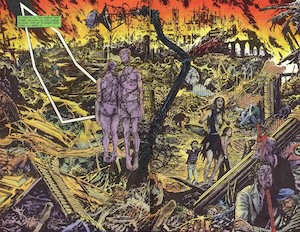
This panel is clearly based on Miracleman #15 (Nov. 1988) when Kid Miracleman gruesomely destroys London and its inhabitants. [pictured]
Page 21, panel 1
In this panel are several more unidentified characters, including apparitions of a man floating in the sky and a woman riding a T-rex, amongst characters that have already been introduced. Additionally, there is:
- An alternate version of the Elongated Man, with his neck stretched above the now-transparent Psycho-Pirate.
- The Red Mask behind Overman. He committed suicide in Animal Man #7.
- Next to him is Kole Weathers. She was a crystal-manipulating associate of the Teen Titans for a short while between her first appearance in New Teen Titans #9 (June 1985) and her death in Crisis on Infinite Earths #12.
- Hanging over her is Beppo the Kryptonian monkey, who first appeared in Superboy #76 (Oct. 1959) as a stowaway on Superman’s rocket to Earth. Though Beppo did not appear in any of the Crisis… issues, he and the rest of the Legion of Super-Pets were not regularly appearing after the Silver Age of Comics and seem to have been written out of continuity by the Crisis.
Page 21, panel 4-5
Psycho Pirate is again addressing the reader. He draws attention to the panel borders, which he refers to as a “cage”.
Page 22
Ultraman then interacts with the panel borders and eventually breaks through, thereby freeing the characters.
The man with the red mohawk looks like Nuklon, though Nuklon was not dead. As a member of All-Star Squadron beginning in The All-Star Squadron #25 (Sept. 1983), his adventures took place on Earth-2. He appeared throughout the Crisis and seems to have survived, though the All-Star Squadron series was now set in the 1940s rather than on an alternate Earth.
Page 23, panel 1
This character with the coconuts is a reference to the film Monty Python and the Holy Grail (1975). In the film, the medieval Knights of the Round Table would mime riding horses while their servants bang coconut halves together to make the sound of a horse’s gallop.
Back Matter:
Letters:
The letters are written in response to Animal Man #19.
The readers begin to understand Morrison’s implication that we may also be characters in a story, and express their reactions to the “I can see you” scene and the murder of the Bakers.
The writer of the second letter makes a succinct comparison between Buddy and Crafty, both having been pulled out of their worlds by their creators and put in another level of existence for a greater purpose (perhaps as a living message about the nature of reality).
The writer of the fifteenth letter correlates characters (such as Highwater) not being conscious between comic panels with the Schrödinger’s cat thought experiment.
References:
[1] Woodward, Jonathan. “Crisis-Relevant Text: Grant Morrison’s Animal Man #8-26”. The Annotated Crisis on Infinite Earths. Archived at https://web.archive.org/web/20210623061928/https://www.prismnet.com/~woodward/chroma/crtanimal.html.
[2] “Truly Gone&Forgotten: Warhund.” Gone & Forgotten, 19 February 2015, http://gone-and-forgotten.blogspot.com/2015/02/truly-gone-warhund.html
[3] Some of the history of Perrier is from an archive of their website.
[4] Callahan, Timothy. Grant Morrison: The Early Years. Sequart Research & Literacy Organization, 2007.
[5] Zani, Steven. “It’s a Jungle in Here: Animal Man, Continuity Issues, and the Authorial Death Drive.” The Contemporary Comic Book Superhero, edited by Angela Ndalianis, Routledge, 2008, p. 239.
 Wild Planet