Animal Man #22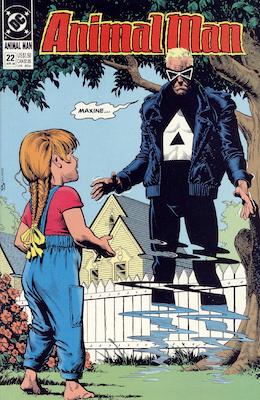
“Time in a Bottle”, April 1990
Credits:
Grant Morrison [writer]
Paris Cullins [artist]
Steve Montano [artist]
John Costanza [letterer]
Tatjana Wood [colorist]
Art Young [associate editor]
Karen Berger [editor]
Brian Bolland [cover (uncredited)]
Background:
This issue takes place at the same time as Time Masters #4 (May 1990).
Front Matter:
Cover:
Buddy speaks to Maxine in the Bakers’ yard. This recreates the cover of Animal Man #14 but from a different perspective, with the mysterious figure now revealed to be Buddy from the future.
Inside Cover:
The ‘DC Checklist This Week’ section includes the following description of Animal Man #22: “Animal Man travels back in time, thanks to Rip Hunter, seeking his past in an attempt to alter his future.”
Story:
Page 1
This is the title page. This page show various objects used for measuring time or telling the time of day. We see analog clocks, a digital clock radio, a small sundial, and a candle clock that measures time as the wax melts, but no hourglasses.
At the end of the credits, there is a “special thanks to Maximum Overtime”, a studio that Paris Cullins established in Philadelphia with some other illustrators. Several of the clock faces on this page include names that may relate to Maximum Overtime staff: Kellin, (Martin) King, (Christopher) Taylor, Hyman, (Sky) Owens, and something ending in “poson”. Artist Christopher Taylor may have helped with the layouts for this issue.[1]
The title “Time In a Bottle” comes from a Jim Croce song released posthumously as a single in 1973. The song lyrics express a wish to preserve time so that days last forever.
Job Number: G-5495 appears within the indicia.
Page 2, panel 2
“Time waits for no man” derives from the much older proverb “Time and tide wait for no man” that is attributed to the Christian Saint Mahrer in 1225.[2]
The “At my back…” line comes from the poem To His Coy Mistress by Andrew Marvell, published posthumously in 1681.[3] In this poem, the speaker reflects on how short life is.
The “Time runs…” line is from Christopher Marlowe’s play The Tragical History of the Life and Death of Doctor Faustus, written and first performed at the end of the 16th Century.
Page 2, panel 3
Buddy’s jacket is damaged from when it was scorched by Bug-Man’s napalm.
Page 2, panels 4-6
We saw in Animal Man #16 that Starr could bring people back from the dead. It didn’t require him to travel through time, only focus his hourglass device in a particular direction.
Page 4, panels 1-2
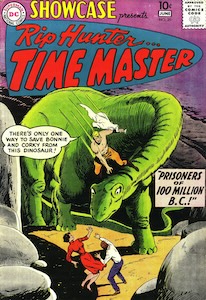
Buddy is meeting with Booster Gold and some of the Time Masters (Rip Hunter, Jeff Smith and Bonnie Baxter are present). These Time Masters (as well as Bonnie’s brother Corky, who doesn’t appear here) first appeared in Showcase #20 (May 1959) [pictured] as adventurers who use Hunter’s Time Sphere to travel through time. Morrison had mentioned that Rip Hunter would appear in the pages of Animal Man as early as 1988.[4] Booster Gold is a post-Crisis character whose origin is explained in the notes to issue #20 (panel 15:2).
Rip Hunter’s first post-Crisis appearance came in Booster Gold #13 (Feb. 1987) where he is developing time travel technology in a mountain lab in New York. Rip appears in a few more issues of Booster Gold, during which time the Time Sphere is destroyed. The Time Masters receive their own series in 1990 that establishes their post-Crisis continuity. In Time Masters #1 (Feb. 1990), Rip and Jeff are working for Will Magnus when their lab is destroyed. It’s established that each traveller can only use any method of time travel only once, so the pair begin work on another method so that they can prevent a nuclear war instigated by the secret society, the Illuminati. The Time Masters, through Booster Gold, ask the superhero community for volunteers to help them. Bonnie joins the team in the same issue after responding to a job advertisement.
This scene from Animal Man #22 also occurs at the end of Time Masters #4 with a few differences. Panel 1 here shows the setting as the destroyed lab, but the conversation in the Time Masters issue occurs in Cave Carson’s underground base. The dialogue from panel 1 here is similar to TM #4 page 24:4, and the dialogue from panel 2 is similar to TM #4 page 24:3. The Time Masters are wearing different clothes in each issue. The inoperable Time Sphere is shown in panel 2.
Page 4, panel 3
Buddy’s dialogue is taken from TM #4 page 24:3.
Page 4, panels 4-5
The dialogue is different in the Time Masters issue but the concept is the same: Rip is reluctant to help and has to be persuaded by Bonnie and Jeff.
Page 5, panel 1
The dialogue is different but, in both issues, Buddy lies to Rip in order to borrow a time travel device. Here Buddy mentions the Time Commander (who we have met) and the Lord of Time. Buddy is likely referring to Epoch, a recurring enemy of the Justice League who first appeared in Justice League of America #10 (Mar. 1962).
Page 5, panel 4
The dialogue is similar to TM #4 page 25:4. The unit was damaged in Time Masters #3 when Corky accidentally travelled back to a prehistoric era.
Page 5, panel 5
Buddy and Rip have met many times. Rip was a member of the Forgotten Heroes, and they also went into space together during the Crisis. Its unclear why he and Rip don’t remember each other as Buddy recalled Dolphin in Animal Man #15 and she had been on many of the same adventures. Jonathan Woodward[5] suggests this is due to Rip’s association with the Forgotten Heroes being removed from Rip’s continuity, while Buddy still remembers the Forgotten Heroes.
Page 7, panel 1
In this panel, Hayden is addressing the reader and accusing us of being perverts.
Page 7, panels 5-7
Hayden seems to conjure a copy of The Flash #123 (Sept. 1961). As explained in the annotations for Animal Man #8, this contains the ‘Flash of Two Worlds’ story where the Golden Age Flash (Jay Garrick) meets the Silver Age Flash (Barry Allen). This issue introduced the concept of the Multiverse to DC continuity.
Woodward[6] suggests that the physical comic must come from Earth-Prime, which was destroyed during the Crisis. Earth-Prime refers to a universe where superheroes are fictional and only exist in comic books – basically, our reality, and those of DC’s writers. Earth Prime first appears in The Flash #179 (May 1968) when the Flash accidentally gets stuck there (here) and needs assistance from editor Julius Schwartz to return to Earth-1. Earth Prime deviated further from our reality when it received its own superhero, Ultraa. Earth-Prime was removed from continuity by the Crisis though Morrison and their native Glasgow seem to exist in an Earth Prime-type world when they appear in the pages of Animal Man.
The comic book page on panel 5 that says “No pain no gain” (a phrase that is repeated by Hayden) is from another Charles Atlas bodybuilding advertisement (see also the annotations for Animal Man #17, page 9:1). I don’t believe that such an ad ran within The Flash #179. Morrison seems to have an interest in these Atlas advertisements and around this time they created the superhero Flex Mentallo who was empowered by Atlas’ bodybuilding program.
Pages 9-10
This double page spread forces the reader to turn the pages anti-clockwise to read the captions. In the background we see (clockwise from the top of the page):
- Swamp Thing, who is a plant with the consciousness of a human, Alec Holland. He first appeared in House of Secrets #92 (June/July 1971) and I have written extensively about the character. Throughout 1989, Swamp Thing spent much of his series travelling through time, having been thrust into the past through exposure to a piece of amber that contained a prehistoric version of himself. At one point in this story arc, he collided with Hunter’s Time Sphere in Swamp Thing #86 (May 1989). Buddy refers to Swampy when he mentions “something that feels like a forest”.
- Both the Golden and Silver Age (or Earth-2 and Earth-1) Flashes racing each other.
- The Time Sphere.
- The villainous scientist T.O. Morrow, who first appeared in The Flash #143 (Mar. 1964) and was able to see into the future and steal technologies. He later fled to Earth-2 and fought both the Justice Society and Earth-1’s Justice League. His post-Crisis continuity has not been established yet in 1990.
- Mordru, a bearded sorcerer who first appeared in Adventure Comics #369 (June 1968) where he pursued the Legion of Superheroes from the 30th to the 20th Century. He also fights both the JSA and JLA in Justice League of America #147-#148 (1977).
- Epoch, the Lord of Time, who Buddy mentioned earlier in the issue. He can time travel using his chrono-cube. Like other villains who can time travel, he fought both Earth-1 and Earth-2 heroes.
- At the bottom of the page are Kid Eternity and Mister Keeper; Quality Comics characters who first appeared in Hit Comics #25 (December 1942). Kid Eternity can summon any real or fictional historical figure, and Keeper is his guardian. The Quality characters were purchased by DC in the 1950s. Morrison would soon revive these characters for a 1991 miniseries.
Page 11
Buddy has travelled back to the end of Animal Man #8. Buddy and Ellen’s dialogue in panels 2-4 is the same as in issue #8, page 21:5-7. Ellen is wearing a different outfit here.
Page 12
This part of the conversation was not included in issue #8.
Page 13
Here, Buddy has travelled back to Animal Man #9, page 11, though Cliff is wearing different clothes.
The “Woods decay…” quote in panel 6 is from Lord Tennyson’s poem Tithonus, completed in 1859[6]. In the poem, the Greek mythological figure Tithonus has been granted immortality but still ages. He asks his lover Eos (who is a goddess that possesses “immortal youth”) to make him mortal again so that he may die.
Buddy wonders whose thoughts they are (they are Morrison’s).
Page 14, panel 1
The man is using the term ‘Buddy’ as in “friend” and can’t actually see Animal Man.
Pages 14-15
The interaction with Maxine on these pages is taken from Animal Man #14, pages 1-4. Page 15:3 is taken directly from Animal Man #14, page 3:6.
Page 16
This scene is also taken from Animal Man #14, pages 12-13. Panel 1 here is very similar to Animal Man #14, page 12:4.
Page 17
This scene is also taken from Animal Man #14. Panel 3 references issue #14, page 11:6. Page 4 is from issue #14, page 14:6, and the glass breaks on page 15:3.
Page 18
This scene is from Animal Man #14, with Ellen exclaiming “It’s him!” on page 20:4.
Buddy writes the date of his family’s murder (27 9) on the window because he remembered that occurring. This is known as an information loop or bootstrap paradox, where the event keeps occurring but there is no known first occurrence. The events are unfolding how Buddy remembered them, suggesting that he is not able to affect what is occurring.
Page 19
This sequence is from Animal Man #14, pages 22-23.
Pages 20-22
It’s finally revealed what Buddy means when he says “When I was ten […] I saw you”. Buddy meets his childhood self in around the year 1969.
Page 23, panel 2
Buddy thinks the phrase “time in a bottle”, which is the name of the issue. The Jim Croce song is about a wish to preserve time so that days last forever, which is really the opposite of what Buddy is thinking about.
 Page 23, panels 3-6
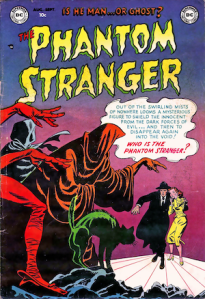
Buddy is approached by the Phantom Stranger. Phantom Stranger first appeared in Phantom Stranger #1 (Aug. 1952) [pictured] and, like Mirror Master and Elongated Man, was created by John Broome and Carmine Infantino. A second series ran between 1969 and 1976 with the first three issues consisting of reprints. From issue #4 (Dec. 1969), Phantom Stranger became more of an omniscient hero that wandered the Earth and fought supernatural threats, and was always seen wearing an amulet. When asked who he is, Phantom Stranger often mentions that he is “just a stranger”. His origin was not fully explained at this point but four possible origins were provided in Secret Origins #10 (Jan. 1987), most of which involved him being cursed for affronting Jesus or God. A much later origin story presented in Phantom Stranger #0 (Nov. 2012) explains that he is Judas Iscariot.
Page 24, panel 1
This page is referred to as a Prologue even though it appears at the end of the book. I assume that this is a reference to the time travelling that has occurred throughout the issue.
Page 24, panel 4
The “Wanted” poster refers to Ultraman from Earth-3 – a universe that was destroyed during the Crisis. We will meet Ultraman and his colleagues in the next issue.
Another image in this panel shows someone being handled by people wearing uniforms emblazoned with swastikas. Presumably this is a reference to Earth-X, a reality where the Nazis won a prolonged World War II. Earth-X first appeared in Justice League of America #107 (Oct. 1973) and was home of the Freedom Fighters: a team of superheroes that DC had acquired from Quality Comics in the 1950s. Earth-X was merged with several other Earths during the Crisis to become a single post-Crisis Universe.
Back Matter:
Letters:
The letters are written in response to Animal Man #18.
The first letter makes reference to Morrison’s final issue being Animal Man #26, so Morrison had already announced their intention to leave the series by this point.
The third letter equates Buddy with the mythical Oedipus, who paid a heavy cost for learning the truth.
The fourth letter presents another defence of animal experimentation. The writer provides an example where treatments developed by such experimentation have helped save another animal species from extinction.
The sixth letter shares an (ultimately incorrect) interpretation of the petroglyph. The writer predicts that there are multiple Animal Men from the various Earths and that these have not been successfully absorbed into the ‘post-Crisis’ Animal Man. This risks causing a second Crisis.
References:
[1] According to https://avp.fandom.com/wiki/Christopher_Taylor
[2] Martin, Gary. “Time and tide wait for no man.” Phrase Finder, https://www.phrases.org.uk/meanings/time-and-tide-wait-for-no-one.html
[3] You can read the poem here: https://www.poetryfoundation.org/poems/44688/to-his-coy-mistress
[4] Millar, Mark. “Grant Morrison Talks to Mark Millar.” FA, no. 109, Jan. 1989, p. 36. Scans available at https://sites.google.com/deepspacetransmissions.com/deepspacetransmissions/interviews/1980s/fa-109-1989
[5] Woodward, Jonathan. “Crisis-Relevant Text: Grant Morrison’s Animal Man #8-26”. The Annotated Crisis on Infinite Earths. Archived at https://web.archive.org/web/20210623061928/https://www.prismnet.com/~woodward/chroma/crtanimal.html.
[6] Ibid.
[7] You can read the poem here: https://www.poetryfoundation.org/poems/45389/tithonus
 Wild Planet