Animal Man #21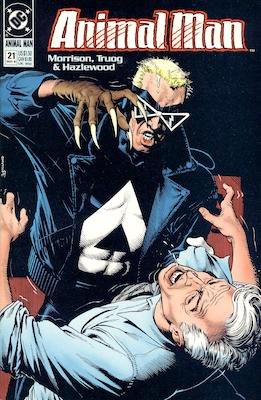
“Tooth and Claw”, March 1990
Credits:
Grant Morrison [writer]
Chas Truog [artist]
Doug Hazlewood [artist]
John Costanza [letterer]
Tatjana Wood [colorist]
Art Young [associate editor]
Karen Berger [editor]
Brian Bolland [cover (uncredited)]
Front Matter:
Cover:
Buddy, with a claw for a hand, fights Lennox.
Inside Cover:
The ‘DC Checklist This Week’ section includes the following description of Animal Man #21: “The ultimate revenge story: Animal Man’s true powers come to the fore – but at what cost?”
Story:
Page 1, panel 1
Travis Bickle is a fictional character played by Robert De Niro in the film Taxi Driver (1976), directed by Martin Scorsese. Bickle is mentally unstable and frustrated with his life and environment. He eventually cuts his hair into a mohawk and plans to assassinate a presidential candidate, but instead kills the pimp of a young prostitute.
Callahan notes that this is the first time in the series that the reader is looking through Buddy’s eyes, and that “Morrison seems to be playing with the tradition of hero identification […] while at the same time, undercutting the glory of such a role by referencing the unstable Travis Bickle”.[1]
Page 1, panels 3-5
Buddy keeps repeating that he must stop thinking and “become an animal” (though he already is one). B’wana Beast expressed something similar in Animal Man #3, page 12. Both characters are regarding non-human animals as incapable of reasoning and instead acting on savage impulses. Buddy probably understands that, if he stopped to think about it, he’d realise that what he is about to do is morally questionable. Buddy wears leather boots instead of his usual costume in an attempt to bring himself physically closer to an animal. In Animal Man #17, it’s revealed that Buddy and Roger were into punk music when they were teenagers, and the boots originate from that time.
Singer explains that this issue is Morrison’s parody of the violent “realism” that had come to define contemporary superhero comics, and in this panel Buddy is “narrating his transformation in the clipped, faux hard-boiled style of the time”.[2]
Page 2
This is the title page. The title ‘Tooth and Claw’ may be taken from Lord Tennyson’s poem In Memoriam A.H.H., published in 1850 as an elegy for his friend. The poem popularised the phrase “red in tooth and claw” referring to the savagery of nature, though “tooth and claw” was a term used prior to Tennyson.[3]
Buddy’s dark costume was seen on the washing line in issue #17 when Buddy mentions he hasn’t worn it since he was 21. Buddy learned Mirror Master’s real name when they first met in Animal Man #8.
Job Number: G-5337 appears within the indicia.
Page 3, panel 1
Mirror Master is also seen with a can of drink when meeting with Lennox in Animal Man #17.
Page 3, panel 5
High Heejins (sometimes spelled as high heidyins) roughly translates to a ‘high head one’ and means bosses or “powers-that-be”.[4]
Page 3, panel 6
Mirror Master warned Buddy to cease his activist activities in Animal Man #8.
Page 3, panel 7
Lennox was only referred to as The Owl in the last issue, not the White Owl. The name may be due to Lennox having white hair.
Page 4, panel 1
Fish usually smell using their nostrils, though some catfish (which are related to minnows) have chemoreceptors across their entire bodies that allow them to taste and smell using their skin.
Page 4, panel 6
Buddy confirms the detective’s theory that Lennox accessed the house via the transporter. This suggests that Lennox wasn’t acting alone if both his black sedan and a moving van were in the area. Perhaps he knocked on the door first to check that Ellen was home. In the case of the Linfield hit, Lennox shot his targets from the front door, but maybe the Bakers’ security system wouldn’t have allowed that.
Page 5, panel 4
British Telecom was a British telecommunications company. It was government-owned until 1991 when the UK government sold its remaining shares and the company’s trading name changed to BT.
Page 5, panel 5
Mirror Master opens another can, but we don’t see what has happened to the last one he was drinking from.
Mirror Master hadn’t been paid for his services by the end of issue #8, so maybe his outstanding payments still relate to his job threatening the Bakers.
Page 6, panel 1
Charybdis is the name of a sea monster in Greek mythology that could create whirlpools capable of destroying ships.
Page 7
The scene of this villain drowning (whose name is later revealed to be Elson) is similar to the page in Animal Man #15 when Ongur is underwater. Panel 3 here is particularly reminiscent of page 23:5 of issue #15, with Buddy tapping Elson on the shoulder here instead of the dolphin coming eye-to-eye with Ongur. This time, the drowning man is not rescued.
Death by drowning is commonly referred to as being a peaceful way to die, and there is anecdotal evidence from drowning survivors to support this, but the experience may not be limited to only drowning deaths.[5]
Page 8, panels 1-2
There is still no explanation of why the Linfields were killed, but it may have just been another job for Lennox. Perhaps they were involved in environmental activism in some way.
Thirtysomething was an American drama television series that ran for 4 seasons between 1987-1991. The image in panel 1 is likely supposed to depict literature professor Gary Sheperd, played by Peter Horton. In an incredible coincidence, the Gary Sheperd character is killed in a car accident in a 1991 episode when he is taking a copy of Through The Looking Glass… to his friend Nancy. He later returns as a ghost who enters a room through a mirror.
Page 8, panel 6
Lennox is taking an insulin injection, so he is diabetic. He may be experiencing hypoglycaemia which may be contributing to his sweating on panel 3. His condition doesn’t have any impact on the story but it’s notable that insulin is frequently championed as a product discovered through animal testing, though there are activists who have argued against the importance of vivisection to the discovery and development. The insulin to treat diabetes was originally extracted from animal pancreases until a synthetic version was developed in the 1980s.
Page 9, panel 1
In 1981, President Ronald Reagan did inaccurately claim that “Trees cause more pollution than automobiles do” referring to hydrocarbons emitted by trees in hot weather. These hydrocarbons may combine with other emissions (from automobiles, for example) to contribute to ozone pollution.[6]
Some sort of burrowing mammal (perhaps a gopher) can be seen in the foreground.
Page 10, panel 5
The line “down among the dead men” refers to an English folk song of the same name that dates from at least the 18th century. In the song, the “dead men” refer to empty liquor bottles.
Page 11, panel 2
It’s true that superheroes traditionally don’t kill people, but that rule is less adhered to in the Modern Age of Comics, which is considered to have commenced in the mid-1980s. For example, Marvel’s The Punisher (whose first series debuted in 1986) is a brutal antihero who kills villains. Writer/illustrator Frank Miller helped usher in the Modern Age with his violent titles that included The Dark Knight Returns (1986), though Batman stops short of directly killing anyone in that series. Buddy has already killed two people in this issue. Here Morrison is engaging with the current trend of serious, violent heroes, even giving Buddy an edgy new appearance.
Page 12, panel 1
A Batman logo can be seen on a billboard in the background. There’s no good reason for this to exist in the DC Universe, and for the bat signal to be trademarked, so this is probably a reference to the Batmania that was gripping the real world at around the time of the 1989 Tim Burton Batman film.
Buddy is wearing his regular old jacket that appears on the covers and in early issues of the series. Issue #17 was the last time he wore “Truog’s” jacket (see the notes for Animal Man #13, page 4:5). Since then, Buddy has been wearing his original jacket but hasn’t been in costume. In this issue he is back in costume (albeit a new one) but wearing his original jacket.
Page 12, panel 2
A chib is Scottish for a shiv, or makeshift knife.
Page 12, panel 3
Buddy is taking a deterministic viewpoint. He is suggesting that he is not responsible for his actions as he is not truly in control of his life.
Page 12, panel 4
In Scottish, to be talking mince is to be talking nonsense. It may relate to the idea of someone “mincing their words”, or speaking indirectly.
Page 12, panel 6
In Scottish slang, a rammy (or rammie) is a street fight.
Page 13, panels 3-4
Brumley is singing ‘That’s Amore’, first performed by Dean Martin in the 1953 film The Caddy.
Page 13, panel 5
The word ‘Vikings’ on the sports pages of Brumley’s newspaper may refer to the NFL team the Minnesota Vikings. Chaz Truog is from Minnesota.
Page 14, panel 6
Scots occasionally use ‘jaisket’ for jacket.
Page 15, panel 1
Mirror Master refers to a blank check book as a “Blankety Blank check book”. Blankety Blank was the name of a British comedy game show that ran throughout the 1980s.
Page 15, panel 3
“That’s sweetie money” – Mirror Master is suggesting that the amount Brumley has offered is only enough to buy candy.
 Page 16
“Shoot the craw” is the Scottish version of the idiom “shoot the crow” meaning “to leave quickly”. I’m not sure of the origin of the phrase but some websites suggest that it’s rhyming slang for “go”.
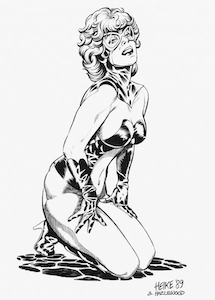
The billboard seen in the corner is advertising Coors beer. It is signed “Heike ’89”. Mark Heike had collaborated with inker Doug Hazlewood on Nightveil for AC Comics and, at the time of Animal Man #21, they were probably working together on ‘The Girls of the FemForce’ portfolio. Together, they created a pinup of Ellen Baker in the same year [pictured].[7] Perhaps Heike helped with some pencilling or inking in this issue.
Page 21
Flies perceive time up to 4 times faster than humans[8] (not 10 times as suggested by Buddy) and they are one of the species that perceives time the fastest.[9] Note the similarities between the Bug-Man suit and the fly’s head in this panel.
Page 22
Buddy mentions two types of electric fishes: the electric eel and electric ray. Both are freshwater fish that can use special organs to produce an electric charge and stun prey. An electric eel can discharge 3-4 times more volts than the most powerful species of ray, and is capable of killing a human.
Page 23, panels 4-5
Again Buddy doesn’t want to think about what he’s going to do so insists that he “must be an animal”, though an animal wouldn’t go this far out of their way to seek revenge. In Ecce Animot[10], the author suggests that Buddy’s removal of the jacket relates to his shedding of his humanity, however he is actually picking it off the ground in this panel after discarding it when it was on fire. His donning of a taloned glove, however, is definitely part of his transformation into an “animal”, as was his wearing of leather boots.
Page 24, panel 2
Buddy ultimately finds his violent actions unfulfilling, despite the modern trend in comics that sees violence as a solution. The reader knows by now that Buddy is not a violent person by nature, and has previously elected to avoid confrontation when possible. As Elizabeth Sandifer notes, “Morrison was still rejecting the grim and gritty aesthetic, but they were by this point doing it by showing its failures, allowing its logic to reach the collapse Morrison had by early 1990 been arguing for years was inevitable.”[11]
Page 24, panel 3
Mirror Master disappeared to steal objects from the offices and has picked up what looks like a trophy and a picture frame, or perhaps a mirror.
Back Matter:
Letters:
The letters respond to Animal Man #17. Some of the letters praise Bolland’s striking and discomforting cover. The second letter suggests that environmental action must remain non-violent. Most writers voice their own opinions about what is right and wrong when it comes to the torture and killing of animals.
References:
[1] Callahan, Timothy. Grant Morrison: The Early Years. Sequart Research & Literacy Organization, 2007.
[2] Singer, Marc. Grant Morrison: Combining the Worlds of Contemporary Comics. University Press of Mississippi, 2012, p. 61.
[3] Martin, Gary. “Red in tooth and claw.” Phrase Finder, https://www.phrases.org.uk/meanings/red-in-tooth-and-claw.html
[4] Scott, Maggie. “Scots Word of the Week.” The Herald, 24 Dec. 2005, https://www.heraldscotland.com/news/12447629.scots-word-of-the-week/
[5] Tipton, Michael, & Montgomery, Hugh. “The experience of drowning.” The Medico-legal journal, vol. 90, no. 1, Mar. 2022, pp. 17–26, https://doi.org/10.1177/00258172211053127
[6] Radford, Tim. “Do trees pollute the atmosphere?” The Guardian, 13 May 2004, https://www.theguardian.com/science/2004/may/13/thisweekssciencequestions3
[7] The image is taken from https://www.comicartfans.com/gallerypiece.asp?piece=835251, uploaded by Doug Hazlewood from his collection.
[8] Taylor, Lenore. “Time passes more slowly for flies, study finds.” The Guardian, 16 Sept. 2013, https://www.theguardian.com/science/2013/sep/16/time-passes-slowly-flies-study
[9] British Ecological Society. “Which animals perceive time the fastest?” ScienceDaily, 20 Dec. 2022, https://www.sciencedaily.com/releases/2022/12/221220113053.htm
[10] Mahmutovic, Adnan, et al. “Ecce Animot: Or, The Animal Man That Therefore I Am.” ImageTexT: Interdisciplinary Comics Studies, vol. 8, no. 2, https://imagetextjournal.com/ecce-animot-or-the-animal-man-that-therefore-i-am/.
[11] Sandifer, Elizabeth. “Live With The Contradictions (Book Three, Part 6: Animal Rights, Psycho Pirate).” Eruditorium Press, 3 May 2021, https://www.eruditorumpress.com/blog/live-with-the-contradictions-book-three-part-6-animal-rights-psycho-pirate
 Wild Planet