Animal Man #2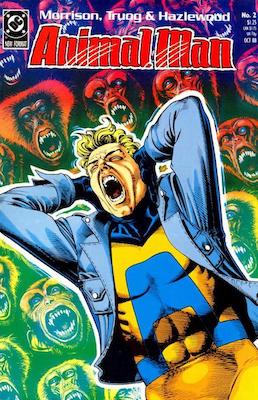
“Life in the Concrete Jungle”, October 1988
Credits:
Grant Morrison [writer]
Chas Truog [penciller]
Doug Hazlewood [inker]
John Costanza [letterer]
Tatjana Wood [colorist]
Karen Berger [editor]
Brian Bolland [cover (uncredited)]
Front Matter:
Cover:
Buddy is distressed on a backdrop of screaming primates. Animal Man’s costume again has the extended ‘A’ throughout this issue, though it’s often difficult to see because of the jacket.
On the cover images, Brian Bolland explains:
I much prefer story-specific covers as opposed to the generic poster shot […] I always thought 2000 AD had a mixture of action, horror and comedy that worked very well and I wasn’t seeing quite that combination in American comics at the time. I’m happy with that combination and the Animal Man covers allowed me to do that. If I remember correctly I usually had a script to read for the covers. I went along and put stars on the pages of script where something was happening that I thought would make a cover. Quite often I was coming up with ideas that meant something to me that probably wouldn’t have been noticed.[1]
The cover for issue #1 could definitely be considered a “generic poster shot” but, from issue #2, Bolland interprets scenes from the interior story, usually showing Buddy (or another animal) in a state of suffering or confusion.
Inside Cover:
The ‘DC Checklist This Week’ section includes the following description of Animal Man #2: “Life in the concrete jungle reaches a dead heat as Animal Man battles the beast that stalks San Diego.”
Story:
Page 1
Sheba is the cat that Violet Weidemeir mentioned was missing in the previous issue.
Job Number: G-3504 is visible in panel 4.
Page 2
This is the title page. As on the previous page, this page opens with a completely black panel.
Page 3
Disturbingly, the mass of monkeys is still alive.
Page 4
Dr. Myers explains that an 8-foot cockroach broke into the lab, but this is obviously not the same Beast that we saw reach S.T.A.R. labs in the previous issue.
Page 5, panel 2
We get another reference to the biblical Adam and a “fall”.
Page 6
From the Beast’s narration we can assume that the monkey fusion didn’t go to plan. The Beast crushes a brick with his hand as a show of his superhuman strength and of his opposition to civilisation.
Page 7
The bubbles around Buddy’s head (referred to as “squeans” in Mort Walker’s The Lexicon of Comicana) indicates that he is feeling a bit unwell or disoriented after picking up tracking abilities from a dog that is being used as a test subject. He also picks up the flying power of a bird, as flying seems to be his preferred means of travel.
Page 8
Sheba’s killing of the mouse is revealed to be for the purposes of survival for her kittens, in contrast to the humans’ killing of the deer for sport. Ray and his friends make more references to cartoon characters – this time Walt Disney’s Bambi and Donald Duck. (The first panel of the next page also mentions Disneyland). Panel 6 includes another reference to the Garden of Eden.
Page 9, panel 2
Buddy describes having incredible sensory powers but uses these to experience some rather boring objects in his vicinity. Wallin notes that “Morrison juxtaposes such potent animal-becomings to the banality of bourgeois suburbanism.”[2]
Page 9, panel 3
Animal Man is listening to his walkman again, but it isn’t visible like it was in issue #1. ‘Teenage Lobotomy’ is a Ramones song from their third album Rocket To Russia, released in 1977. The lyrics concern a teenager who has suffered brain damage from exposure to DDT, an insecticide that has largely been banned because of its damaging effects on humans, other animals and the environment.
Page 9, panel 4-5
The destination sign on the bus suggests that it is travelling down Market Street and 35th. Market Street (which was briefly renamed Martin Luther King Way in 1986-87) is a major thoroughfare in San Diego. Though a few bus routes travelled down this road, I don’t see any reference to route 135B on old transit maps (if that’s what this number refers to), and I don’t believe Market intersects with 35th St. Howard Johnson’s was a large restaurant and hotel chain, which may have had multiple locations in San Diego at the time.
Page 10
The skateboarder Jaime is wearing an Anthrax t-shirt – one of the “Big Four” thrash metal bands of the era along with Metallica, Slayer and Megadeth. Anthrax, the bacterial disease, will soon become part of this story.
The other superheroes who have signed the book are all ‘Justice League’-tier superheroes. Judging from Blue Beetle’s autograph, the kid asks all the heroes to write the same phrase. Animal Man doesn’t look much like Aquaman (of the underwater kingdom of Atlantis), though they both often wore a lot of orange.
Page 11, panel 3
The call of “Kiuuiii” is made by the Beast, who we will meet next issue.
 Page 11, panel 6
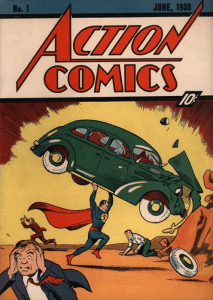
Superman needs no introduction. He is the archetypical superhero since his first appearance in Action Comics #1 (June 1938) [pictured left] and arguably DC’s most well known character. He was the only survivor of the planet Krypton, sent to Earth in a spaceship by his parents as a baby just before his planet was destroyed. He has superpowered senses, can fly, and is practically invulnerable. Note that Superman is illustrated in a position of prominence over Buddy in every panel they share in this scene, sometimes even obstructing our view of Buddy.
Page 12, panel 1
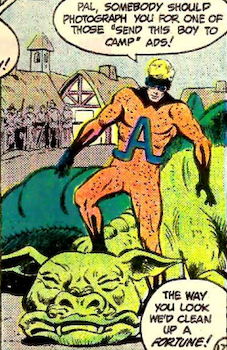
Superman and Buddy have met several times before in the pages of Action Comics and DC Comics Presents. Buddy actually beat him in a fight when Superman was transformed into a dragon in DC Comics Presents #77 (Jan. 1985) [pictured below].
Page 12, panel 5
Port Townsend in Washington state is about 1300 miles away, so Superman’s hearing is really quite super. Wallin points out that, though Superman is quick to respond to a human distress call hundreds of miles away, he does nothing to relieve the suffering of animals being vivisected nearby.[3]
Page 12, panel 6
‘Superman’ is a song by The Clique released in 1969, and later covered and released by R.E.M. in 1986. The song is not literally about Superman, but makes a subtle reference to his X-ray vision.
Page 13, panel 1
The wall is graffitied with the initials C.T. and D.H., which presumably represents the artists Chas Truog and Doug Hazlewood. CT/DH is also seen on a scrap of paper on the final page of the issue.
Page 14
Buddy has seemingly called up Ellen just to tell her about his encounter with Superman.
Page 15, panel 7
The Rainbow Bears might be analogous to Care Bears (a popular toyline and cartoon in the 1980s), which might make Mr. Grizzly a version of Grumpy Bear.
Page 17
Buddy takes on the strength of a praying mantis. Buddy seems to have reached out to the insect and absorbed its abilities without specifically focussing on any specific trait, and then only considered what he had “picked up” later on.
Page 18
There are more references to the Garden of Eden, including the presence of a snake, with Ellen explicitly compared with Eve.
Back Matter:
There is no letters column yet, but instead a piece by Grant Morrison explaining how they came to be writing Animal Man. Morrison also makes mention of Buddy being in a comic book “Limbo” throughout the 1970s, and again after the Crisis.
Following Morrison’s text is an image of the cover of issue #3 with incomplete colours.
References:
[1] Srbek, Wellington. “A brilliant artist from cover to cover: an interview with Brian Bolland, part3.” Mais Quadrinhos, 25 July 2009, http://maisquadrinhos.blogspot.com/2009/07/brilliant-artist-from-cover-to-cover_25.html
[2] Wallin, Jason. “Evolve or Die! Enmeshment and Extinction in DC’s Animal Man.” Closure: Kieler e-Journal Für Comicforschung, no. 7, 2020, p. 22. https://www.closure.uni-kiel.de/closure7/wallin
[3] Ibid., p. 25.
 Wild Planet