Animal Man #19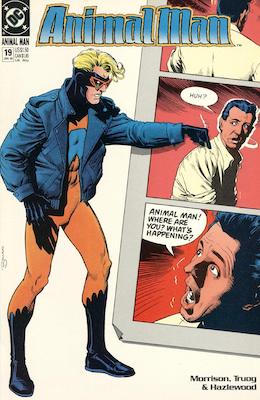
“A New Science of Life”, January 1990
Credits:
Grant Morrison [writer]
Chas Truog [artist]
Doug Hazlewood [artist]
John Costanza [letterer]
Tatjana Wood [colorist]
Art Young [associate editor]
Karen Berger [editor]
Brian Bolland [cover (uncredited)]
Background:
In an interview in Amazing Heroes #176 (not actually published until a few months after Animal Man #19), Morrison gives a preview of what happens in this issue:
The one I’m writing at the moment – #19 – reveals the secret of the universe. The secret of the universe will appear on page 11 of Animal Man #19. The Red Indian Guy’s a major figure who appears in a two-issue peyote trip where Animal Man finds out the secret of the universe, and all about how he came to be. All the questions that weren’t answered in the Secret Origin.[1]
Front Matter:
Cover:
Animal Man is seen outside of a comic book page, interacting with Highwater who exists within its panels.
Inside Cover:
The ‘DC Checklist This Week’ section includes the following description of Animal Man #19: “Animal Man learns the secret of the universe. The hard way.”
 Story:
Page 1
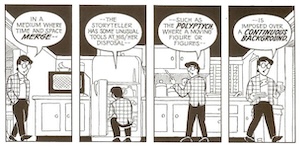
The first page is divided into 6 panels, but they are combined to show a single image of Grant Morrison’s writing room. In Understanding Comics: The Invisible Art, Scott McCloud refers to this as a polyptych, “where a moving figure or figures is imposed over a continuous background”[pictured][2]. This page is a little different as there is no movement by a figure through the image, but the panels nonetheless guide the reader’s eyes through the correct sequence of captions by the narrator.
Panel 1 shows an object labelled “Oxford” weighing down a stack of loose papers.
Panel 2 shows a can of Campbell’s brand soup, perhaps a reference to the series of 32 artworks produced by Andy Warhol in the early 1960s with each work depicting a different flavour of Campbell’s soup. There is also a stack of hardcover books on Morrison’s desk.
Panel 3 shows that the book on top of the stack is a Dictionary-Thesaurus published by Collins. There is also some artwork showing Batman with a shard of glass in his hand. This is an image illustrated by Dave McKean from page 49 of Arkham Asylum: A Serious House on Serious Earth, another work by Grant Morrison that was published slightly before Animal Man #19.
Panels 4 and 5 show David Bohm’s book Unfolding Meaning: A Weekend of Dialogue with David Bohm, which concerns his theories on the implicate order. This cover is from the 1987 ARK edition.
Panel 6 shows the computer. The text on the case of the computer is difficult to read but I’m still confident it’s an Amstrad PCW9512. Unfolding Meaning… actually uses a computer as an analogy for an implicate order, where a computer will “unfold” its data and programming onto a screen display. [3]
Page 2
This is the title page. The title refers to the 1982 Rupert Sheldrake book A New Science of Life: The Hypothesis of Formative Causation, which was referenced in the last issue in relation to his theories of morphic fields
Job Number: G-5319.
Page 3
The sky is red, mirroring what happened immediately prior to the Crisis on Infinite Earths.
Page 4
Panel 2 shows Buddy in a black void, but panel 3 reveals this as the pupil of a giant eye. Something similar happens to Lennox in Animal Man #17.
Page 5
An omnipresent voice announces that everything Buddy has ever known is a hallucination, alluding to the fact that he is a character in a comic book.
Page 6, panel 1
The next two pages are presented as a “Who’s Who” entry for Animal Man. DC Comics published a series titled Who’s Who: The Definitive Directory of the DC Universe between 1985-1987, and further updates were published in 1987 and 1988. Like the Secret Origins series, it was a way for DC to explain the revised histories of its characters post-Crisis. The Animal Man entry appeared in Who’s Who… #1 (Mar. 1985).
In this panel, Buddy wears a Superman t-shirt. I think this is the first time it’s explicitly stated that Buddy gained his powers at age 19.
Page 6, panel 2
Roger’s surname was revealed to be Denning in Strange Adventures #190 (July 1966).
Page 6, panel 3
In Animal Man #12 (page 18:5), the aliens explained that Buddy died in the explosion. See that annotation for further thoughts about this.
Page 6, panels 4-6
The meaning of these panels is still a little unclear but I assume that, if it were not for the aliens, Buddy would usually only conform to the morphic fields relating to his species (human). The aliens put Buddy in touch with a broader field that allowed him to connect to the morphic fields of other species and access their ideal forms and abilities.
I don’t know how this explains how Buddy was able to inherit B’wana Beast’s powers in Animal Man #4. B’wana Beast is a human, but his abilities aren’t (arche)typical of humans. But it’s also possible that, after drinking the elixir and becoming a superhero, B’wana Beast generated his own set of morphic fields that Buddy was able to tap into. The question remains whether Buddy is able to inherit the abilities of other humans or superhumans.
Page 7, panel 2
Animal Man first appears in costume in Strange Adventures #190, and Roger is surprised by this and tries to talk Buddy out of being a superhero. So the superhero idea was certainly not “at Roger’s suggestion” in the pre-Crisis stories.
Page 7, panel 3
Who’s Who… #1 revealed Ellen’s maiden name and the names of their children, though not their ages. In this image, the Bakers may be at Disneyland, though the building does not closely resemble Sleeping Beauty Castle. Cliff wears a t-shirt of the American glam metal band Ratt, which also appropriately refers to the name of an animal.
Page 8
There was quite a lot of red paint that resembled blood in Animal Man #5 and this page resembles page 20 of that issue, when Crafty is travelling between levels of reality. In Animal Man #12, the aliens explained that, when Buddy finds himself in a white space, he is in an area outside of his illustrated world.
Page 9, panel 1
Buddy meets someone who represents the pre-Crisis Animal Man, though the Animal Man of the 1960s never quite appeared like this. Though his costume was scaley, his goggles were never of the triangular design, and his hair was never this short. Pre-Crisis Animal Man accurately describes his origin and early adventures.
Page 9, panel 2
Buddy being sterile was never mentioned in the pre-Crisis issues. This was only revealed by Ellen in Animal Man #11 just before she is disintegrated by the aliens.
Page 9, panels 4-5
Pre-Crisis Animal Man is getting to the point that Morrison is trying to make. Comic characters are harmed, killed or written out of existence for the purposes of entertainment for “them”…
Page 11
…and “them” is us, the readers.
In Supergods, Morrison explains in detail the intention of this page:
“I tried to condense the painful adolescent self-awareness that had come to superhero comics into a single image […] It was the violated superhero finally confronting the voyeuristic reader. I wanted the superhero to face up to us – to challenge the zealous missionary work of [Alan] Moore and his successors, who had inflicted real-world tortures and judgments upon the ethereal, paper-thin constructs of unfettered imagination.“[4]
Jonathan Woodward[5] notes the visual similarities between this page and a panel from Animal Man #10 where Highwater is confronted by the Mad Hatter (page 9).
Page 13, panels 3-5
This is another major theme of the narrative, now made explicit. There are different levels of reality, each more “hellish”, and the creators at each level have the capacity to create a better world through their art. The implication is that there are also levels of reality above our own.
Page 13, panel 6
The incident in the woods occurred in Animal Man #3, which was published more than a year ago, but set sometime in June (as shown on a calendar in issue #1) or July (as shown on the calendar in issue #10). The current issue is set in late September so time is definitely moving more slowly in the Baker’s world.
Page 14, panel 1
Buddy is pointing out some inconsistencies in the plot.
Page 14, panel 3
Buddy is referring to the space between panels, known as “gutters”, that represent a gap in time between one panel and the next. When we see Buddy in his home in one panel, and then in Paris in the next, the reader is left to imagine what happened in the space between these images (e.g. Buddy walked to the teleporter in his house, or he flew through the sky for hours across the Atlantic Ocean). In this sequence, Buddy is suggesting that he is not conscious of what happens in the gutters. Highwater has consistently expressed this in his appearances so far – he has an identity but no memory of his past or of how he gets from location to location. Steven Zani argues that “Animal Man offers an oblique criticism of the desire for completion and satisfaction that comic books offer their audience, and reveals the loose ends and plot complications that occupy the empty spaces of all texts, despite our attempts to narrate them out of existence.”[6] Zani’s point is made both in reference to plot points within Animal Man (as illustrated on this page) but also in reference to the broader continuity that the DC Universe struggles to maintain.
Page 15, panel 1
Bohm’s ideas about the Implicate Order have been explained in earlier annotations. See Animal Man #10 (page 9:3) and the analogy of a holographic plate in Animal Man #14 (page 6:2).
Page 15, panel 2
Here Highwater is talking about levels of reality and linking this to indigenous knowledge. The concept of the Dreamtime in Australian Aboriginal cultures generally refers to a time when ancestral figures existed and the world was being created. In its common usage, the nagual is a human who can shapeshift into other humans or animals. However, in Tales of Power[7] by Carlos Castaneda, in which the author learns from a Indigenous Yaqui named don Juan Matus, nagual is described both as a title for a leader of seers, and also as a realm that is different from our rational reality.
Page 15, panel 4
Singer writes that “Morrison’s inter-connected universes and implicate orders also imply an ethical framework“[8]. The wider effect of one’s actions (from eating meat, to burning down a building) was illustrated several times in Animal Man #17 (aptly titled ’Consequences’).
Page 16
Buddy realises this is a hallucination because “whales can’t open their mouths that way…”. I’m not sure of the basis for that comment, but it’s known that whales have small throats so realistically-sized whales can’t actually swallow humans. This scene recalls one from Carlo Collodi’s 1883 story Le Avventure di Pinocchio (later adapted into the Walt Disney animated film Pinocchio) where Pinocchio and his maker Geppetto are swallowed by an enormous dogfish (replaced by a sperm whale named Monstro in the film). Parallels can be drawn between Buddy and Pinocchio, who was a puppet crafted by a creator but wished to be real. This passage from Pinocchio may itself derive from a story about the minor prophet Jonah who was swallowed by a sea creature in the Book of Jonah which makes up part of the Old Testament of the bible.
Page 17
As on the cover, Buddy leaves the comic page and interacts with Highwater who is still within the panels.
Page 18, panel 1
The Lorenz attractor is sometimes referred to as looking like an owl’s mask. Highwater still seems to be seeing that pattern around the mesa that we observed in the last issue (page 14:4).
Page 18, panel 3
The eagle is still gushing blood.
Page 18, panel 4
A quantum leap in this case refers to a quantum jump – the abrupt transition of an electron in a quantum system (such as an atom) from one energy level to another. Like much of Animal Man, the concept is concerned with the relationship and transition between different (quantum) states and levels.
Quantum Leap was a sci-fi television show popular at the time that involved a scientist who inhabited the bodies of other people to change something about their past lives.
Page 19
The fall from the cliff recalls what happened to Crafty in Animal Man #5, page 12.
Page 21, panel 1
Morrison is making fun of themselves.
Page 21, panel 3
The theory of unification is a hypothetical theory that would unite Einstein’s general relativity (which focuses on gravity and accurately explains the behaviour of large objects such as planets) with quantum mechanics (which is concerned with particles). This is sometimes referred to as a ‘Theory of Everything’. Perhaps Highwater has seen a path towards unification through Bohm’s Implicate Order theory.
Page 21, panel 6
The quote is from the Edgar Allen Poe poem, ‘A Dream Within A Dream’, first published in 1849[9]. Poe was referenced also in the title of Animal Man #7.
The phrase “dream within a dream” infers at least 3 layers of reality – the original reality, the dream, and a dream within that. The layers in this case may be our (Morrison’s) world, Buddy’s world (the DC Universe), and Crafty’s world. Or our creator’s world, our world, and Buddy’s world. It also evokes Alice’s relationship to the Red King in Through the Looking-Glass… (see Animal Man #9, page 8:4-5).
Page 24
Josh Lukin suggests that Buddy is being punished for his search for knowledge, with Foxy warning him that “the truth always costs” on page 16. Lukin equates this with the expulsion of Adam from the Garden of Eden after eating from the Tree of Knowledge.[10] However, the readers are also complicit in the murder, having earlier been told by the Silver Age Animal Man that the violence in Buddy’s world is being enacted by the creator for our entertainment.
Hennum points out that Buddy is actually being punished, by Lennox and his employers, for his direct-action activism.[11] Though the issue “offers a limited critique of capitalists that accurately captures their tendentious use and promotion of legal and extralegal violence to kill […] environmental activists”, by punishing Buddy in this way the text also serves to “scare off” any readers from “emulating him”. Thus, the episode supports Hennum’s overall argument that superhero comics act as “copaganda” that discourage lawbreaking.
Back Matter:
Letters:
The letters are in response to Animal Man #15.
The writers of the second and seventh letters explain how the tuna fishing industry contributes to the death of dolphins.
The writer of the fifth letter does not realise that the depiction of the dolphin slaughter in the Faroe Islands is based on true events, and refers to Buddy’s treatment of Ongur as attempted murder. Art Young responds to explain that Buddy’s actions will be addressed in a future issue.
Other readers found that they approved of Buddy’s behaviour, only to then be shamed by the dolphin at the end of the issue, who explained that “our way is different” and showed Ongur mercy.
The writer of the eighth letter notes that Virgil (referenced in Animal Man #15, page 16:6) traveled only between the Inferno and Purgatory in Dante’s Divine Comedy, and links this also to the issue title “[between] The Devil and the Deep Blue Sea”.
References:
[1] Maddox, Mike. “Arkham’s architect.” Amazing Heroes, no. 176, February 1990, p. 28. Scans available at https://sites.google.com/deepspacetransmissions.com/deepspacetransmissions/interviews/1990s/amazing-heroes-176-february-1990.
[2] McCloud, Scott. Understanding Comics: The Invisible Art. 1993. HarperPerennial, 1994, p. 115.
[3] Bohm, David. Unfolding Meaning: A Weekend of Dialogue with David Bohm. 1984, Routledge, 1987, p. 14
[4] Morrison, Grant. Supergods: What Masked Vigilantes, Miraculous Mutants, and a Sun God From Smallville Can Teach Us About Being Human. Spiegel & Grau, 2011, p. 219.
[5] Woodward, Jonathan. “Crisis-Relevant Text: Grant Morrison’s Animal Man #8-26”. The Annotated Crisis on Infinite Earths. Archived at https://web.archive.org/web/20210623061928/https://www.prismnet.com/~woodward/chroma/crtanimal.html.
[6] Zani, Steven. “It’s a Jungle in Here: Animal Man, Continuity Issues, and the Authorial Death Drive.” The Contemporary Comic Book Superhero, edited by Angela Ndalianis, Routledge, 2008, p. 234.
[7] Casaneda, Carlos. Tales of Power. Simon and Schuster, 1974. The text can also be found online at https://avalonlibrary.net/ebooks/Carlos%20Castaneda%20-%20Tales%20of%20Power.pdf.
[8] Singer, Marc. Grant Morrison: Combining the Worlds of Contemporary Comics. University Press of Mississippi, 2012, p. 59.
[9] You can read the poem here: https://www.poetryfoundation.org/poems/52829/a-dream-within-a-dream
[10] Lukin, Josh. “Childish Things: Nostalgia and Guilt in Grant Morrison’s Comics”. The Comics Journal, no. 176, Apr. 1995, p. 84.
[11] Hennum, Shea. “Are Superhero Comics Copaganda?” Inks: The Journal of the Comics Studies Society, vol. 9, no. 2, 2025, p. 171, https://muse.jhu.edu/article/969126
 Wild Planet