Animal Man #18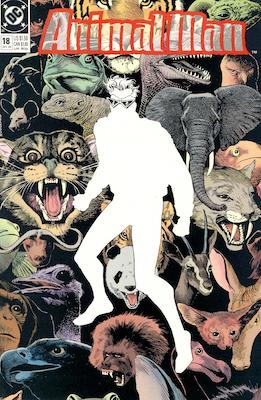
“At Play in the Fields of the Lord”, December 1989
Credits:
Grant Morrison [writer]
Chas Truog [artist]
Doug Hazlewood [artist]
John Costanza [letterer]
Tatjana Wood [colorist]
Art Young [associate editor]
Karen Berger [editor]
Brian Bolland [cover (uncredited)]
Front Matter:
Cover:
The cover shows the outline of Animal Man surrounded by a number of animals (mammals, reptiles, birds and fish).
Inside Cover:
The ‘DC Checklist This Week’ section includes the following description of Animal Man #18: “Everything you’ve always wanted to know about Animal Man’s powers is finally revealed, with the help of the mysterious Dr. Highwater.”
Story:
Page 1, panels 1-5
This scene of Roger and Tricia is from Buddy’s perspective. There is a spot of blood under the sink.
Page 1, panel 6
A VDT refers to a video display terminal: what we’d commonly refer to as a computer screen. This symbol in this panel is a cursor that shows where text would be entered, also known as a caret. I’m not familiar with this design of caret, which looks different than the solid block cursor seen previously on Morrison’s computer in Animal Man #8.
Page 2
This is the title page. The title is displayed on a computer screen, as it may have been when Grant Morrison was scripting the issue. The title, At Play in the Fields of the Lord, refers to a 1965 book of fiction by Peter Matthiessen about two Americans in a remote South American rainforest.
Job Number: G-5259.
Page 3, panel 1
Morrison’s script continues in this panel and corresponds with what Truog and Hazlewood have illustrated.
Page 3, panels 3-6
Maxine continues to holds her Gorilla Miller toy and eerily prophesises about Highwater’s impact on the family.
Page 4, panel 4
At the end of the last issue, the bottom half of Highwater had been reduced to rough pencil drawings.
Page 4, panel 5
Buddy witnessed something similar when Hamed Ali was erased by the aliens in Animal Man #12. Buddy mentions that it is hard for one’s mind to comprehend. It would be difficult to imagine what it would be like to see someone from our reality be reduced to a pencil drawing.
Page 4, panel 6
Highwater previously experienced this phenomenon when driving his car, also in the previous issue. His theory is that someone (presumably their creator, Grant Morrison) is trying to prevent these two characters from meeting. Highwater describes his form becoming “simpler, more primitive”, which I guess accurately describes a reversal of the process of illustration.
Page 5, panel 2
Next to Buddy, we see an image of “Animal Man” from the neck up. I think this is just supposed to depict the recent Animal Man design (not the pre-Crisis deisgn) and represents Buddy thinking about his superhero persona.
Page 5, panel 3
Psycho-Pirate gave Highwater an old comic in Animal Man #10. Highwater expects Buddy to be older because the comic page was from Strange Adventures #184 from 1966. In the revised continuity, Buddy would have been a child in 1966.
Page 5, panel 6
On a modern map, the mesa looks to be in the region of Dilkon or Indian Wells, Arizona. It’s not clear from Highwater’s description, but the Hopi Indian Reservation is surrounded by the reservation of the Navajo Nation, and the mesa is located within the latter.
Page 6, panels 1-2
Highwater first came across a mysterious scrap of paper in Animal Man #9.
Page 7, panels 2-3
Both Buddy and Ellen would like to understand the strange events involving the aliens that resulted in their dematerialisation. They discussed this while strolling along the River Seine in Animal Man #16.
Page 7, panel 4
Cliff wears a “Lestat Lives” t-shirt. In Animal Man #1, Vampire Lestat is mentioned on the cover of a Rolling Stone magazine. This may be a band or artist named after the Anne Rice novel The Vampire Lestat (1985).
Page 8, panel 1
Ellen is referring to Mirror Master, and possibly Vixen who led the aliens’ invisible beasts to the Baker residence.
Page 10
The Native American Church (sometimes referred to as Peyotism) originated in the Territory of Oklahoma in the late 19th century and is the most widespread indigenous religion in the conterminous United States, Canada and Mexico. Peyote refers to the small type of cactus that contains the hallucinogenic agent.
Page 11, panels 2-3
The aliens actually referred to “morphogenetic grafts”.
The concept of the morphogenetic field traces back the early 20th century and is used to explain a finding of embryonic development where cells from, say, a limb area of a embryo can be replaced by other cells and still produce a limb. It seemed that the region (or field) determined a form more than the cells themselves.
The author and parapsychology researcher Rupert Sheldrake expanded the concept in his 1982 book A New Science Of Life to theorise that morphic fields may convey information about biological form, or even memories and abilities, between members of the same species across space and time by a process called morphic resonance. Morphogenetic fields are a subset of morphic fields that relate only to the development of a species’ physical form though, once formed, an organism can then more easily attune to other organisms with a similar form[1]. Sheldrake’s ideas have been criticised for a lack of scientific evidence but have been used to explain the results of older experiments. In one example, some rats were taught how to run a maze. Later generations of the rats were able to run the maze more quickly, even those that were descended from rats who had never run the maze. The theory is that the habitual behaviour (running the maze) reinforced the behavioural field so animals of the same species (and not necessarily descendants of the original maze runners) learned the behaviour quicker, even without any direct communication between the rats.
Sheldrake and David Bohm discussed the relationship between morphogenetic fields and implicate order theory, and the conversation was published in the journal ReVision[2]. Bohm correlates Sheldrake’s morphogenetic fields with the implicate order extension of quantum mechanics (which explains how successive moments in time are related) combined with the principle of quantum nonlocality (describing how particles can react to the states of other particles irrespective of distance between them).
Page 11, panel 5
The peyote ritual of the Native American Church is usually conducted in an overnight ceremony by a fire.
Page 12, panel 2
Peyote is known to taste very bitter, and a general numbness can occur but not specifically of the mouth.
Page 13
A gigantic eye opens and shoots out celestial bodies and colourful objects as it moves towards the pair.
Page 14, panels 2-3
Buddy points out what appears to be our solar system, with moons and planets rotating around the sun. However, Highwater argues that they are actually observing events at a quantum level and witnessing electrons circling around protons. Both perspectives appear to be correct. Highwater also mentions the title of this issue.
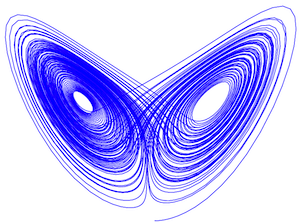 Page 14, panel 4
The shapes around the mesa recall the Lorenz attractor – a graphical representation of three equations proposed by Edward Lorenz initially to calculate an atmospheric condition known as rolling fluid convection. Putting any parameters into the equation results in a chaotic system that is infinite and never-repeating. Any slight change to the parameters returns a wildly different result – what Lorenz referred as as the “butterfly effect” (see the previous issue, page 17, for an explanation of the popular usage of that phrase). The Lorenz attractor is often said to resemble the wings of a butterfly [see picture].
Highwater mentions Kwahu, the name for an eagle spirit (or katsina).
Page 15, panel 2
The fox mentions the “world above”, presumably the reader’s world if Animal Man exists in the “hell above” Crafty’s world.
Page 15, panel 3
Foxy was the name of Grant Morrison’s childhood friend mentioned in Animal Man #10. In The Comics Journal #176, Morrison explains their connection to the fox:
But I did have an imaginary friend called Foxy, and in the period when I was having hallucinations and fevers, everything that I hallucinated had to do with foxes. Since then, I’ve just assumed that it’s some kind of personal totem, and these experiences were this thing trying to reveal itself to me.[3]
In this interview and panel, the word “totem” is used in the sense of a guiding spirit, rather than as an emblem for a family or tribe.
Page 16
This page is similar to the cover but here insects are also included alongside fish, mammals, birds and reptiles.
Page 17, panels 2-3
Highwater begins explaining the morphogenetic field. In the earliest use of the concept, the morphogenetic field provides a “blueprint” only for a region of an embryo. Highwater’s explanation says that a field may contain a blueprint for an entire species, and that field may contain smaller blueprints (for an organ, or limb, etc.). This is moving into the Sheldrake definition of the concept, where morphic resonance reinforces the morphic fields of the species. Morphic resonance can occur across space and time, so Buddy doesn’t “need to be near an animal to absorb its power”, though you’d think Buddy and Ellen would have discovered this when testing Buddy’s powers in Animal Man #1. He can also connect to “every creature that has ever existed”.
“Plato’s archetypal reality” refers to the classical philosopher Plato’s concept of Forms, which are perfect archetypes of all phenomena in the physical world (the ‘essence’ or ‘idea’ of things) and which have existed forever. In the conversation with Bohm for ReVision, Sheldrake differentiates his theory from Plato’s Forms by explaining that “morphogenetic fields are built up causally from what’s happened before”.[4]
In an interview in 1992, Morrison mention the connection they are trying to make between Sheldrake and the beliefs of indigenous peoples:
“One thing I wanted to put into Animal Man was a biochemist [Sheldrake] who’s come up with a completely new theory of evolution; it’s called ‘formative causation’. The idea is that on some platonic reality outside our own there are ideal forms, archetypal forms of all the creatures on Earth. It ties in with the American Indian concept of totem spirits.”[5]
Page 18, panel 1
Prophecy Rock is the name sometimes given to a boulder located on a cliff called Wutatakyawvi, near Kyotsmovi Village in the middle of what is now the Hopi Reservation. Buddy and Foxy appear to have travelled about 50 miles instantly.
Page 18, panel 2
The actual petroglyph (rock etching) looks different than this but similarly depicts human-like figures standing on different levels. In The Invention of Prophecy[6], Armin Geertz suggests that, in the late 19th century, the Hopi people explained the petrograph to geologist John Wesley Powell as depicting a battle against the Spanish. However, other interpretations explain that the etching represents Purification Day (similar to the Christian Judgment day) when Hopi who have lived correctly will enter a new age (the Fifth World) and others will be destroyed.
In the Animal Man version of the petroglyph, we can see what may be an alien ship, interconnected circles (representing the Earths of the multiverse), lightning bolts, and people (some of them wearing hats). Jonathan Woodward[7] suggests that the lightning bolts and/or the figures wearing hats may represent versions of the Flash. (The Golden Age Flash Jay Garrick wore a hat in the style of the god Mercury, while the Silver Age Flash Barry Allen had an important role in the Crisis).
It appears that some of these symbols (the UFO/cloud-shaped object, some of the lightning bolts, and the hatted figures) have been taken from the depiction of the petroglyph from Meditations with The Hopi[8] by the Frenchman Robert Boissiere.
Page 18, panel 5
The second illustration depicts more circles, people, and alien spacecraft. I believe that Woodward correctly identifies these circles (Earths) issuing out of the head of one person.
Page 19
The three figures appear to be katsinam (plural of katsina), which is a term used to refer both to spirit beings and to those who are dressed up to represent them. The quotation on this page and the next is taken from Mediations with the Hopi, specifically Chapter 6 which is concerned with the prophecies surrounding the Day of Purification. The prophecy was recounted to Boissiere by several Hopi. Massoua (or Masauwu) is a major deity of the Hopi who is sometimes referred to as the Spirit of Death and who helped teach humans the proper way to live. A Pahana (or Bahana) is a white person, and a certain “White Brother” will one day appear to the Hopis at the destruction of the Fourth World (the current age) and usher in a new Fifth World[9]. Again this is similar to the Christian story of the Second Coming of Jesus and the Last Judgement. Purification Day is also described as a mystery egg because the outcome of the judgement event is unknown. Morrison is equating Buddy with Pahana, and the dropping of the Atomic Bomb (possibly the Trinity test in nearby New Mexico in 1945) with the mystery egg.
Page 20
Meanwhile, Highwater’s vision sees Kwahu emerge from the world as if Earth were an egg. It recalls a passage in Hermann Hesse’s novel Demian: “The bird fights its way out of the egg. The egg is the world. Who would be born must first destroy a world.”[10]. Though I’m sure that similar symbolism can be found in other literature.
Page 21
The enormous bird has blood streaming out of its body but I’m not sure of the symbolism of this.
Page 22, panels 2-3
You can see the giant eagle’s eye behind Highwater in panel 2, and its full head in panel 3, so the stream of blood showering Highwater no longer seems to be emanating directly out of the eagle.
Highwater’s “This is my body. This is my blood” is taken from the Gospel of Matthew, the first book of the New Testament (specifically Matthew 26:26). This passage recounts an event at the Last Supper where Jesus gives bread and wine to his disciples. These words are recited in the ritual of the Eucharist in some Christian denominations
Page 22, panel 3
A peyote trip can often last 12 hours.
Page 24, panel 3
Ultra, the Multi-Alien, is an obscure DC character who appeared in several issues of Mystery in Space in the mid-1960s. We will meet him later in the series.
Note that the only number we can read on the calendar is 27, which suggests the date is September 27. The numbers 9 and 27 appear several times in Animal Man #14 as a warning to the Bakers.
Back Matter:
Letters:
The first few letters continue the response to the collection of “controversial letters” printed at the end of issue #13. The author of the third letter lists a number of examples where animal testing has been detrimental to the adoption of pharmaceuticals by humans (because the product was safe for animals but dangerous to humans, or vice versa).
The next couple of letters identify the character strolling through Glasgow in Highwater’s dream in issue #14 as Grant Morrison.
The final letter writer draws a connection between the bar Lock 27 (seen on page 7:4 of issue #14) and the number 27 that appears elsewhere in the issue (which we now understand to be a date).
References:
[1] Sheldrake, Rupert. A New Science of Life: The Hypothesis of Formative Causation. 3rd ed., Icon Books, 2009.
[2] Sheldrake, Rupert, and David Bohm. “Morphogenetic fields and the implicate order”. ReVision, vol. 5, no. 2, 1982, pp. 41-48. This article was republished as an appendix in some editions of Sheldrake’s A New Science of Life, and is freely available on Sheldrake’s website here: https://www.sheldrake.org/files/pdfs/A_New_Science_of_Life_Appx_B.pdf
[3] Hasted, Nick. “Grant Morrison.” The Comics Journal, no. 176, Apr. 1995, p. 54.
[4] Sheldrake & Bohm 1982.
[5] Gibson, Gary. “Grant Morrison.” Exuberance, no. 5, Summer 1992, p. 34. Scans available at https://sites.google.com/deepspacetransmissions.com/deepspacetransmissions/interviews/1990s/exuberance-5-1992
[6] Geertz, Armin W. “The Legacy of Prophecy Rock: on the Mutability of Petroglyphs”. The Invention of Prophecy: Continuity and Meaning in Hopi Indian Religion. University of California Press, 1994, pp. 257-287.
[7] Woodward, Jonathan. “Crisis-Relevant Text: Grant Morrison’s Animal Man #8-26”. The Annotated Crisis on Infinite Earths. Archived at https://web.archive.org/web/20210623061928/https://www.prismnet.com/~woodward/chroma/crtanimal.html.
[8] Boissiere, Robert. Meditations with the Hopi. Bear & Company, 1986.
[9] See Geertz 1994, but also: Courlander, Harold. The Fourth World of the Hopis. Crown Publishers, 1971, pp. 30-31.
[10] Hesse, Hermann. Demian. 1919. Harper Perennial, 1999, p. 78.
 Wild Planet