Animal Man #17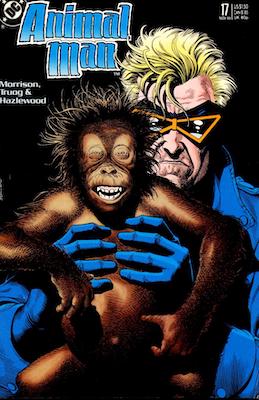
“Consequences”, November 1989
Credits:
Grant Morrison [writer]
Chas Truog [artist]
Doug Hazlewood [artist]
John Costanza [letterer]
Tatjana Wood [colorist]
Art Young [associate editor]
Karen Berger [editor]
Brian Bolland [cover (uncredited)]
Front Matter:
Cover:
The cover depicts Buddy with an adolescent chimpanzee that has had its eyes sewn shut. This is the first issue without the ‘New Format’ text on the cover.
 Story:
Page 1, panels 1-2
Here we see Glasgow from above the Necropolis cemetery. In panel 1, the Glasgow Cathedral is on the left, and the Glasgow Royal Infirmary (with a tower from the Queen Elizabeth Building) in the centre. [Pictured is a photograph from 2019 showing an image similar to panel 2]
Page 1, panels 3-5
This is the first time that the Evan McCulloch Mirror Master has been seen outside of his costume.
Page 2, panel 1
“Never mind the ‘McCulloch’…” may be a nod to the Sex Pistols’ 1977 debut album Never Mind The Bollocks, Here’s The Sex Pistols.
Page 2, panel 2
McCulloch refers to Lennox as Jim, but it’s still not clear whether that’s actually Lennox’s name. McCulloch appears to be leaning on the family memorial of the preacher and theological writer John Dick, with the memorial to minister Duncan Macfarlan in the background, overgrown with a creeping plant.
Page 3, panel 4
The European City of Culture is a title awarded by the European Union by a panel of cultural experts. From 1999, the award was re-titled the European Capital of Culture. In their article at end of issue #2, Morrison also signs off from “The European City of Culture 1990, Glasgow, Scotland”.
Page 4, panel 1
The complete sign would read Riverside Laboratories, University of California.
Page 5
This is the title page.
Job Number: G-5207.
Page 6, panels 3-6
The events in this issue reference the raid of a laboratory at the University of California Riverside campus by the Animal Liberation Front (ALF) in 1985. The ALF freed hundreds of animals, including a macaque with its eyes sewn shut that was dubbed Britches by the scientists. Britches was part of a research program studying the development of infant monkeys when subjected to sensory deprivation. Once the experiment had been concluded, Britches would have been euthanised. The ALF also destroyed equipment in the raid to hamper further such experiments and cause economic losses. The activist here is insinuating that the grant money is the true motivation for the experiment. The cultural anthropologist Barbara Noske coined the expression the ‘animal-industrial complex’ in her 1989 book Humans and Other Animals to describe the systematic exploitation of animals for economic gain. Note that Buddy doesn’t wear his Animal Man costume during the raid, which is clearly against the law and violating the ‘No Trespassing’ sign seen on the exterior of the facility.
Page 7, panel 1-2
Britches regained his eyesight and was rehabilitated by veterinarians and lived in sanctuaries with other rescued animals.
Page 8
Highwater is beginning to understand what the Psycho-Pirate explained to him: that they are comic book characters and their lives are at the whim of the writer. In panel 4, his hands and arms revert back to rough pencil outlines.
 Page 9, panel 1
Cliff is a reading issue #1 of a fictional comic that has “The Tremendous Tachyon Man” on the cover. The term tachyon was coined by Gerald Feinberg in 1967 to describe a hypothetical particle that could travel faster than light. Einstein and others previously described how faster-than-light signals could theoretically be transmitted into the past. This theoretical property of the theoretical tachyon was used as a plot device in the Watchmen series.
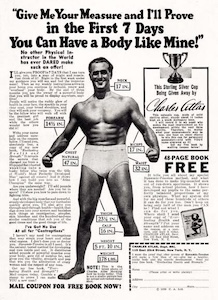
The back cover of the comic references Charles Atlas’ bodybuilding advertisements [an example pictured] frequently found in comic books until the 1970s.
Page 9, panel 2
Cliff has an older style, surfboard-shaped skateboard. An example of this design would be an Earth Ski skateboard that had been produced by the Logan family since the 1970s.
Page 9, panel 3
In the pages of Cliff’s comic, we can read “Faster than a tachyon” (a reference to the Superman tagline “faster than a speeding bullet”) and also the onomatopoeic “Pow” and “Blam” text indicating an action scene.
Page 9, panel 4
Skipper now has the burger.
Page 10
Regarding Buddy’s comment that “nothing exists in a vacuum […] everything is connected”: while Buddy goes on to detail the literal relationship between meat consumption and environmental destruction, Singer[1] relates Buddy’s comments to other themes that have been introduced into the series. In issue #14, the Grant Morrison character mentions Implicate Order theory, which posits that observed phenomena may be an expression of different phenomena in another order of reality. The characters in Animal Man are becoming aware of interconnected universes, and interrelated layers of reality.
Page 11, panel 2
McCulloch uses some peculiar turns of phrase. “You think my head’s buttoned up at the back?” is a particularly Scottish phrase. It means “Do you take me for an idiot” and evokes the image of someone whose brain is removable. “You think I came up the Clyde on a bike?“ relates to the River Clyde in Glasgow so is quite regional. “Away and chase yourself!” is used more generally in the Celtic nations.
Page 12, panel 2
The black costume hasn’t been seen before. If Buddy hasn’t worn that since he was 21, he would have worn it in the very early 1980s according to his revised history.
Page 12, panel 3-6
We learned about the “three firemen injured in a chemical blaze” from Highwater on page 8. Just after lecturing Cliff on the same topic, Buddy is learning that everything is connected, and that the actions of the animal liberators have had unintended consequences.
Page 13, panels 2-3
For Ellen, Buddy has “crossed a line” by harming humans. She may not be aware that Buddy almost murdered the whaler Ongur in Animal Man #15. Ellen’s claim that the activists want to hurt people is unlikely as the firefighters were injured performing their regular duties, though admittedly the activists created a hazardous situation. The ALF claim to take reasonable precautions not to harm humans and non-humans.
Page 15, panel 4
This panel shows Roger discovering the second spaceship. The scene originally appears in Strange Adventures #184 (Jan. 1966, page 3), but the story was revised in Animal Man #12 (page 21) to make the spaceship (the Traveller) different in appearance and to change the time period to the late 1970s
Page 15, panel 5
Roger is wearing a t-shirt that displays the name of the US punk band Ramones. Buddy was listening to the Ramones on his walkman while tracking B’wana Beast in issue #2.
Page 15, panel 6
This recreates the scene from Animal Man #12 (page 21:4) but from a different angle. That was the first time Ellen’s father had been depicted and was a revised version of a scene from Strange Adventures #184 (page 3). Sex Pistols were a UK punk band that broke up in early 1978. Like Buddy and Roger’s band, they had songs about anarchy (not specifically the political theory).
Page 16, panel 1
Roger briefly encountered the aliens and their Xtona beast in Strange Adventures #184 before Roger was hit with the alien’s “hate ray”.
Page 16, panel 2
The panel in the background depicts Jim Morrison, the singer of the rock band The Doors. The poster is based on a 1967 photograph of the singer by Joel Brodsky titled ‘American Poet’.
Page 16, panels 3-6
Roger initially seems to be rebuking Buddy because of his involvement in the injuring of firemen, but he may be just as concerned that Buddy is challenging those in power, even if its only those who are operating unethically.
Page 17
I’m not certain of the significance of the butterfly here, but it’s worth noting that the term “butterfly effect” is used to describe a situation where a small change results in an unintended and more dramatic outcome. The term comes from mathematician and meteorologist Edward Norton Lorenz who explained that an event as small as a butterfly flapping its wings could theoretically influence characteristics of a tornado elsewhere. If these panels are supposed to evoke the “butterfly effect”, it would certainly fit into the issue’s theme of ‘consequences’.
Page 18
Dr. Whitmore appears to be a new character and it’s unclear who the television presenter is. Here Morrison (through Buddy) presents some common arguments against drug testing on animals, including its unreliability. For example, thalidomide was harmful to humans while being safe for animal test subjects, while other drugs (such as penicillin) have harmed animals but are beneficial for humans.
Whitmore’s point about “free will” echoes one of the “controversial” letters from issue #13, though there are obviously many cases where it would be morally justifiable to prevent a person from doing whatever they want (to prevent them from committing murder, for example, or stop them torturing a pet).
Page 19
Buddy is being provoked into admitting his willingness to break (unjust) laws, which may also be what Roger is taking issue with. Everyone (Ellen, Roger, the media, and increasingly Buddy himself) seems to be having a problem with where Buddy’s political stance has logically taken him. Morrison predicts this in an issue of Cut from February 1989: “People will be cheering him along for a while and then they’ll realise ‘this guy’s gone a bit too far…’”.[2] The same article mentions that Morrison is a supporter of the Animal Liberation Front.
Page 21, panel 3
To “drop a caramel” is Scottish slang for defecation.
Page 21, panel 4
“Howzitgaun, wee man” = How is it going, little man?
By this point, we can see that the black void that Lennox finds himself in is the pupil of McCulloch’s eye.
Page 21, panel 5
Telling someone to “whistle for it” means that they have little to no chance of getting what they want. It has a nautical origin where sailors would whistle if they wanted the wind to pick up.[3]
Page 22
Buddy admits that he is uncomfortable with injuring humans even if it stops the needless suffering of non-human animals. He wants to quit his superhero role and his membership in Justice League Europe as it puts him in the spotlight and places unrealistic expectations on him. In Justice League Europe #7, Buddy confesses to Red Rocket that he feels he’s “in way over [his] head” as a member of the JLE.
The activist wears military style clothing and haircut (accompanied by punk style buttons and an earring) as he talks of war. In the labs, one of activists could be seen wearing a jacket with camouflage print.
Page 24
Highwater’s legs have been reduced to pencil drawings. Callahan[4] points out that, from Highwater’s perspective, his problem is metaphysical – his body parts are occasionally disappearing. To the reader, the nature of Highwater’s predicament (his legs have become pencil outlines) highlights his construction as a work of fiction, but we would still respond to Highwater’s problem as a metaphysical one. Callahan argues that “we still tend to think How is Highwater going to get out of this mess? and not How is Grant Morrison going to get Highwater out of this mess?”, such is the power of the narrative.
Back Matter:
Letters:
The letters here are in response to Animal Man #13 and the collection of “controversial letters” printed at the end of that issue.
The first two letters praise the new Freedom Beast. The writer of the first letter also argues that animal rights activists have successfully dissuaded animal testing by some cosmetic brands.
The writer of the second letter mentions Cry Freedom – a 1987 film about the murder of black South African journalist Steve Biko by his government. In relation to apartheid South Africa, the first two letters mention the US government’s complicity in murder and terrorism in Central America, referring to the CIA-funded and trained Contras who opposed the democratically elected Marxist government in Nicaragua. The second letter also mentions the recent Tiananmen Square massacre by the Chinese government, and the bounty issued against author Salman Rushdie by the Supreme Leader of Iran. The writer then goes onto explain all the animal rights and environmental causes he supports and those he doesn’t.
The first three letters address the veterinary student who said they would try to get the comic cancelled, with the writer of the third letter responding to the other “controversial” letters in turn. They also recommend the 1975 book Animal Liberation by Australian philosopher Peter Singer.
The final letter assumes that Morrison is not a vegetarian or holds the same views as Buddy, and recommends some introductory texts about the topic to help inform the politics of the character. They again include Animal Liberation, and also Diet for a New America by John Robbins.
DC Checklist:
The section providing DC Comics publishing updates and the ‘DC Checklist’ appears at the back of the issue this month. The ‘DC Checklist This Week’ section includes the following description of Animal Man #17: “Buddy Baker takes part in a raid to free laboratory animals… and he has to face some unpleasant moral consequences.”
References:
[1] Singer, Marc. Grant Morrison: Combining the Worlds of Contemporary Comics. University Press of Mississippi, 2012, p. 59.
[2] Denholm, Jane. “Scotch Myths.” Cut, Feb. 1989, p. 14. Scans available at https://sites.google.com/deepspacetransmissions.com/deepspacetransmissions/interviews/1980s/cut-february-1989.
[3] From Pip Taylor’s Nautical Sayings and Expressions and elsewhere.
[4] Callahan, Timothy. Grant Morrison: The Early Years. Sequart Research & Literacy Organization, 2007.
 Wild Planet