Animal Man #16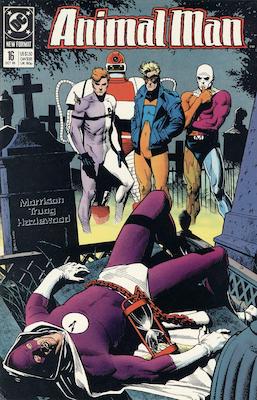
“The Clockwork Crimes of the Time Commander”, October 1989
Credits:
Grant Morrison [writer]
Chas Truog [artist]
Doug Hazlewood [artist]
John Costanza [letterer]
Tatjana Wood [colorist]
Art Young [associate editor]
Karen Berger [editor]
Brian Bolland [cover (uncredited)]
 Front Matter:
Cover:
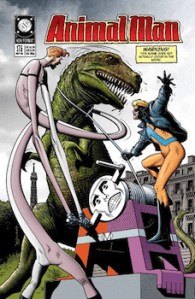
The cover shows the Time Commander and a broken hourglass in the foreground with (from left to right) Elongated Man, Rocket Red, Animal Man and Metamorpho observing. [pictured left is an alternative cover that Brian Bolland finished about 30 years after the issue’s publication][1]
Inside Cover:
The ‘DC Checklist This Week’ section includes the following description of Animal Man #16: “The Time Commander is back and Paris is in trouble! It’s Animal Man and JLE to the rescue!”
Story:
Page 1, panel 1
A man walks along the street. The stereotypical baguette, beret and the sign in French indicates that the setting is France. Though the full sign is not visible, the writing may say Chez ma concierge restaurant, which translates to “At my caretaker’s restaurant”.
Page 1, panel 5
The Frenchman’s watch has stopped at 11:55.
Page 2, panel 1
Skipper can be seen tied up in the front yard.
Page 2, panel 5
There was a Pacifica Publishing located near Los Angeles at this time that published the surfwear trade magazine Action Sports Retailer, but that is probably a coincidence.
Page 3, panel 4
Tricia hasn’t been seen since Animal Man #1 but she is the Bakers’ neighbour and the ex-wife of Roger.
Page 4, panels 1-3
The Eiffel Tower and the Arc de Triomphe identifies the location as Paris.
Page 4, panel 4
Ralph Dibny, the Elongated Man, first appeared in The Flash #112 (Feb. 1960) and was created as a knockoff of the Quality Comics character Plastic Man. He is a detective who first gained his powers of bodily elasticity by drinking the extract of the fictional Gingo fruit, though it’s revealed in the Invasion! series that he possesses the metagene and that ingesting the toxic fruit may have merely activated latent abilities. Sue Dibny (née Dearbon) first appeared The Flash #119 (Mar. 1961 – Ralph’s third appearance) when it’s revealed that she and Ralph had married. Sue doesn’t possess any superhuman abilities except for an extraordinary level of patience with her husband. In Justice League Europe #2 (May 1989), Sue volunteered herself to be the team’s computer expert and researcher.
Page 4, panel 7
Elongated Man stretches and wriggles his nose (sometimes unconsciously) when he senses a mystery, to the revulsion of everyone around him.
Page 5, panel 1
There is a transporter connecting the Bakers’ home to Justice League embassies around the globe, including one in Paris where Justice League Europe are based. In the ‘Animal Writes’ section of Animal Man #11, Art Young explains that this was installed in Buddy’s home by the tradespeople in issue #9.
Page 5, panel 4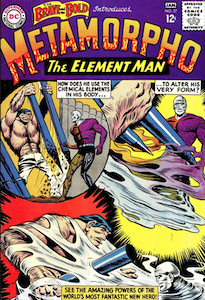
Metamorpho, the Element Man, debuted in The Brave and the Bold #57 (Jan. 1965) [pictured]. Rex Mason was an adventurer employed by the wealthy Simon Stagg, but Stagg plots his murder when he learns that Rex is dating his daughter Sapphire. Rex is given the task of fetching the Orb of Ra – an ancient relic created from a meteorite. After finding the Orb, Rex is knocked unconscious by Stagg’s henchman Java and exposed to the original radioactive meteorite, altering his appearance and giving him the ability to transform part or all of his body into different elements and compounds. Rex confronts Stagg, but Stagg discovers that Rex is weakened when near the Orb and subsequently uses the object to control him. In the 1980s, Metamorpho forms a team called The Outsiders with Batman. In Outsiders #27 (Jan. 1988), which formed part of the ‘Millennium’ event, Metamorpho is killed in a fight with an undercover alien agent called a Manhunter. He was then resurrected when the gene bomb detonated in Invasion #3 (Jan. 1989).
Page 6
On this page, the man (soon to be revealed as the Time Commander) produces a locker key, while a broken clock is reconstructed until it is set as 11:55. The phrase ultima forsan (Latin for “perhaps the last”) was often printed on clocks as a memento mori (a reminder of mortality).
Page 7, panel 1
This is the outside of one of Paris’s train stations (or gares).
Page 7, panel 5
“Quis custodiet ipsos custodes?” is a Latin phrase found in Satire VI, which forms part of a collection of satirical poems written by Juvenal in the early 2nd century. It could be translated to “Who watches the watchmen?” In Alan Moore’s Watchmen comic, this translation is commonly seen graffitied around New York City, calling attention to the lack of oversight of the eponymous superhero team.
Page 7, panel 6
Though reversed in the mirror, the clock reads 11:55.
 Page 8
This is the title page. No job number can be found in this issue.
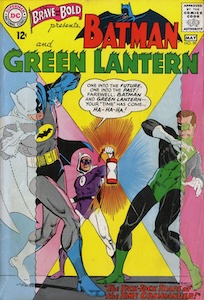
The Time Commander (real name John Starr) first appeared in Brave and the Bold #59 (Apr.-May 1965) [pictured] as a scientist and criminal. While in prison for an unspecified crime, he created a time control device shaped like an hourglass. When energy from the hourglass is focused on an object, Starr can transform the object to its state at a different time. In that issue, he travels through time to alter evidence and gets the general population on his side, then poses as a injured Batman to receive energy from Green Lantern’s power ring before committing more crimes. In his next and only other appearance in Brave and the Bold #69 (Dec. 1966/Jan. 1967), Starr again steals some of Green Lantern’s power. At the end of that issue, Time Commander is knocked unconscious and his hourglass confiscated by Batman.
On this page, we are seeing a reflection of the Time Commander and the clocks. The name of the issue is a reference to Brave and the Bold #59 which was titled “The Tick-Tock Traps of the Time Commander”.
Page 9, panel 1
The foreground may depict a gargoyle on the side of the Notre-Dame cathedral. Rainwater runs off the roof and into a trough in the back of the gargoyle then shoots out of its mouth, directing the water away from the cathedral’s walls. If this is Notre-Dame, we are looking east down the Seine, and Buddy and Ellen are strolling along the river on the Left Bank.
Page 9, panel 2-5
Ellen doesn’t remember Buddy being disappeared by the aliens, which occurred at the end of Animal Man #10. Her own disappearance occurred in Animal Man #11 (page 18). Her next appearance in Animal Man #14 doesn’t make any reference to these events.
Page 11
The street sign reads Rue De Harryhausen, or Harryhausen Street. Ray Harryhausen was a stop-motion animator responsible for the visual effects in several films. He animated model dinosaurs in such live action films as The Beast from 20,000 Fathoms (1953) and One Million Years B.C. (1966).
A poodle (a popular dog breed in France) is barking at the Tyrannosaur.
The Time Commander caused similar mayhem in Gotham in Brave and the Bold #59, sending pockets of the city backwards or forwards in time. The press referred to these disruptions as “time bombs”.
Page 12, panel 3
The two-fisted flying assault mirrors Buddy’s confrontation with the elephant in Strange Adventures #180 (Sept. 1965), which was recounted in Secret Origins #39.
Page 12, panel 5
The poodle’s barks are suddenly interrupted, suggesting it was crushed.
Page 13, panel 6
These are the same members of Justice League Europe that appeared on the cover.
Page 14, panel 1
The events that Ralph mention are from different time periods in the history of Paris. The German tanks date from mid-1940 to mid-1944 when the German army occupied Paris. Sartre was a 20th century French philosopher who lived in Paris through much of the occupation and wrote about these experiences. The French Revolution, however, occurred in the late 18th century. Tyrannosaurus rex (which seems to be the dinosaur being depicted here) has only been found in North America, but some smaller tyrannosauroids have been discovered in Europe and elsewhere.
Page 14, panel 2
The Time Commander is always stopping clocks at 11:55, which is the time displayed on the clock on his costume. In Brave and the Bold #59, Batman refers to this as the criminal’s “time trademark” but no further explanation is given.
As far as I’m aware, the last time Time Commander and Green Lantern met was Brave and the Bold #69 from early 1967, which was more than “a few years ago”.
Page 14, panel 4
Ralph’s nose is twitching again.
Page 15, panel 1
The three people in the foreground may be French historical figures, but I haven’t been able to identify them.
Page 15, panel 2
Place de la Concorde is a large public square on the Right Bank that features the Luxor obelisk – one of two large obelisks that once marked the entrance to the Luxor Temple in Egypt.
Page 15, panels 3-4
Dmitri Pushkin is a member of the Rocket Red Brigade who were first introduced in Green Lantern Corps #208 (Jan. 1987). The Rocket Reds were created by the Soviets to have super-strength and they wear armoured battle suits, but the project was not successful until the Green Lantern Kilowog intervened. The original Rocket Red was Josef Denisovich (originally referred to as Josef Danoff). In Green Lantern Corps #209 (Feb. 1987) another six Reds are created, and Denisovich is killed in Green Lantern Corps #210 (Mar. 1987). His replacement, Rocket Red #7, was introduced as a member of the Justice League in Justice League International #7 (Nov. 1987) but he was revealed as a Manhunter sleeper agent two issues later and also died. Rocket Red #4 was first named as Dmitri in Justice League #3 (July 1987) and joins the League in Justice League International #11 (Mar. 1988)
A running gag throughout Dmitri’s Justice League appearances is his use of (outdated) English slang. Gerry and the Pacemakers and the Applejacks were both 1960s British beat bands. Presumably his exposure to the West was limited due to the metaphorical Iron Curtain that separated the USSR from the rest of the world.
Page 16, panel 1
The grave in the foreground shows an hourglass and the phrase Tempus Fugit, or “Time flies”. Though we don’t see the Place de la Concorde’s Luxor obelisk in this issue, there is an obelisk visible in the cemetery. In Egyptian mythology, the obelisk symbolised the sun god Ra, and represented a petrified ray of light. There was a revival of interest in Ancient Egypt in the West sparked by Napoleon’s Egyptian campaign in the late 18th century, with obelisks becoming more prevalent as a symbol of greatness and immortality. The largest obelisk in the world is the Washington Monument, which was briefly the world’s tallest building until the Eiffel Tower was completed.
Page 16, panels 5-6
Time Commander makes references to prison and psychiatrists. Being based in Gotham, it’s possible that he has been locked in Arkham Asylum since his last appearance and this has caused his mental state to deteriorate.
Page 18, panel 3
Time Commander shoots the hands of clocks at the heroes. In Brave and the Bold #59 he shoots entire clocks at his pursuers. I’m not sure how his powers make that possible, but he did possess some of Green Lantern’s energy at the time.
Page 19, panels 5-6
Time Commander focuses the energy from the hourglass in a particular direction to cause a time shift in that area.
Page 20, panel 1
Dmitri’s boxer shorts have red rockets printed on them.
Page 20, panel 2
The guillotine is a symbol of the French Revolution and was a device used to behead thousands of people at that time, including the deposed King Louis XVI and Queen Marie Antoinette when the monarchy was abolished. For many of the executions, the device was situated at the Place de la Concorde, though it was sometimes set up in other public squares. In the mid-19th century, it was located outside the Grand Roquette prison, near the Père Lechaise cemetery – the largest cemetery in Paris, which may be the setting for this current confrontation.
Page 20, panel 4
Clocks and sundials have a different function than hourglasses. Sundials and clocks are used to determine what time of day it is (though sundials are only effective when the sun is shining). Hourglasses are used to measure the passing of time.
Metamorpho has somehow become trapped inside an hourglass. Time Commander creates a giant hourglass in Brave and the Bold #59 using Green Lantern’s energy.
Page 21, panel 1
Animal Man tries to reason with the “villain” rather than approaching the situation with violence, as another costume-wearing superhero might do. This recalls Buddy’s (eventual) attitude towards B’wana Beast in issue #4 (page 18:6), where Buddy saved his opponent’s life and let him go free rather than sending him to prison.
Page 21, panel 4
It’s not clear what the Time Commander’s goal is and what a final transformation would entail, but he seems to want to bring back all who have died and thus eradicate grief.
Page 21, panels 5-6
When Metamorpho broke out of the gigantic hourglass (seen in panel 6) using a literal hammer, that somehow destroyed the Time Commander’s smaller one.
Page 22, panel 1
Here is another reference to the Garden of Eden. Time Commander wanted to turn Earth into a paradise.
Page 22, panel 2
This page uses the same images of the breaking clock that appeared on page 6, but in the reverse order. Time Commander similarly reconstructs a broken clock in Brave and the Bold #59. The momento mori “ultima forsan” has a greater significance now as the Time Commander’s aim in this issue was to erase death.
Page 22, panel 5
Time Commander makes a plea to “Stop the siren!”. He was defeated in Brave and the Bold #59 when a high pitched siren was used to break his hourglass device.
Page 23
Metamorpho’s actions recall the unnecessary violence that has marred many of Buddy’s interactions. Though the violence towards the Time Commander has had negative consequences for everyone around them (the grievers’ loved ones have disappeared again), Metamorpho does not understand how superheroes are supposed to act in any other way: “That’s what we’re supposed to do, isn’t it?”
Page 24
Buddy’s French should be improving considering he has been stationed in Paris with the JLE for some time now. The last panel ominously shows the assassin Lennox (from Animal Man #14) observing the Bakers and writing something in a notebook.
Back Matter:
Letters:
The letters relate to issue #12.
The writer of the second letter suggests that Morrison is represented by one of the yellow aliens responsible for Buddy’s origin, but Art corrects him and says that Grant Morrison (the character who has begun to appear in the series) represents the author Grant Morrison.
The writer of the third letter ruminates on the power of comic book writers and editors to kill characters, which Morrison seems to be highlighting in that issue.
References:
[1] From https://theshift.store/blogs/judge-dredd-and-2000ad-creator-interviews/my-lengthy-discussion-with-brian-bolland-in-progress
 Wild Planet