Animal Man #14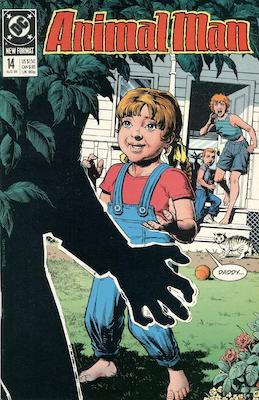
“Spooks”, August 1989
Credits:
Grant Morrison [writer]
Tom Grummett [artist]
Steve Montano [artist]
John Costanza [letterer]
Tatjana Wood [colorist]
Art Young [assistant editor]
Karen Berger [editor]
Brian Bolland [cover (uncredited)]
Front Matter:
Cover:
The cover shows a mysterious figure in the Bakers’ front yard, along with Maxine, Cliff, Ellen, and their cat T.C.
Inside Cover:
The ‘DC Checklist This Week’ section includes the following description of Animal Man #14: “Buddy finally gets home, only to hear his wife’s version of his ‘reconstruction’.” However, in this issue Buddy and Ellen do not really get a chance to talk about the strange disappearance of Buddy in issue #10. That conversation will not occur until issue #16, and then only briefly.
Story:
Page 1, panel 4
Job Number: G-4895.
Page 2
This is the title page. A spook may refer to a ghost, but is also used as slang for a spy.
Page 3, panel 1
The calendar is opened to July. It displayed June in issue #10.
Page 4
This scene almost replicates the front cover, except that Cliff is nowhere in sight. The strange man (who also appeared briefly in issues #8 and #9) appears to be Buddy but with a closely cropped haircut. His comment on the previous page about “miss[ing] you all so much” ominously suggests that something terrible has happened to this alternate Buddy’s family. As Callahan notes, “Even with all the metafictional playfulness buzzing throughout the series, constantly reminding us that these are just characters in a pretend universe, [Morrison] imparts such personality into the Bakers that we feel concern for their safety.”[1]
Page 5
Buddy is at the airport, presumably coming back from his adventures in South Africa, or is just about to embark on them if this issue takes place before Animal Man #13. At this time, he is simultaneously in the fictional Middle Eastern country of Bialya in the pages of Justice League Europe.
Page 6, panel 2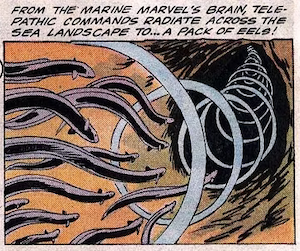
Though it will not be explained until later in the series, this is the writer Grant Morrison in his hometown of Glasgow. They have already made some intrusions into the series so far. In this scene, Morrison is walking down the Forth and Clyde Canal. When ‘real’ Glasgow is depicted in the series (that is, the city in which the Grant Morrison character resides), a sepia colour palette is used.
Concentric circles are used in comics to visually represent waves of telepathic energy, and are commonly associated with telepathic Marvel Comics characters like Professor X of the X-Men. In DC Comics, this effect has been used since at least 1965, as a CBR article about Aquaman explains[2]. [Pictured is a panel from Aquaman #20, Mar./Apr. 1965]. Concentric circles have also been used as a way to visually represent Buddy’s powers since Animal Man #1.
Though I don’t think it’s clear from the writing, Morrison is saying that the holographic plate (rather than a circle) is the symbol of Bohm’s Implicate Order theory. A 2D holographic plate stores visual information about a 3D object, and the plate can later be used to reconstruct this object in three dimensions. The plate, which may appear to be a solid mirror, actually contains many tiny mirrors and each region stores information about the complete object. This is what Morrison means by the next line “…every part contains the whole”, which is very similar to Mandlebrot’s definition of a fractal in the annotations for Animal Man #6 (page 17). For Bohm, the region of the photographic plate is the implicate level, while the three dimensional projection (the hologram) is the explicate level[3].
Page 7, panel 1
Morrison was quoting from the English folk song ‘The Unquiet Grave’ in panels 4-5 of the previous page.
Page 7, panel 2
Morrison is passing one of the gasometers visible from Kelvindale railway station in Glasgow.
Morrison is making light of his own literary pretensions here, but also making fun of other contemporary comic writers such as Alan Moore, who has literally quoted from Nietzsche, Shelley and Shakespeare in some of his superhero comics (most notably in Marvelman, Watchmen, and V for Vendetta respectively).
Page 7, panel 4
The “who’s dreaming who” line again references Lewis Carroll’s Through the Looking-Glass, and What Alice Found There.
Lock 27 is a Glasgow pub, only a few hundred metres down the canal from the gasometers.
Page 8, panels 3-4
The “nine circles of the Inferno” wasn’t mentioned in the part of Highwater’s dream that we witnessed, but there were circles, and Dante’s ‘Inferno‘ was referenced back in Animal Man #5.
The “words are ugly when they travel in packs” line seems to be an original quote by Morrison (as Highwater), and by including it in this comic, Morrison has written it down.
Page 8, panel 6
Judging from the Golden Gate Bridge, Highwater is in San Francisco, and this will be confirmed later.
Page 9, panel 4
The Lookout is a name of a Christian periodical, published by the Seamen’s Church Institute since 1910, but I don’t know if that specific publication is being referenced here.
Page 10
This mysterious man (potentially a government assassin) could be the ‘Spook’ referred to in the issue’s title.
Page 11, panel 1
The boys have an issue of Swamp Thing. If it’s referencing a specific issue, I haven’t been able to identify it. The cover is vaguely reminiscent of The Saga of Swamp Thing #2 (June 1982) or #36 (May 1985) but the back cover advertisement doesn’t match up. It is unusual that a DC comic book appears within another DC title, but this won’t be the only time this happens in this series.
The Ouija board is used for automatic writing, with the written output usually attributed to spirits. While use of these “talking boards” was popular in the late 19th century, it was patented as a Ouija board by Elijah Bond in 1891, with rights soon passing to William Fuld, and later to Parker Brothers in 1966[4]. It may be a Parker Brothers board seen in this issue, though the ‘Yes’ and “No’ options were usually written at the top of the board. The board should also read Ouija near the top, but Truog is inconsistent in showing that detail.
Page 11, panel 2
Penthouse is a pornographic magazine.
Page 12
Ellen is an illustrator by profession. It may be obvious but here she is drawing ghosts, while spooky occurrences are simultaneously happening in her house.
Page 14, panel 4
The kids employ the other use of the term spook, meaning ghost.
Page 14, panel 6
The significance of this message will be revealed in Animal Man #22.
Page 16, panel 1
Ellen receives a call for Buddy from Dane, who will be introduced in the next issue.
Page 16, panel 6
Though the calendar displayed July earlier in the issue, it has now been moved to September.
Page 17, panel 2
As we have seen previously, Maxine loves to draw – an interest probably picked up from her mother.
Page 18, panel 2
Highwater had previously traveled to Arkham Asylum in Gotham, which is a fictional city on the East Coast. And, yes, “the universe is a mirror” was uttered by Morrison in the dream on pages 6-7.
Page 18, panel 3
Alice travels through a mirror in Through the Looking-Glass… Mirrors are also used as portals into Mirror Master’s Mirror World, as we saw in issue #8.
Page 19, panel 3
Morris Weidemeir is the Bakers’ neighbour who we haven’t seen for a while.
Page 19, panel 5
Buddy is referring to his experience with the aliens, which he has yet to fully understand.
Page 23, panel 4
Buddy’s insistence that he saw the mysterious man when he was 10 will also be explained in Animal Man #22.
 Back Matter:
Letters:
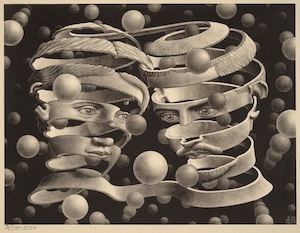
The letters relate to Animal Man #10. Some readers begin to understand the implications of Psycho-Pirate remembering the events of the Crisis, which makes him part both of the DC Universe and spectator above it. The third letter writer also notes that Bolland’s cover for issue #10 owes a debt to M.C. Escher, perhaps referring to Escher’s Bond of Union illustration from 1956 [pictured].
References:
[1] Callahan, Timothy. Grant Morrison: The Early Years. Sequart Research & Literacy Organization, 2007.
[2] Cronin, Brian. “When Did Aquaman First Have Telepathic Circles From His Forehead?”. CBR, 29 Apr. 2020. https://www.cbr.com/aquaman-telepathy-circles-debut/
[3] Bohm, David. Wholeness and the Implicate Order. Routledge Classics, 2002. p. 188.
[4] Hunt, Stoker. Ouija: The Most Dangerous Game. Harper & Row, 1985. p. 5.
 Wild Planet