Animal Man #13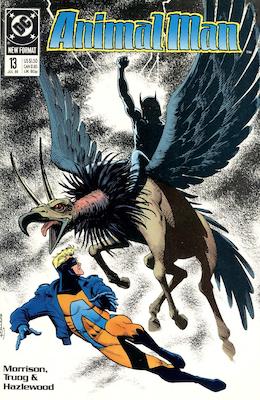
“Hour of the Beast”, July 1989
Credits:
Grant Morrison [writer]
Chas Truog [artist]
Doug Hazlewood [artist]
John Costanza [letterer]
Tatjana Wood [colorist]
Art Young [assistant editor]
Karen Berger [editor]
Brian Bolland [cover (uncredited)]
Background:
At around this time, Animal Man’s adventures with Justice League Europe had him based in Paris but also visiting the fictional middle-eastern country of Bialya. His adventures with the JLE are independent of his activities in Animal Man at this time.
Front Matter:
Cover:
The cover shows Animal Man and B’wana Beast, who is riding a vulture crossed with a horned antelope like an oryx.
Inside Cover:
The ‘DC Checklist This Week’ section includes the following description of Animal Man #13: “Buddy is anxious to get back to his family and resume a normal life… but his problems are just beginning.”
Story:
Page 1
This story takes place in the context of the final years of apartheid in South Africa. Apartheid (from the Afrikaans word meaning “separateness”) refers to a system of legislated racial segregation between the privileged (but minority) white population and the majority black population. Apartheid existed from the late 1940s, with Nelson Mandela and his African National Congress leading a resistance movement throughout the 1950s and 1960s until the ANC leadership was imprisoned. A fresh wave of civil disobedience and revolt in black townships from the mid-1980s led to the imposition of a national state of emergency for several years and an upswing in political violence. Morrison’s story was written just months before the resignation of Prime Minister P. W. Botha. In the face of mass protests and Western sanctions, Botha’s successor, F. W. De Klerk, freed Mandela in 1990 and began the process of dismantling apartheid.
Job Number: G-4837 appears in panel 4.
Page 2, panel 3
GBS stands for Galaxy Broadcasting System, a media company in the DC Universe based in Metropolis and a competitor to the Daily Planet. Galaxy Broadcasting and its owner Morgan Edge first appeared in Superman’s Pal, Jimmy Olsen #133 (Oct. 1970)
Page 3
The photographer is Dominic Mndawe, who will be introduced soon.
Page 4, panel 4
The last time we saw B’wana Beast was in Animal Man #4, cover dated December 1988.
Page 4, panel 5
In an interview with The Comics Journal[1], Chaz Truog mentions that he modified Buddy’s jacket in issue #10 based on one that he owned, but I think the new jacket actually makes its first appearance here in issue #13. The jacket in #10 seems identical to the jacket shown throughout the series to that point, and no jacket is worn in issue #11 or #12. In this panel, the jacket is noticeably different from what Buddy has worn previously. Bolland never makes such an adjustment to the jacket on his covers.
Page 5, panel 2
This image looks like it is taken from their fight on page 5 of Animal Man #4, though this scene may also have taken place later in the issue, after Buddy’s left arm is scratched by the winged wolf.
Page 5, panel 6
Each successor to the Dalai Lama is found by senior monks who interpret spiritual signs until a potential child has been located. The child then undergoes a series of tests to confirm that it is a reincarnation of the previous Dalai Lama.
Page 6, panel 2-4
It’s unclear what Buddy means by “real Africa”, though he has been amongst the fictional Zambesi people, while Kilimanjaro and Tanzania certainly exist in the real world.
Page 7, panel 1
Mike Maxwell speaks of a lineage of ‘Beast’ superheroes, but this was never mentioned in the Showcase issues. In Showcase #66 (Jan./Feb. 1967), he is unsure of the origin of the helmet after it is presented to him by Djuba.
Page 7, panel 2
It was in the previous issue that the aliens claimed to have brought the Beast’s helmet and elixir to the world.
In the story of Mkunare and Kanyanga[2], two poor brothers decide to climb Kilimanjaro and ask a Chief for help. Mkunare meets an old woman and asks for directions, but she asks Mkunare to lick her eyes clean. He refuses and continues, meeting a group of small men who he mistakes for children, and eventually returns home empty handed. Kanyanga later makes the same journey but decides to help the old woman. She then explained that the small men are the Chief’s councillors and must be treated with respect. Kanyanga is introduced to the Chief, who provides him with food, shelter, and knowledge about pest control, while the dwarfs give him cattle. Mike may believe that the Chief was a prior incarnation of the Beast, living on Kilimanjaro with knowledge of pests and insects.
Page 7, panel 3
Singer suggests that Mike’s comment that he should have tried a little harder is an admission of guilt after not doing enough to help in Africa. In Showcase #66, Ken suggests that Mike has the chance to be “something that could be a great help out here… helping make a new country — a new way of life for my people!”[3]. In Swamp Thing Annual #3 (Oct. 1987), B’wana Beast refuses to get involved in preventing a conflict even after a priest appeals to him directly.
Page 8
The elixir usually grants Mike super strength, with the helmet allowing the telepathic connection with animals, but here the liquid is inducing visions. Mike is looking for his successor in a spiritual vision perhaps comparable to the Buddhist monks seeking the next Dalai Lama.
Page 9
Kaffir is considered an extremely offensive racial slur, with its origins laying somewhere between ‘infidel’ and ‘savage’.
Page 10
B’wana Beast creates the fused animal seen on the cover. His hands glow when he is fusing animals, though his eyes do not usually glow in this way.
Page 12, panel 4
The villainous cop has a Dutch name, with the Dutch being the white colonisers of South Africa.
 Page 14, panel 2
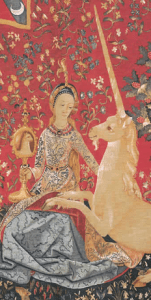
The story of the unicorn being placated by a virgin or maiden has existed since at least the Physiologus – an ancient text composed in around the 2nd century. The image in this panel is based on the ‘Sight’ tapestry which forms part of the ‘The Lady and the Unicorn’ (La Dame à la licorne) series of tapestries created in around 1500. [The relevant detail from this tapestry is pictured on the right].
 Page 14, panel 4
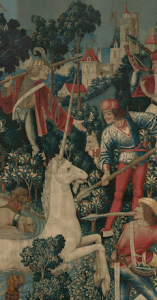
The image in this panel is based on ‘The Unicorn Crosses a Stream’ tapestry which forms part of the ‘Hunt of the Unicorn’ (La Chasse à la licorne) series of tapestries also created in around 1500. [The relevant detail from this tapestry is pictured on the left]. Truog incorporates the hunter, dog, castle and tree from this tapestry, but adds the ‘Lady’ from panel 2.
The adjective Freudian refers to the psychoanalytic theories of Sigmund Freud, but it’s unclear what specifically van de Voort considers ‘Freudian’ in this story. Stereotypically, Freud was concerned with unconscious (and particularly sexual) desires.
Page 16, panels 1-2
The first panel shows houses with corrugated iron roofs in the foreground, with a modern city on the horizon. In the second panel, a wooden pallet is burned on an open fire, so I think this scene is supposed to depict life in a shanty town or slum.
Page 16, panel 3
As explained in the annotations for Animal Man #3, B’wana translates to ‘sir’ or ‘master’ and was given to B’wana Beast by the local people, though Mike didn’t have any concerns with adopting the problematic title.
Page 16, panel 5
Mike seems annoyed that Dominic is politicising what he considers to be an ageless, mythological figure. Singer notes that Mike Maxwell originated in the Silver Age when political topics were largely ignored.[4]
Page 17
Dominic describes taking part in the Soweto uprising – a real protest involving school children that occurred on 16 June 1976, which makes Dominic about 23 years old in 1989. Some sources estimate more than 700 children were killed, and from 1991 the date was commemorated in South Africa as the Youth Day public holiday. Like Dominic, many children spontaneously joined the peaceful protest on the day without knowing about it beforehand. Dominic’s point is that, in South Africa, and particularly as a black person, there is no escaping politics and political violence in daily life. Mike becomes defensive.
Page 18
A state of emergency was declared in June 1986, just before the 10th anniversary of the Soweto uprising. It remained in place for several years, and public gatherings were banned.
Page 19, panels 1-2
Archbishop Mogatusi is a fictional character but may be based on Desmond Tutu, who was the Anglican Archbishop of Cape Town at this time and was an anti-apartheid leader who promoted non-violent protest.
Page 19, panel 6
Maxwell naively believes that his white privilege will protect him (and the protesters) from police violence.
Page 22
The creature is a unicorn created out of a zebra and some other horned animal.
Page 23, panel 3
Dominic rechristens the superhero role he has inherited as “Freedom Beast”. As noted by Elizabeth Sandifer[5]: “This anti-apartheid polemic provided a platform for Morrison to address a debt that had hung over their first twelve issues on the comic, namely the figure of B’wana Beast […] And the problems were baked right into the premise—a white savior narrative in which the true and sacred hero of Africa is an American whose name translates to ‘master’.”
Page 23, panel 4
It’s unclear how Maxwell intends to have a positive impact on the situation in South Africa, given that he was fairly ineffectual at the protest.
Page 23, panel 5-6
Van de Voort believed that the unicorn symbolised black supremacy because it could be easily lured and defeated, while Dominic adopted the same symbol for its “untameable” nature and capacity for violence. As Singer explains, “The officer learns, fatally, that fantasies, mythologies, and symbols can exert real political power through their capacity to inspire action.”[6] For Grant Morrison, these mythologies may incorporate comic book characters: Morrison became vegetarian soon after beginning work on Animal Man, and some of their later comic works were specifically created as magical texts intended to change world consciousness.
Page 24
Buddy has apparently met up with David Quinn and has secured Dominic’s photos of police brutality, knowing that Quinn was about to be searched. Buddy goes to the Daily Planet newspaper in Metropolis and meets with the editor Perry White. Perry White was first mentioned in the second episode of the the radio serial The Adventures of Superman (broadcast Feb. 14, 1940) as the editor at the Daily Planet, and soon appeared in comics in Superman #7 (Nov. 1940).
Back Matter:
Letters:
This month, ‘Animal Writes’ consists of letters received throughout Animal Man that Art Young has considered “controversial”. All criticise Buddy’s stance on animal rights issues.
The writer of the first letter calls Buddy a fanatic for his vegetarianism and for forcing his views onto his family, and argues that Buddy would crave eating meat if taking on the abilities of carnivorous animals. The writer also believes that testing on animals is worthwhile because of benefits to humans.
The writer of the second letter believes in some animal testing, but not the testing of cosmetics of animals, and mentions barbaric experiments at the Yerkes National Primate Research Center.
The writer of the third letter is a veterinary student who explains the dangers of liberating animals that are being experimented on. They also argue that many modern medical procedures result from experimentation on animals. The writer believes that other cases of animal abuse should be addressed in the comic before scientific experimentation, and threatens to try to get the comic cancelled if Buddy pursues a “fringe radical position” within the animal rights movement.
The writer of the fourth letter thought it would be interesting if Buddy’s powers were adversely affected by health problems associated with a vegetarian diet. They also believe that people have more of a right to kill animals than a right to stop other humans from doing what they want. They offer a theory that the JLE consists of characters that represent left-wing political ideas, and suggests that we might see the JLE try to educate villains rather than fight them.
Art Young responds at the end of section to explain that Buddy’s position on these issues was not well thought out, and that his ideas may change in the future.
References:
[1] Ah-Sen, Jean Marc. “‘If I Could, I’d Completely Redraw It’: An Interview with Chaz Truog.” The Comics Journal, 20 April 2022, https://www.tcj.com/if-i-could-id-completely-redraw-it-an-interview-with-chaz-truog/
[2] Werner, Alice. “The Little People.” The Mythology of All Races: vol. 7. Armenian, African, Archaeological Institute of America, Marshall Jones Company, 1925, pp. 258–69.
[3] Singer, Marc. Grant Morrison: Combining the Worlds of Contemporary Comics. University Press of Mississippi, 2012, pp. 60-61.
[4] Ibid., p. 60.
[5] Sandifer, Elizabeth. “The More Material Comes In The More Confusing It Gets (Book Three Part 5: Secret Origins, Morrison’s Politics).” Eruditorium Press, 26 April 2021, https://www.eruditorumpress.com/blog/the-more-material-comes-in-the-more-confusing-it-gets-book-three-part-5-secret-origins-morrisons-politics
[6] Singer 2012, p. 61.
 Wild Planet