Animal Man #12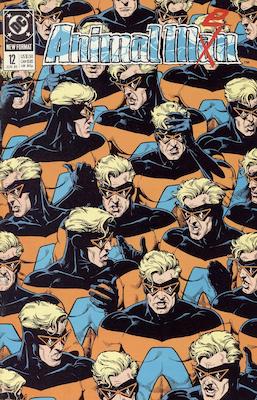
“Secret Origins”, June 1989
Credits:
Grant Morrison [writer]
Chas Truog [penciller]
Doug Hazlewood [inker]
John Costanza [letterer]
Tatjana Wood [colorist]
Karen Berger [editor]
Brian Bolland [cover (uncredited)]
Front Matter:
Cover:
Multiple versions of Animal Man appear on the cover, with the comic’s title logo crudely amended to read ‘Animal Men’.
Inside Cover:
The ‘DC Checklist This Week’ section includes the following description of Animal Man #12: “At last… Animal Man’s powers and origin are made clear to him, as he reconciles his past and begins a new chapter in his life”.
Story:
Page 3:
Animal Man is seemingly able to use the abilities of bacteria, though bacteria aren’t classed in the biological kingdom Animalia because they don’t share the same characteristics as animals. For example, bacteria are single-celled, while animals are multicellular by definition. In Animal Man #4, Buddy affected B’wana Beast’s cells but this was by using the Beast’s own powers to fuse organisms.
Page 4, panel 6:
Buddy, while saving the day, is still outdone by the practical intelligence of Vixen, who had considered a less abstract way that Buddy could have used his powers.
Page 5:
This is the title page. No job number can be found in this issue. The history of the term ‘Secret Origin’ is explained in the annotations for Animal Man #7 (page 10:7).
Page 7, panel 3
The sky also changed during the Crisis event, where it turned to a reddish colour. Here, a whiteness is covering the sky.
Page 8
Presumably the flames are raining down from the explosion caused by Vixen’s bomb.
Page 9, panel 3
The energy emanating from the pit has “un-drawn” some of the distinguishing features of the people nearby.
Page 10
Notice the effect of the white energy in erasing the borders of panels 1 and 3.
Page 11, panel 2
Buddy perceives the dimensions of the space using the ultrasonic abilities of fruit bats and this is expressed visually by only showing the silhouettes of objects in this panel.
Page 11, panels 3-4
The orbs in the ship depict Strange Adventures-era Buddy, Vixen, and the disintegrating Ellen from the previous issue. Buddy never really looked like this in his Strange Adventures appearances; he didn’t have a crewcut, and the legs of the letter ‘A’ on his costume were always extended.
Page 13, panels 2-3
The gods that the shaman refers to may be the aliens (the creators of Buddy within the DC Universe continuity) or they might be the creators of the comic (Morrison, Truog, et al.) who are tasked with maintaining the continuity of the title and characters within the wider DC Universe. The ghost voices (previously referred to as the dead residing within the ghost country) are the characters from “many worlds” who were wiped from continuity by the Crisis.
Page 14, panels 4-5
It’s suggested that the beasts were perhaps the aliens in a different form. The man at the airport who was killed (by having his spine ripped out) was indeed an inconsequential character never encountered before or since.
Page 15, panel 1
The threat to the entire stratum/reality/DC Universe remains.
Pages 16-17
Vixen is impervious to Tabu’s attacks.
Page 18, panel 1
The alien explains that the white light is a manifestation of an absence – literally a blank white page onto which Buddy’s Universe is drawn.
Page 18, panel 2
Possibly Vixen cannot be destroyed because she is a major character with unresolved storylines in other DC titles. She may be destroyed if the continuity errors aren’t resolved in the pages of Animal Man and another Crisis is triggered.
Page 18, panel 3
The word ‘memoryform’ has been mentioned a few times already but hasn’t been fully defined. It may refer to a ‘recognisable archetype’, such as an alien invader, a savage beast, or even a mythological figure such as Ananse.
Page 18, panel 5
The alien explains that Buddy did not survive the explosion of the alien ship (in Strange Adventures #180) but Buddy’s spirit or consciousness was used to create a new character (Animal Man) who was enhanced with animal powers through morphogenetic grafts. While pre-explosion Buddy and Animal Man are the same person in one sense, they are different on a cellular level.
This recalls the philosophical thought experiment known as Theseus’s Paradox, which asks: if every part of a ship is replaced over hundreds of years, to what extent is the final ship the same as the first ship.
The alien’s story also recalls the origin of Swamp Thing. Swamp Thing believed he was a man (Alec Holland) transformed into the creature Swamp Thing. However in The Saga of Swamp Thing #21 (Feb. 1984), writer Alan Moore reveals that Alec Holland died and decomposed in a swamp, but the vegetation took on Holland’s consciousness and grew itself a new human-like body.
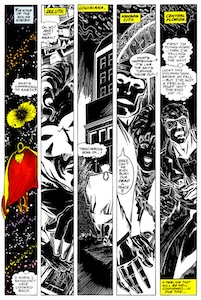 Page 18, panel 6
The “recent events” that damaged the grafts was the explosion of the gene bomb during the Invasion! series [pictured is a page from Invasion! #3].
Page 19, panel 3-4
The alien explains that Animal Man’s pre-Crisis origin story was inconsistent with his post-Crisis existence – partly because the original Buddy Baker seemed to be much older than a teenager and lived in world reminiscent of the early 1960s.
Page 20
The alien is asking Buddy to re-remember his origin story so that it fits into the continuity of the stratum (the post-Crisis Universe). This revision of an origin story is not unusual, especially after a continuity-shaking event such as the Crisis. However, rather than the revision being presented in Secret Origins #39 as would be the usual practice, Morrison has drawn attention to Buddy’s changing origin story by making it a major plot point of the last few issues, and Buddy has even had a hand in re-shaping it. As Steven Zani notes, “Animal Man uses its metatextual focus to confront directly the recent revision that DC Comics had done to its own textual universe”, raising questions about “authorial intent and authorial construction” of the text.[1]
Page 21, panel 1
Buddy’s origin tale again takes place 10 years ago, but that makes this the late 1970s instead of early 1960s. The language of Buddy, the narrator, and other characters is much less formal.
Page 21, panel 2
The orange alien has been replaced by one of the invisible beasts seen in Animal Man #10.
Page 21, panel 3
In this origin story, Buddy never temporarily loses his powers, which happened between Strange Adventures #180 and #184 originally.
Page 21, panel 4
Buddy’s friend Roger looks much more of the time period. Ellen is studying and lives with her father, which makes much more sense for her age. In the original Strange Adventures stories, it’s implied that she lives by herself.
Page 21, panel 5
The ship looks much more like the Traveller as we have observed it in these recent issues.
Page 22, panel 5
The alien mentions that it is an agent of the power that creates the comic book world, meaning that the aliens are a way for Morrison to affect events in the Animal Man title and the DC Universe.
Page 23
The glint in the eye of the alien is similar to the eyes of the beast that disintegrated Buddy. Here, Hamed Ali is un-drawn in the reverse of how he would have been constructed – reduced to rough outline, then to stick figure, and finally to non-existence. At the end of the letters section of the previous issue, Art Young promises that Ali would suffer “a fate never before seen in comics”.
Back Matter:
Letters:
The letters are in response to Animal Man #9. Some note that Buddy is never seen in costume in that issue, nor is there any fight scene. A couple of letters suggest that the Bakers’ cat T.C. is named after the Hanna-Barbera cartoon character Top Cat.
There are letters voicing support for and opposition to Grant Horwood’s argument against vivisection in the ‘Animal Writes’ section of issue #9.
References:
[1] Zani, Steven. “It’s a Jungle in Here: Animal Man, Continuity Issues, and the Authorial Death Drive.” The Contemporary Comic Book Superhero, edited by Angela Ndalianis, Routledge, 2008, p. 234.
 Wild Planet