Animal Man #10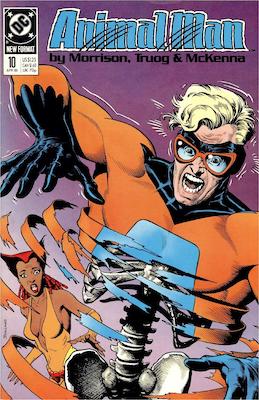
“Fox on the Run”, April 1989
Credits:
Grant Morrison [writer]
Chas Truog [artist]
Mark McKenna [artist]
John Costanza [letterer]
Tatjana Wood [colorist]
Art Young [assistant editor]
Karen Berger [editor]
Brian Bolland [cover (uncredited)]
Front Matter:
Cover:
The cover shows Animal Man with Vixen.
Inside Cover:
The ‘DC Checklist This Week’ section includes the following description of Animal Man #10: “Animal Man meets Vixen… and begins to uncover the true secrets behind his origin.”
Story:
Page 1
This page briefly summarises Buddy’s origin story. It recreates the images and text from Strange Adventures #184 (page 2:4-5 and page 3:1-3). The battle with the orange alien occurs in the second story of Strange Adventures #180.
Job Number: G-4638.
 Pages 2-3
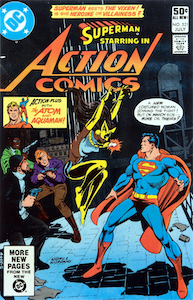
These pages alternate between images of the superhero Vixen running near an airport, and a fox fleeing from a group of hunters and hounds. A vixen refers to a female fox. The character Vixen first appeared in Action Comics #521 (July 1981) [pictured]. She was actually created with the intention of having her own series in 1978, but the first issue and series was cancelled as part of the “DC Implosion”, where struggling sales forced the sudden cancellation of more than a dozen titles. In her first published appearance, Vixen is the alter ego of fashion model Mari Macabe, and in that issue she teams up with Superman to stop the illegal trade of animal furs.
Page 4, panels 1-3
In Justice League of America Annual #2 (Oct. 1984), Vixen decides to join a reconfigured and multicultural Justice League but leaves in Justice League of America #261 (Apr. 1987) after the deaths of two of its members. This brief version of the team is often referred to as Justice League Detroit after the location of its headquarters. From her JLA appearances onward, Vixen’s real name was often given as Mari McCabe (rather than Macabe).
The man is about to say that he thought Vixen was dead. Notice the faint outline of an invisible beast in the rain behind the security guard.
Page 6
This is the title page. ‘Fox On The Run’ is the title of a song by British glam rock band Sweet, released in 1975.
Page 7
Buddy is helping the fox hunt saboteurs mentioned in the last couple of issues. The Hertfordshire Hunt Saboteurs is a real group. The Hertfordshire chapter of the Hunt Saboteurs Association has existed since 1966.
Page 8
Ellen’s friend hasn’t been seen or mentioned before. Wild Kingdom (referred to in panel 3) was a long running nature documentary television series.
Page 9, page 1
Arkham Asylum is a fictional psychiatric hospital previously mentioned in Animal Man #7 (page 13:2).
Page 9, panel 2
Dr. Huntoon first appeared in Swamp Thing #66 (Nov. 1987) as a psychiatrist at Arkham with a deep suspicion of, and obsession with, superheroes. His comments here suggest he went to the same school (perhaps college) as Highwater, while in Swamp Thing #66 it’s suggested he went to school (likely high school) with John Constantine.
Page 9, panel 3
Omni was a popular science and science fiction magazine.
Superstring theory is an attempt to explain the fundamental forces of nature, incorporating the theory of general relativity and quantum mechanics, by arguing that the fundamental units of reality are not particles but super symmetrical, one-dimensional strings.
The implicate order is a term coined by theoretical physicist David Bohm to describe a deeper level of reality with forces that act upon and are observed in our (explicate) reality. Time and space, for example, might be surface-level forms of something else that has a basis in the implicate order.
Page 9, panel 4
Huntoon has previously published books about superheroes, including Pow! Psychology: Understanding the Super-Men (and Women), as mentioned in Swamp Thing #66.
Redskin is a derogatory term for native Americans.
Page 10, panel 1
The Mad Hatter is a Batman villain, first appearing in Batman #49 (Oct. 1948) and modelling himself off the Hatter from Lewis Carroll’s Alice stories. His hat carries the label “In this style 10/6”, referring to the price tag of 10 shillings and 6 pence. This is the same label that appears in John Tenniel’s illustrations of the Hatter in Carroll’s books. Mad Hatter appears in Morrison’s Arkham Asylum: A Serious House on Serious Earth, released later in 1989, where he talks about the implicate order.
A penny dreadful refers to a cheap form of serialised literature in Victorian England, often about sensationalistic topics like crime and horror.
Page 10, panel 2
Since at least the 19th century, Native Americans have referred to white colonists (the “paleface”) as speaking “with a forked tongue”, meaning that the colonisers have consistently lied to the indigenous peoples to further their own interests. This phrase, or something similar, is sometimes attributed to Tonto, the Native American sidekick to the title character in the Western TV series The Lone Ranger, which ran through the 1950s.
Page 10, panel 3
“No room” is exclaimed by the Hatter, March Hare and Dormouse to Alice in Alice’s Adventures in Wonderland when Alice approaches their tea party.
Page 11, Panel 1
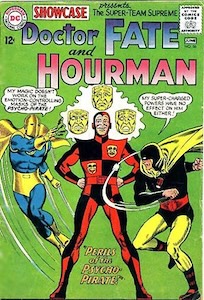 The original Psycho-Pirate (Charles Halstead) first appeared in All-Star Comics #23 (Dec. 1944) as an emotionally manipulative villain. The Roger Hayden iteration of the character first appeared in Showcase #56 (June 1965) [pictured] as a gangster on Earth-2 who meets Charles Halstead in prison and learns about Medusa Masks, which allow the wearer to project emotions onto others. Psycho-Pirate is an occasional villain of the Justice Society until the Crisis, when he is first recruited by the Monitor, and then the Anti-Monitor. His powers are enhanced so that he is able to manipulate the emotions of everyone in three realities at the same time, but the strain of doing this weakens him. At the very end of the Crisis… miniseries, Hayden has been institutionalised in Arkham as the only person who remembers the prior existence of the Multiverse.
After the events of the Crisis, Hayden was broken out of Arkham by Thunderbolt, and electroshock treatment temporarily made him forget about the Multiverse (as explained in Infinity, Inc #32, Nov. 1986). This is what Huntoon is referring to in the previous panel when he says “[Hayden] was out for a short while”.
The pink hexagons and circles in this panel seem to represent a lens flare from the light globe. Jonathan Woodward[1] points out that the intersecting circles (or Earths) were a frequently used symbol for the Crisis event. Hayden is repeating the phrase “Worlds will live, worlds will die”, which was the tagline for the Crisis On Infinite Earths series in promotional material.
Page 11, panel 2
Psycho-Pirate is listing some of the Earths that existed in the Multiverse: Earth-1, Earth-2, Earth-S, Earth-X, Earth-3, Earth-4, and Earth-Prime. The Wolfman refers to Marv Wolfman, the author of the Crisis… series.
Page 11. Panel 4
Hayden is again referencing the Crisis, when the existence of many characters (including Supergirl) were removed from continuity.
Page 12
Cardonald is a suburb of Glasgow, which further hints at the message being from the author Grant Morrison. “Son of the fox” in Scottish Gaelic is something like “mac an t-sionnaich”, so deriving “Morrison” from this seems quite a stretch. Foxy is the third reference to a fox in this issue (after Vixen, and the fox that Buddy saves from the hunters).
Page 13
The flip side of the paper shows panels originally published in Strange Adventures #184 (pages 7:4-5, 16:2 and 16:4 respectively). The relationship between the page in Highwater’s hand and the page in the reader’s hand is unclear, with Hayden shown in panel 4 of Highwater’s page even though he is also in the same room as Highwater.
Page 14, panel 2
George is another character we haven’t been introduced to before.
Page 15
Something unseen travels destructively through the yard.
Page 16, panel 1
I’m not sure if Mari was publicly known as being Vixen, but she was a famous model and Vixen didn’t wear a mask (or even spectacles) after her first couple of appearances, so anyone who saw Vixen could have recognised her from her day job. Note that Ellen’s friend calls her Macabe (as per her first appearance) not the more commonly used McCabe.
Page 16, panel 2
Issey Miyake was a Japanese fashion designer.
Page 16, panel 6
The clock’s second hand hasn’t moved since panel 2. It’s June, which is what Ellen’s calendar read in issue #1. Either the last 9 issues have taken place in the space of a month, or a year has already passed in the Bakers’ world.
Page 17, panel 1
It’s not clear why everyone thought Vixen had died but maybe they are confusing her with her teammates Steel and Vibe from Justice League Detroit. Since leaving the JLA, Vixen has been an active member of the Suicide Squad.
Page 17, panel 2
Vixen doesn’t know why she came to visit Buddy but she also didn’t blindly flee the invisible beasts in his direction. In Suicide Squad #26 (Apr. 1989), Vixen (here referred to as Mari MacCabe) tells Ben Turner (Bronze Tiger) that she is heading to New York before the West Coast, so the trip to visit Buddy had been planned.
Page 17, panel 5
The radioactive fox joke relates to Marvel’s Spider-Man, who gained his powers after being bitten by a radioactive spider. This conversation recalls the one between Buddy and the Red Mask in issue #7 where they flippantly discuss the fantastically unlikely origin of their superpowers.
Page 18, panel 1
The source of Vixen’s power is explained in Justice League of America #239 (June 1985). Like Animal Man, Vixen can utilise the abilities of animals, but through the use of an object called the Tantu Totem that she wears around her neck. Ananse the spider (a figure in West African folklore) gave the powerful totem to a man named Tantu, who was a descendent of Mari.
Page 18, panel 3
In her initial stories, Vixen’s home country was the fictional African nation M’Changa.
In Justice League of America #239, Maksai stole the Tantu Totem and was transformed into a mindless beast called the Gored Ox. He was then impaled to death during a fight with Vixen.
Page 18, panel 4
Hamed Ali (written as Hamid Ali at the time) was B’wana Beast’s enemy in their first appearances in Showcase #66 and #67 (1967).
Page 19, panel 3-4
The phrase “They’re here” is famously uttered in the film Poltergeist (1982), which is also about invisible beings invading a family home.
Back Matter:
Letters:
The letters relate to Animal Man #7. A few letters mention the references to Watchmen.
References:
[1] Woodward, Jonathan. “Crisis-Relevant Text: Grant Morrison’s Animal Man #8-26”. The Annotated Crisis on Infinite Earths. Archived at https://web.archive.org/web/20210623061928/https://www.prismnet.com/~woodward/chroma/crtanimal.html.
 Wild Planet