Animal Man #1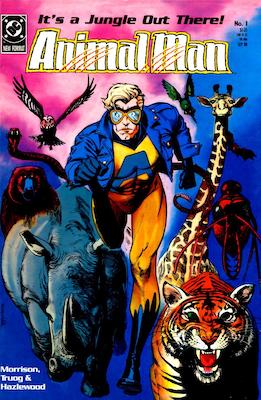
“The Human Zoo”, September 1988
Credits:
Grant Morrison [writer]
Chas Truog [penciller]
Doug Hazlewood [inker]
John Costanza [letterer]
Tatjana Wood [colorist]
Karen Berger [editor]
Brian Bolland [cover (uncredited)]
Background:
In an article at the end of Animal Man #2, Grant Morrison explains how they came to be involved in the title[1]. They first read the stories from Strange Adventures when some were reprinted as backups stories in Adventure Comics in 1971/72. Morrison was struck by Buddy’s ‘everyman’ quality – narrating his own story and not appearing in costume until his third appearance – and the nostalgic innocence of Buddy’s domestic life in the mid-1960s at a time when the real world was undergoing cultural upheaval. Also mentioned was Buddy’s atypical behaviour for a masculine superhero, fainting out of nervousness when proposing to his girlfriend.
In February 1987, Morrison was writing for Marvel UK and 2000 AD when they were asked to meet with Karen Berger, Jenette Kahn and Dick Giordano who were in London trying to recruit more UK talent for DC Comics. Morrison pitched a 4-issue Animal Man series knowing that revivals of old characters were popular. The pitch involved reimagining Buddy as an animal rights activist, and exploring the complex ethics around this. The proposal was accepted and soon extended to an ongoing series. (The other title that Morrison pitched at this meeting was the Batman story Arkham Asylum: A Serious House on Serious Earth, which was eventually published as a graphic novel in October 1989).
On their revised characterisation of Buddy, Morrison later wrote:
I don’t ‘construct’ characters, I come to them full-blown as if they’re people I’m meeting or have met […] When I started Animal Man, for example, the Buddy Baker character was little more than a super-cipher glimpsed occasionally in crossovers, wisecracking pitifully, like a tenth-rate Peter Parker. But for some reason, I looked at him and knew immediately where he lived and how he related to his family and the world and to me. I knew he was going to be important and meaningful in my life and then he was simply there talking. In an instant, I knew Buddy Baker from the DNA out — I knew he loved spicy Mexican food and post-punk American ‘paisley underground’ psychedelia like early REM, Rain Parade etc … I knew he would be a proto-slacker with a daredevil, idealist reflex and an easy target for emotive causes. I knew he would be really happy when the grunge movement got going and a little embarrassed by his costume.[2]
Chaz Truog (stylised as Chas Truog throughout the series) was asked to illustrate Animal Man in perhaps his first assignment for DC. He never worked closely with Grant Morrison; they lived in different countries and communication was only one way[3]. According to Truog, they only met briefly in person once, after the series had concluded.
Chaz also mentions that Brian Bolland was brought on to do the covers in early 1988. Bolland was already an established artist at British publisher 2000 AD, and was brought to DC to illustrate the Camelot 3000 miniseries in 1982. Batman: The Killing Joke, his collaboration with Alan Moore, was released in March 1988.
In Amazing Heroes no. 145 (the ‘Preview Special’), Karen Berger provides a hint of what is to come in the series, explaining that Buddy is inspired to come out of retirement and becomes sensitive to the plight of animals. She explains “Animal Man is a very – I guess you could say ‘realistic’ – realistic portrayal of a middle class retired super-hero with a wife and kids, who decides to resume his career, and when he does, a lot of weird things start happening”.[4]
Front Matter:
Cover:
Tagline: It’s a Jungle Out There!
The cover depicts Animal Man in his new costume (really just a new jacket over the top of the old costume) charging towards the reader.
The Animal Man title logo was designed by Todd Klein.
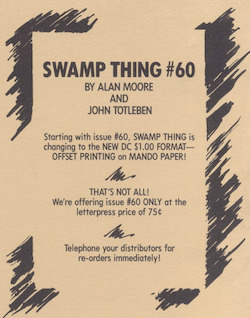
Underneath the DC Comics logo is the text “New Format”. This likely referred to the type of paper stock being used for Animal Man, as distinct from the Standard Format being used for other titles. Swamp Thing was also being published in the New Format at the time, having transitioned with issue #60 (May 1987). Swamp Thing #60 uses noticeably finer paper than #59, and displays more vibrant colours[5]. A flyer from around the time [pictured] advertises the New Format as offering “offset printing on Mando paper!”[6]. Within six months of the New Format being introduced, the price for an issue published in the New Format had increased from 75c to $1.25.
Inside Cover:
The ‘DC Checklist This Week’ section includes the following description of Animal Man #1: “Buddy Baker has decided to rejoin the super-hero game, but is he up to the task in today’s world? Find out in this all-new series.” Animal Man is also one of the few titles in the list marked as being “Available at Select Outlets”. This may indicate that Animal Man was only available in comic books stores and other speciality shops (a retail network commonly referred to as the Direct Market), as opposed to newsstands, grocery stores and some of the places where comics were traditionally sold. Animal Man may have been distributed through the Direct Market because its themes were seen as too mature for newsstand customers. For the major comic publishers, the 1980s saw a big shift towards Direct Market distribution until it eventually became the primary channel for selling comics.
Story:
Page 1
A mysterious character travels towards San Diego. Though his identity is not revealed until Animal Man #3, his reference to being a “beast” is a clue.
The narration is written in a rather overwrought style similar to that employed by Alan Moore in his other DC titles Watchmen (narrated by the character Rorschach) and Swamp Thing. In an interview with writer Mark Millar in 1988, Morrison explains that the Moore homage was conscious:
“The thing is, that at the time I wrote the first four issues – originally just a mini-series – I was so keen for DC to love me and pay me that I simply did work I thought THEY would like, rather than trying to do something to please myself. It was a serious mistake on my part and I pulled out all the dreary old ‘British Comic Writer’ clichés like poetic captions and tacked on subtext and glaringly obvious panel transitions.” [7]
And again in 2012, in a response to an earlier article on the blog The Beat:
“There is a reason those pieces were written in a vaguely Alan Moore-ish style and it’s because I was trying to sell to companies who thought Moore was the sine qua non of the bees knees and those stories were my take on what I figured they were looking for.”[8]
As part of their ‘Last War In Albion’ series of blog posts, Elizabeth Sandifer points out that this style was only used for the Beast’s narration, and that Morrison is only borrowing techniques from Moore rather than adopting his approach extensively.[9]
Job Number: G-3377. This number appears in the final panel. Job numbers were a common appearance in comics publishing, and were unique codes assigned to each project. These job numbers followed a sequential pattern based on when a project was assigned, not when it was completed[10]. At DC, the letter prefix usually related to the editor, so the ‘G’ may represent Karen Berger, at least at this point in the 1980s. (Berger’s editing debut was House of Mystery #292, May 1981 – an issue in which she also appeared as a character).
Page 2
This is the title page. “The Human Zoo” is a term that appears later in the issue.
The image of Buddy in the tree shown directly after the Beast’s question on the previous page (“Why did we ever come down out of the trees?”) is an example of the “glaringly obvious panel transitions” used in homage to Alan Moore. Similar transitions appear frequently throughout Morrison’s early Animal Man issues.
Here we meet Buddy Baker, the star of the series. He had previously appeared as the main character in several stories within Strange Adventure comics in the 1960s beginning in #180 (Sept. 1965), before guest-starring in a few other titles in the 1980s. See Early Years for further details.
Page 3
Here we see Buddy absorb the cat’s ability to land on its feet (it’s “righting reflex”), and the concentric circles are a new way to represent this absorption process, which had been invisible to the reader in Buddy’s previous appearances.
Page 4
We are introduced to Buddy’s neighbours Violet and Morris Weidemeir. Buddy mentions that he is, or was, a stuntman, which we already learned in Wonder Woman #267 (May 1980).
The essay ‘Ecce Animot: Or, The Animal Man That Therefore I Am’[11] brings attention to various Biblical references in the first issues of Animal Man. On this page, Buddy is expelled from the Weidemeir’s garden after falling out of a tree, bringing to mind the expulsion and Adam and Eve from the Garden of Eden after disobeying God (a story commonly known as ‘The Fall of Man’ from the Book of Genesis). Violet’s cats Rufus and Sheba are also named after Biblical characters. Contrast these references with the Beast’s thoughts on page 1 about (humans) “com[ing] down out the trees”, which is the alternative perspective of the origin of humans from evolutionary theory.
Artist Doug Hazlewood uploaded the original inked version of this page to his Comic Art Fans account and explains:
This page I actually inked TWICE. I did it as a try-out for the book (either on a big photocopy or an overlay) and then had to do it again for the actual book. Believe me when I got that as the one sample page I had NO idea what this book was going to be like.[12]
Page 5, panels 1-2
Here we meet Buddy’s wife Ellen, who first appeared in Strange Adventures #180 (Sept. 1965). At the end of that issue, Buddy proposes to her but, by the time of issue #201, he had postponed the wedding.
Ellen is singing (but misquoting) the song ‘If You Were the Only Girl (In the World)’ written by Nat D. Ayer with lyrics by Clifford Grey and first published in 1916. This again references the Garden of Eden.
Page 6, panel 1
It’s implied that Buddy has wanted to be a full-time superhero since soon after he and Ellen were married, which is odd since he originally postponed the wedding so that he could focus on super heroics a little longer without endangering her.
The “Crisis” that Ellen mentions refers to the events of the Crisis on Infinite Earths miniseries. To summarise: occasionally superheroes such as Superman and the Flash encountered the versions of themselves that existed in comics from the 1940s. To explain how this was possible, an idea was concocted that there were alternative universes, or realities. Earth-1 was the main DC continuity, while Earth-2 was populated by superheroes from the Golden Age (1938-1956) of comic publishing. Eventually, any time there was a story that didn’t fit into the established continuity of the character, it would be explained away as occurring in a different universe, until there were infinite realities and versions of each character. By the 1980s, this concept was deemed confusing for new and casual comic book readers, so DC published the Crisis on Infinite Earths miniseries. In that story, many of the alternate “Earths” and characters were destroyed, and all of the surviving universes were merged into one with a new unified history. This allowed characters that DC had recently acquired (such as the Marvel family of Fawcett Comics, and characters from Charlton Comics) to be introduced into the main DC Universe. It also meant that many characters had new origins and histories that had to be explicitly explained in comics immediately after the Crisis. Buddy’s personal involvement in the Crisis event is explained in more detail on the Early Years page.
Buddy was a member of a team dubbed the Forgotten Heroes in two issues each of Action Comics and DC Comics Presents. He didn’t technically “go into space with the Forgotten Heroes”, but rather an assortment of heroes that included Dolphin and Rip Hunter from his old group.
Page 6, panel 2
Buddy says he is nearly 30. His first appearance was in a comic from Sept. 1965 (23 years earlier), and he is definitely not ageing in real time. In Wonder Woman #267 from 1980, Buddy mentions that he hadn’t been in the news as Animal Man for about 10 years, which suggests he would have been a late teen when he became a superhero and proposed to Ellen, assuming he wasn’t older in 1980 than he is in this 1988 appearance.
Page 6, panels 2-3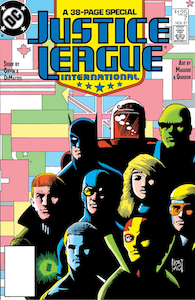
The musicians mentioned on the cover of Rolling Stone magazine are all real and relatively likely to be in this magazine, except for Vampire Lestat who appears to be fictional. This may be a reference to the Anne Rice novel The Vampire Lestat (1985), in which her vampire protagonist Lestat de Lioncourt awakens in the 1980s and becomes a rock star.
The cover of Rolling Stone depicts Captain Atom, Blue Beetle, Mister Miracle and Booster Gold, who were all members of JLI (Justice League International) at this point. The Justice League is the pre-eminent superhero team in the DC Universe. After the Crisis, the team’s membership changed, and the title of their comic also changed from Justice League to Justice League International with its 7th issue (Nov. 1987) [pictured right].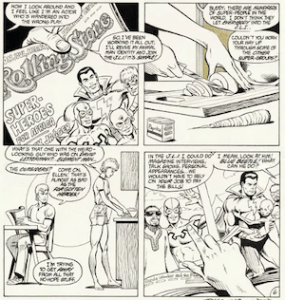 On Comic Art Fans[13], Hazlewood presents the original version of the art [pictured left], which depicted some different characters in the pages of Rolling Stone. Captain Atom (seen in panels 3 and 6) was originally Captain Marvel, while Mister Miracle was originally Flash. Booster Gold was drawn differently, or may have been another character entirely. Blue Beetle remains unchanged from the original art.
Page 6, panel 5
The “Element Man” they are referring to is Metamorpho, who first appeared in Jan. 1965. Metamorpho was a founding member of the Outsiders, which formed in 1983 and was led by Batman.
Page 6, panel 6
On this panel we see Blue Beetle (with musician Stevie Wonder) and Captain Atom again. Notably, both characters originally appeared in titles published by Charlton Comics. In the early 1980s, DC bought all of the Charlton characters and introduced them into the DC Universe via the Crisis on Infinite Earths miniseries of 1985/86. The characters in Alan Moore and Dave Gibbons’ acclaimed Watchmen series (1986/87) are based on these Charlton characters, with Watchmen‘s Nite Owl II and Doctor Manhattan being analogous to Beetle and Atom.
Page 7, panel 1
Regarding Buddy’s claim, “I’ve been a super-hero longer than this guy…”: technically, the Blue Beetle character has been around a lot longer than Animal Man (since 1939), though the Ted Kord version of the character first appeared in comics slightly after Buddy. Of course, Buddy and the rest of his world were probably not aware of Blue Beetle’s existence until the Crisis.
Page 7, panel 2
Ellen might be exaggerating, but Animal Man did only appear in a handful of storylines throughout the 1980s.
On this page we’re introduced to Buddy’s children Cliff and Maxine for the first time. We first learn he has two kids in DC Comics Presents #77 (Jan. 1985) and they are named in Who’s Who: The Definitive Directory of the DC Universe #1 (Mar. 1985).
Pages 9-11
On page 9, the “Beast” has a vision of a star that he must seek out to find the source of the pain and noise in his mind. On page 11, we see stars on a poster, and the would-be mugger’s blood creates a star pattern. The description of the Beast’s powers and everything we’ve learned so far suggests that he has some sort of affinity with animals.
Page 12
Here we see Buddy obtain the strength of a spider.
Pages 13-15
Buddy may have scared away the fish from the fisherman accidentally, or on purpose given his attitude towards animals. On page 13, Buddy and Ellen establish that he retains the powers of an animal for about 30 minutes. In his early appearances, his powers didn’t behave consistently.
The next few pages show Buddy testing out the limits of his powers, which is a common trope for new superheroes, though Animal Man has been established for some time and should already have figured much of this out. He takes on the powers of a fish, bird and ant. The scenes with Buddy and Ellen are reminiscent of scenes in the Marvelman story in Warrior #7 (Nov. 1982, later reprinted in Miracleman #2) where Mike Moran and his wife Liz test out Marvelman’s powers.
On page 15, Buddy also says “Meep Meep”, which is the catchphrase of the Looney Tunes cartoon character Road Runner, which will be significant later. Maxine throws a banana peel out of the car in panel 4, and there is a closeup of the peel in panel 6. The panel includes another reference to the word “Fall” and has been drawn to suggest that Buddy might slip on the peel.
Page 16
Here we are reintroduced to Buddy’s friend Roger, who helped him fight crime throughout the Strange Adventures stories. They are actually hunting together in their first appearance, though it’s not clear what they are hunting. Roger is a screenwriter at the time of Wonder Woman #267 and still seems to be involved in the entertainment industry here.
Page 17
The Beast arrives at the San Diego division of S.T.A.R. Labs. Scientific and Technological Advanced Research Laboratories is a non-governmental organisation that has been referenced in DC Comics stories since its first mention in Superman #246 (Dec. 1971).
Page 18
The Baker family watch Buddy’s televised appearance on the Dick Griffith Show. Dick is a fictional character. Maxine is reading the picture book Where The Wild Things Are by Maurice Sendak.
Dick refers to Animal Man as being from Los Angeles. From previous appearances, we knew that Buddy Baker’s city of residence had a zoo (Strange Adventures #195, Dec. 1966) and was near Los Angeles (Wonder Woman #267, May 1980). With its famous zoo, San Diego would have been a good candidate for Buddy’s hometown.
Dick is making fun of Animal Man, so referring to him as a ‘Human Zoo’ seems to be intended as derogatory. Dick probably means that Buddy is the personification of a zoo, as he embodies the qualities of many different animals, but Dick could have used a less demeaning analogy. As Wallin notes, “Animal Man’s public humiliation dramatizes the cheapened status of the animal as it has become reformatted into the circuits of consumptive leisure and quasi-domestication.”[14]
I think the term ‘Human Zoo’ can also be interpreted another way. Historically, a Human Zoo was a zoo full of humans: typically marginalised people who could be gawked at by paying audiences (a freak show is a well-known type of human zoo). In naming this first issue ‘Human Zoo’, Grant Morrison may be drawing on this historical sense of the term: the lives of Buddy and his family are on display in the pages of this comic for our entertainment.
Page 19
Buddy is being called to San Diego, which confirms that he doesn’t reside there. Ellen’s calendar says June, compared to the calendar opened to May on page 6.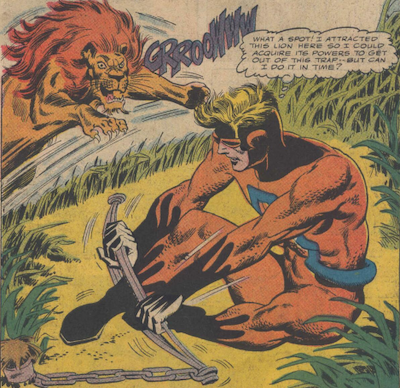 Buddy puts on a jacket as a permanent addition to his costume, for practical purposes (to protect his modesty and “to keep money and stuff”). In the essay Ecce Animot[15], which is partly concerned with the definitions and divisions between ‘Animal’ and ‘Man’, the author cites this scene and argues that Buddy is distancing himself from the animal kingdom by donning a jacket to avoid embarrassment. According to Jacques Derrida, to be clothed or unclothed is one of the properties of being ‘man’ as nakedness as a concept would not exist to animals. In another interpretation of the deeper meaning of the jacket, Steven Zani notes that the jacket over the costume represents a combination of Buddy’s superhero and civilian personas, and distinguishes him as “a nontraditional hero”.[16]
Buddy’s costume has had a couple of variations since its first appearance in Strange Adventures #190 [pictured]. Mostly it is shown with the bottom of the blue letter ‘A’ being extended and wrapping fully around Buddy’s back like a belt. However, in the next issues of Strange Adventures, the blue lines stop midway around his back before they can connect. In his 1980s appearances, the costume has reverted to its original design. In Animal Man #1, the legs of the letter ‘A’ do not seem to extend at all.
Buddy’s goggles also have a different design than we have seen previously. Here, they are larger and more triangular. In his interview with The Comics Journal, Chaz notes “I modified the goggles somewhat, based on Brian Bolland’s covers.”[17]
In keeping Animal Man out of costume so long in this issue, Morrison is drawing attention to Buddy’s life outside of his superhero role. In their piece at the end of Animal Man #2, Morrison highlights the fact that Buddy “spent his first two adventures in civilian clothes” in the early Strange Adventures stories. In their interview with Mark Millar in FA #109, Morrison explains:
“I think we ought to clarify that although he didn’t wear a costume he was dressed in ‘civilian’ clothes. That’s why in my first issue of Animal Man we don’t really see too much of him in costume; it’s a kind of homage to the early stories. I also gave him a jacket to cover up the costume which began to look increasingly ridiculous and offensive on a grown man.”[18]
Page 20
Somehow Buddy’s jacket has changed colour from blue to yellow in the first 2 panels. This appears be an error, but it was not corrected in trade paperback collections.
As in the Strange Adventures issues, Buddy is located in a suburban setting in a home with a large yard, which we can clearly see in panel 2. Callahan[19] notes that this is an unconventional setting for superheroes, who are usually associated with cities. In this panel, we can also see that the Bakers have a pet dog.
On this page, we also meet Roger’s ex-wife Tricia, who Roger mentioned on page 16. She is a neighbour of the Bakers, so it’s possible that Roger was a neighbour at some point too, though I believe he was only ever referred to as Buddy’s friend in previous appearances.
Page 21
Here we are introduced to Ray who drinks with his friends, kill animals for fun, and refers to his partner as “that woman”. Morrison seems to be linking animal cruelty with toxic masculine behaviours. Blake and Alexis are characters from the television soap opera Dynasty, which ran throughout the 1980s.
Page 23
Animal Man meets Dr. Myers at a lab where they conduct animal testing on primates in the hopes of developing an AIDS vaccine. Buddy brings up two theories about the origin of the AIDS virus. One theory involves the African green monkey: an Old World monkey that carries SIV (simian immunodeficiency virus), an ancestor of HIV. The alternative theory implicates humans (specifically the military), though this popular idea that HIV was engineered by humans has been discredited.
Page 24
In Ecce Animot[20], this mass of merged primates forces Buddy to confront the idea that ‘animals’ are not a heterogenous group, and the term describes many disparate species and individual beings. To treat all non-humans as the singular term Animal is foolish (and maybe, as this page suggests, destructive). The essay’s title comes from Derrida’s term animot to describe the singular of the plural animals. The fused mass is its own kind of animot.
Back Matter:
There was no letters column in this first issue, and instead there were some full-page ads for other DC titles.
References:
[1] Grant Morrison prefers singular they/them pronouns.
[2] Lien-Cooper, Barb. “Punching holes through time: Grant Morrison”. Sequential Tart, August 2002, http://www.sequentialtart.com/archive/aug02/gmorrison2.shtml
[3] Ah-Sen, Jean Marc. “‘If I Could, I’d Completely Redraw It’: An Interview with Chaz Truog.” The Comics Journal, 20 April 2022, https://www.tcj.com/if-i-could-id-completely-redraw-it-an-interview-with-chaz-truog/
[4] Mangels, Andy. “Animal Man.” Amazing Heroes, no. 145, 15 July 1988, pp. 25-26.
[5] This article explains how the changing paper stock impacted colouring processes:
https://scarysarah.medium.com/a-brief-and-broad-history-of-post-golden-age-pre-digital-comic-book-coloring-9fe9e386149a
[6] Thanks to Mike Sterling’s Progressive Ruin for the flyer explaining the New Format.
[7] Millar, Mark. “Grant Morrison Talks to Mark Millar.” FA, no. 109, Jan. 1989, pp. 33-37. Scans available at https://sites.google.com/deepspacetransmissions.com/deepspacetransmissions/interviews/1980s/fa-109-1989
[8] Sneddon, Laura. “The Strange Case of Grant Morrison and Alan Moore, As Told By Grant Morrison.” The Beat, 24 Nov. 2012, https://www.comicsbeat.com/the-strange-case-of-grant-morrison-and-alan-moore-as-told-by-grant-morrison/
[9] Sandifer, Elizabeth. “A Red and Angry World (Book Three Part 2: Morrison’s Style, The Coyote Gospel).” Eruditorium Press, 5 April 2021, https://www.eruditorumpress.com/blog/a-red-and-angry-world-book-three-part-2-morrisons-style-the-coyote-gospel
[10] I found some information about job numbers from https://www.kleefeldoncomics.com/2022/02/marvel-job-numbers.html and elsewhere.
[11] Mahmutovic, Adnan, et al. “Ecce Animot: Or, The Animal Man That Therefore I Am.” ImageTexT: Interdisciplinary Comics Studies, vol. 8, no. 2, https://imagetextjournal.com/ecce-animot-or-the-animal-man-that-therefore-i-am/
[12] https://www.comicartfans.com/gallerypiece.asp?Piece=794137
[13] https://www.comicartfans.com/gallerypiece.asp?Piece=785227
[14] Wallin, Jason. “Evolve or Die! Enmeshment and Extinction in DC’s Animal Man.” Closure: Kieler e-Journal Für Comicforschung, no. 7, 2020, p. 21. https://www.closure.uni-kiel.de/closure7/wallin
[15] Mahmutovic.
[16] Zani, Steven. “It’s a Jungle in Here: Animal Man, Continuity Issues, and the Authorial Death Drive.” The Contemporary Comic Book Superhero, edited by Angela Ndalianis, Routledge, 2008, p. 236.
[17] Ah-Sen 2022.
[18] Millar 1989.
[19] Callahan, Timothy. Grant Morrison: The Early Years. Sequart Research & Literacy Organization, 2007.
[20] Mahmutovic.
 Wild Planet